About Akhalkalaki
ExploreAkhalkalaki — History and Town Development
Akhalkalaki is a town in southern Georgia’s Samtskhe–Javakheti region and the administrative center of Akhalkalaki Municipality. It stands on the edge of the Javakheti Plateau, a high-elevation landscape defined by wide open spaces, strong winds, lakes, and long winters—conditions that shape settlement patterns, building materials, mobility, and everyday rhythm.
Akhalkalaki’s identity is commonly read through two interconnected themes:
a high-plateau hub town (routes, connections, and practical municipal functions), and
a multi-layered historic town, anchored by the medieval fortress-city complex and a wider cultural landscape of monuments.
Encyclopedic summaries also note modern civic and cultural features: local institutions, a local-lore museum, and public memorial markers that reflect the town’s cultural environment.
Plateau geography and settlement logic: a highland town as a regional node
In encyclopedic and travel overviews, Akhalkalaki is presented as a town whose plateau setting naturally turns it into a regional node. In Javakheti, movement often follows a few main corridors, and Akhalkalaki consolidates core services: administration, schooling, basic infrastructure, and everyday commerce.
The plateau climate matters for urban form: seasonality, wind exposure, and cold winters encourage compact, practical building choices and a “workable” street rhythm. This is why Akhalkalaki is often described as a highland town where geography actively shapes the way the town functions.
Medieval layers: the Akhalkalaki fortress-city (11th century) as the historic core
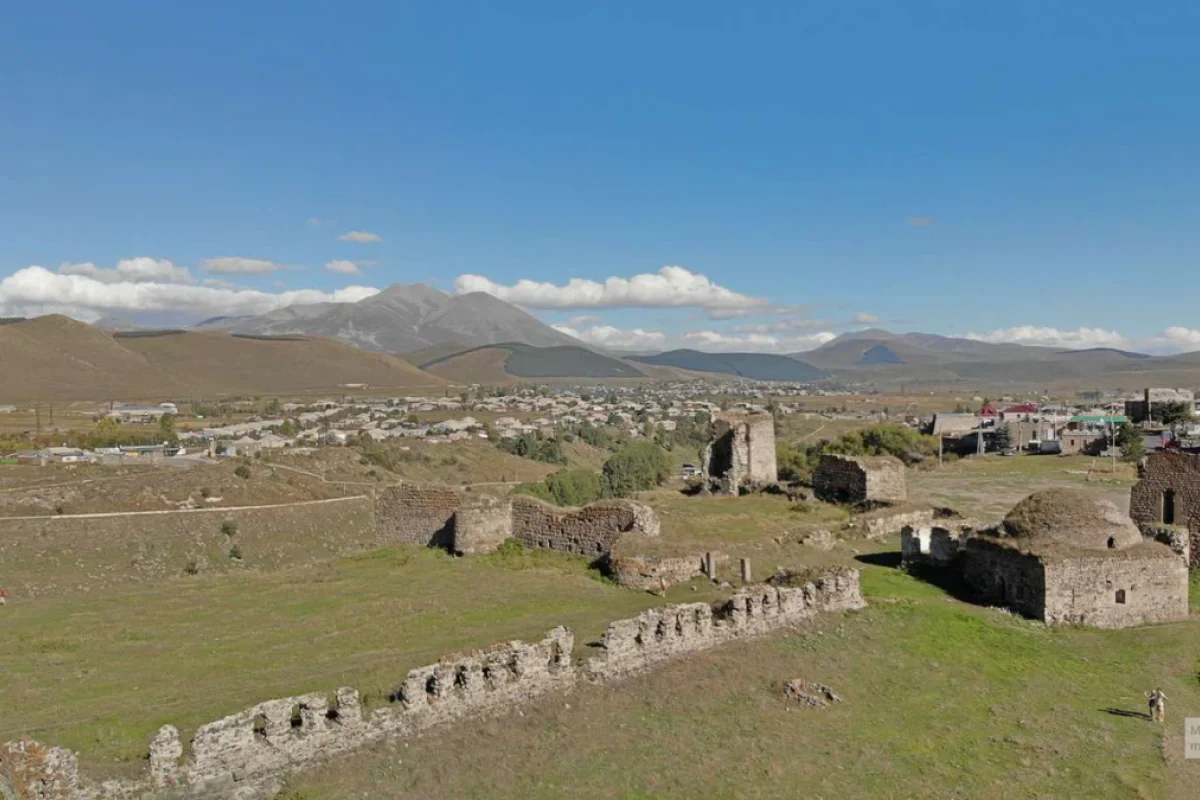
A key landmark in Akhalkalaki’s town narrative is the ruined fortress-city complex, commonly dated to the 11th century in travel summaries. Descriptions list structural elements such as the citadel and towers, and note additional remains associated with the complex.
Guides also emphasize a deeper time layer: archaeological references describe older settlement traces on the site, suggesting that the medieval fortress landscape developed on a place with earlier habitation. This reinforces a “multi-layered” reading of Akhalkalaki—its medieval core is part of a longer settlement story.
Churches and the cultural landscape: a “monuments map” around the town
Akhalkalaki and the surrounding municipality are often described as a territory with a dense cultural landscape: churches from different periods, historic sites, and scenic plateau routes. In practical itinerary terms, the town functions as a base: you stay in Akhalkalaki, then take short trips to nearby monuments, viewpoints, and lake areas.
This creates a clear “town + surrounding routes” model that fits modern travel logic in Javakheti: a stable center with easy day-trip radii.
19th–20th centuries to today: municipal-center functions and modern town life
In the modern era, Akhalkalaki’s defining role is that of a municipal administrative center. Overviews commonly frame it as a service hub for a highland region, with education, healthcare, local governance, and cultural institutions supporting everyday life.
At the same time, heritage remains visible not only through the fortress site, but through the town’s broader cultural markers and the ongoing prominence of historic monuments in travel narratives.
Akhalkalaki today: a historic plateau town with a practical travel base role
Today, Akhalkalaki stands out as a place where:
plateau geography defines the town’s look and rhythm,
the 11th-century fortress-city anchors the historical core, and
the municipal-center role keeps the town active and connected.
This combination makes Akhalkalaki both a destination in itself and a practical base for exploring the Javakheti Plateau.
FAQ
Q: Where is Akhalkalaki located?
A: In southern Georgia’s Samtskhe–Javakheti region; it is the administrative center of Akhalkalaki Municipality.
https://en.wikipedia.org/wiki/Akhalkalaki
Q: What makes Akhalkalaki distinctive?
A: Its high-plateau setting on the Javakheti Plateau and a strong heritage layer, including an 11th-century fortress-city site.
https://georgia.travel/cities-towns/akhalkalaki
Q: What is the Akhalkalaki fortress known for?
A: Travel guides commonly date it to the 11th century and describe a fortress-city complex with surviving structural remains.
https://georgiantravelguide.com/en/akhalkalakis-tsikhe-nakalakari
Q: Is Akhalkalaki good for day trips?
A: Yes—overviews present it as a base for plateau routes, lakes, and nearby cultural monuments.
https://georgia.travel/cities-towns/akhalkalaki
Q: What is Akhalkalaki’s administrative role?
A: It is the administrative center of Akhalkalaki Municipality.
https://en.wikipedia.org/wiki/Akhalkalaki
Sources
Encyclopedic & general overview (location + profile)
Wikipedia — Akhalkalaki
https://en.wikipedia.org/wiki/Akhalkalaki
Official travel overview (town, monuments, routes)
Georgia Travel — Akhalkalaki
https://georgia.travel/cities-towns/akhalkalaki
Fortress-city (11th century, complex description)
Georgian Travel Guide — Akhalkalaki Fortress (Akhalkalaki fortress-city)
https://georgiantravelguide.com/en/akhalkalakis-tsikhe-nakalakari
Additional context (municipality & region)
Wikipedia — Samtskhe–Javakheti
https://en.wikipedia.org/wiki/Samtskhe%E2%80%93Javakheti