About Akhaltsikhe
ExploreAkhaltsikhe — History and City Development
Akhaltsikhe is the administrative center of Samtskhe–Javakheti and Akhaltsikhe Municipality, and one of the main historical cores of Samtskhe (Meskheti). The city lies in the Akhaltsikhe Basin, on both banks of the Potskhovistsqali River (a left tributary of the Kura/Mtkvari), at roughly 980–1000 m above sea level. This natural setting—basin + river + surrounding uplands—helped shape a defensible settlement and a castle-centered town over many centuries.
The name: the idea of a “New Fortress”
The name Akhaltsikhe literally means “new fortress / new fortified place.” The toponym fits the city’s historical identity: in a borderland where power often shifted, the “castle-city” form was the most durable structure, anchoring administration, defense, and trade across changing eras.
Rabati (Akhaltsikhe Castle): the city’s core
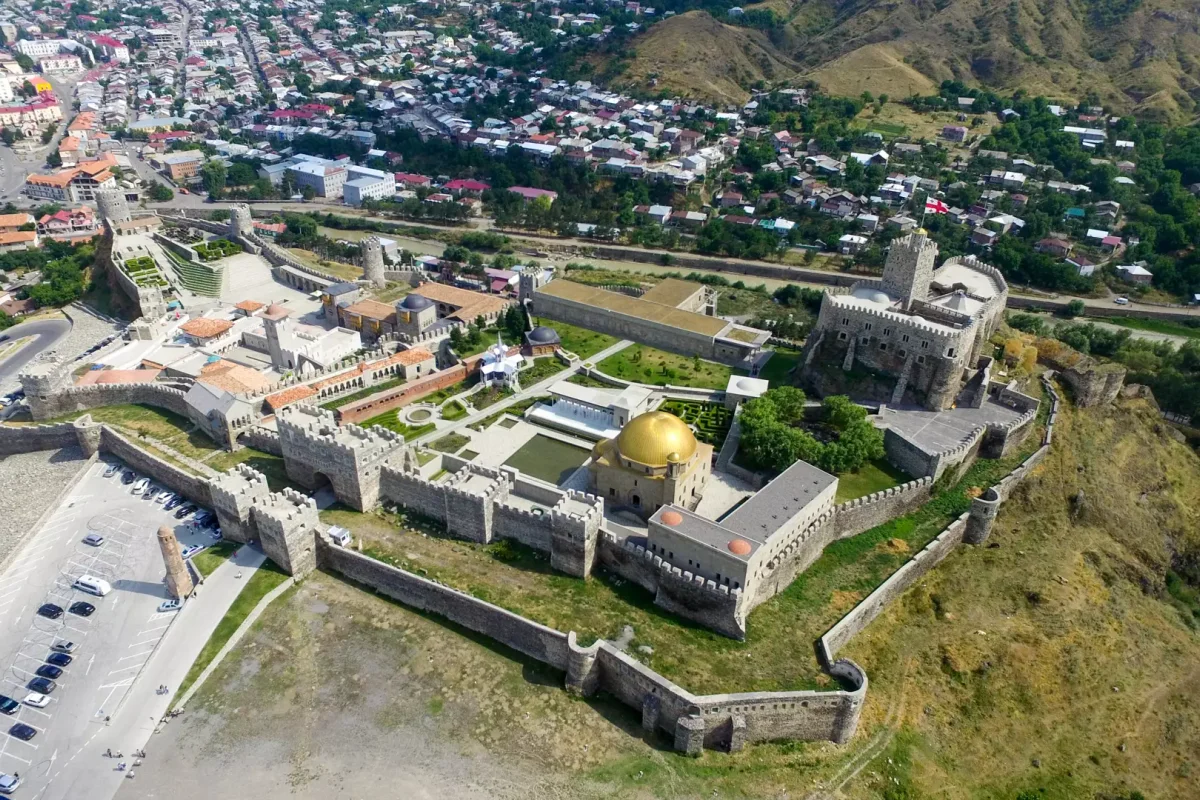
Akhaltsikhe’s strongest urban symbol is Akhaltsikhe Castle, widely known as Rabati. Summaries of the castle’s history note an early layer linked to the 9th century, when it is associated with the name Lomsia. In the 12th century, the fortress was expanded and reshaped into a more pronounced castle-town structure—eventually tying to the name Akhaltsikhe (“New Fortress”) in later tradition.
Historically, the term “rabati” was also used for fortified or commercial quarters near a stronghold, which is why the complex is widely recognized today as Rabati Castle.
The Jaqelis and the Principality of Samtskhe: from fortress-town to regional center
In the later medieval period, Akhaltsikhe grew into a major center within the Principality of Samtskhe (Samtskhe-Saatabago). Accounts of the castle complex emphasize that in the 13th–14th centuries, the stronghold served as a key seat connected to the House of Jaqeli, strengthening Akhaltsikhe’s role as a regional political and administrative hub.
The Ottoman period: a strategic border city
One of the most dramatic shifts in Akhaltsikhe’s history was the Ottoman conquest. Encyclopedic overviews state that the Ottomans captured the city in 1579, after which Akhaltsikhe became a significant point in the Ottoman administrative and military system.
The same summaries note that by 1625, Akhaltsikhe became the center of an Ottoman province (often referenced as the Akhaltsikhe Eyalet), with the city functioning as the seat of a pasha—underscoring its strategic importance in the southern Caucasus border zone.
1828–1829: Russo–Turkish war and the start of the imperial era
Another major turning point came with the Russo–Turkish War of 1828–1829. Overviews note that Russian forces under General Ivan Paskevich captured Akhaltsikhe in 1828, and the Treaty of Adrianople (1829) formalized the transfer of the city to the Russian Empire. From that period onward, Akhaltsikhe continued as a regional center, but under a new imperial administrative order.
A multicultural line: the “border city” character
Akhaltsikhe is often described as a place shaped by long-term multiethnic and multiconfessional coexistence—a borderland city where different communities lived side by side across centuries. This is reflected in the city’s heritage narrative and the layered identity of the Rabati complex and surrounding historical environment.
FAQ
Q: Why is it called Akhaltsikhe?
A: The name literally means “new fortress / new fortified place.”
Q: How old is Rabati Castle?
A: Summaries connect the earliest layer to the 9th century (Lomsia), with major expansion in the 12th century.
Q: When did the Ottomans take Akhaltsikhe?
A: Encyclopedic sources cite 1579.
Q: When did Akhaltsikhe become part of the Russian Empire?
A: Captured in 1828; transfer formalized by the 1829 treaty.
Sources
Encyclopedic & general overview (Ottoman/Russian periods; toponymy)
Wikipedia — Akhaltsikhe
https://en.wikipedia.org/wiki/Akhaltsikhe
Castle complex / Rabati (timeline & naming)
Wikipedia — Akhaltsikhe Castle
https://en.wikipedia.org/wiki/Akhaltsikhe_CastleRabati Castle (official) — History
https://rabati.ge/en/history
Official tourism overview (heritage & multicultural narrative)
Georgia Travel (Official) — Akhaltsikhe
https://georgia.travel/cities-towns/akhaltsikhe