About Gori
ExploreGori — History and City Development
Gori is one of the main cities of Shida Kartli and the administrative center of the Gori Municipality. Its importance begins with geography: the city stands at the confluence of the Mtkvari (Kura) and Liakhvi rivers, a natural junction that historically supported movement, trade, and regional control. This placement—close to the principal corridor connecting eastern and western Georgia—helped turn Gori into a strategic node and explains why the city appears repeatedly in the political and military history of the region.
Early settlement layers and the long timeline of habitation
The area around modern Gori preserves signs of much older habitation. Overviews of the city’s history commonly note settlement evidence reaching back to the Hellenistic period, with the city’s fortified identity developing around the hilltop stronghold that later became Gori Fortress. The key point is that Gori is not a “single-moment foundation” city; rather, it reflects a long process of growth in which different periods left visible layers—topography, fortifications, and the urban fabric.
Gori Fortress (Goris Tsikhe): the logic of a hilltop citadel
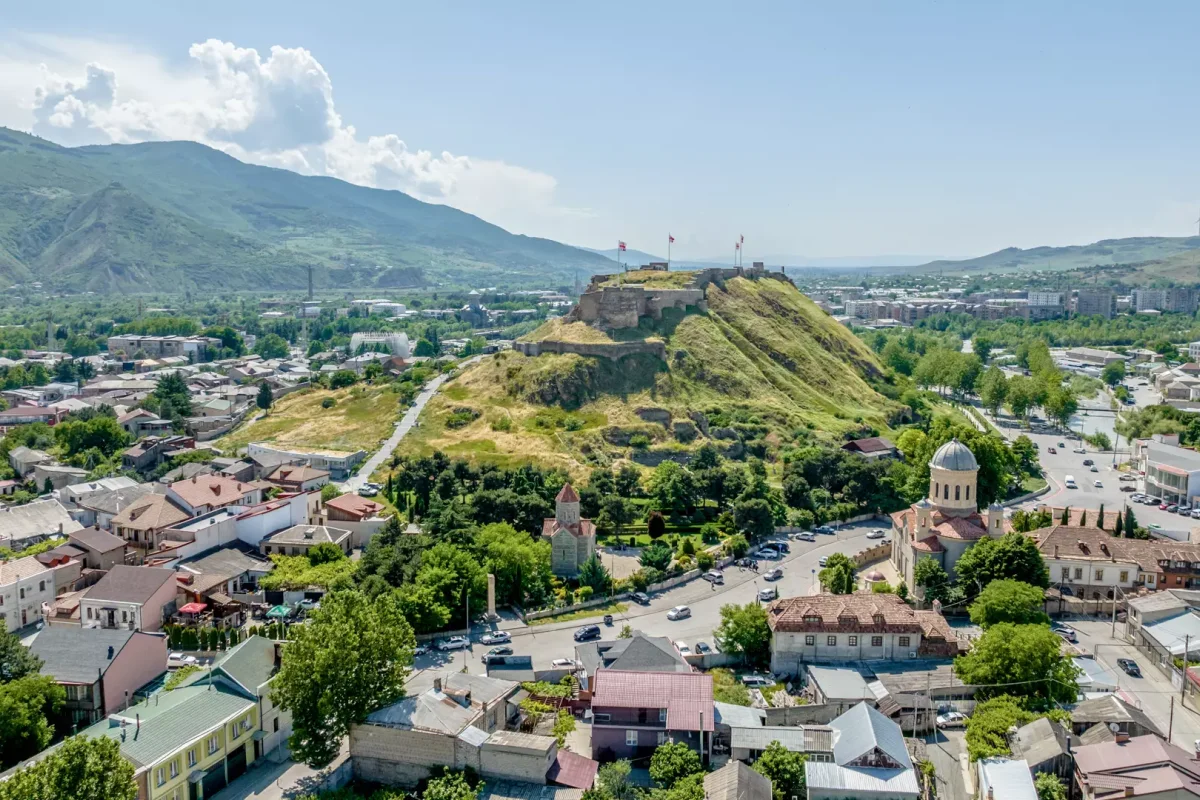
Gori’s most recognizable historical landmark is Gori Fortress, a medieval citadel set on a rocky hill directly above the city. Its hilltop outline follows the natural relief, and the fortress’s position offers commanding views over the surrounding plain and routes—a classic medieval solution for controlling movement along a regional trade corridor.
Sources differ on how early the fortress can be dated, and that difference is itself informative:
Britannica’s short city profile describes Gori as one of Georgia’s oldest cities, founded in the 7th century CE.
Wikipedia summaries emphasize that settlement is known from the Hellenistic period and that the fortress was built at least in the 7th century, while separate fortress-focused pages also mention later written references but earlier archaeological traces.
In practice, this means the hill was strategically valuable early on, while the fortress complex visible today reflects multiple reconstructions and upgrades across later centuries.
Medieval Gori: stronghold, transit routes, and town status
In the Middle Ages, Gori’s role was shaped by two connected realities: the city sat on a major route, and the fortress protected that route. As a result, Gori functioned as a military stronghold and as a place where markets and services for travelers could develop. Overviews of the city commonly note that Gori received town status in the 12th century, a marker of its growing urban importance in medieval Georgia.
The wider cultural landscape: Uplistsikhe and the “Gori region” story
Gori’s historical significance is amplified by what lies nearby. One of Georgia’s most distinctive archaeological sites—Uplistsikhe Cave Town-Fortress—is located close to Gori and is included on UNESCO’s Tentative List. This relationship matters for interpretation: Gori is not only a city with its own fortress, but also a gateway to a broader landscape of older settlement forms, rock-cut urbanism, and long-distance connectivity along the Mtkvari corridor.
Modern layers: administration, memory, and 20th–21st century history
In modern times, Gori remained a regional administrative center. Britannica highlights that it was historically a market and administrative town and notes the city’s association with Joseph Stalin, who was born in Gori.
The Stalin State Museum is one of the city’s most visited institutions: the official museum site states that the museum complex opened in 1957, and that a smaller memorial museum in Stalin’s birth house opened in 1937.
Gori also appears in Georgia’s very recent history due to its proximity to conflict lines; for example, city overviews note occupation during the 2008 Russo-Georgian War, underscoring again how geography continues to shape Gori’s story even in the 21st century.
FAQ
Q: Where is Gori located, and why does it matter?
A: Gori lies at the confluence of the Mtkvari (Kura) and Liakhvi rivers, along Georgia’s main east–west corridor—key for trade and strategy.
Q: How old is Gori?
A: Sources describe it as one of Georgia’s oldest cities, commonly linked to a 7th-century foundation, with settlement layers known from earlier periods as well.
Q: What is Gori Fortress?
A: A medieval hilltop citadel (“Goris Tsikhe”) overlooking the city, historically important for guarding routes and controlling movement in the region.
Q: What major site is near Gori?
A: Uplistsikhe Cave Town-Fortress, listed on UNESCO’s Tentative List, is located close to Gori and is one of Georgia’s standout archaeological destinations.
Q: What is the Stalin Museum, and when did it open?
A: The official site says the museum complex opened in 1957, while a memorial museum in the birth house opened in 1937.