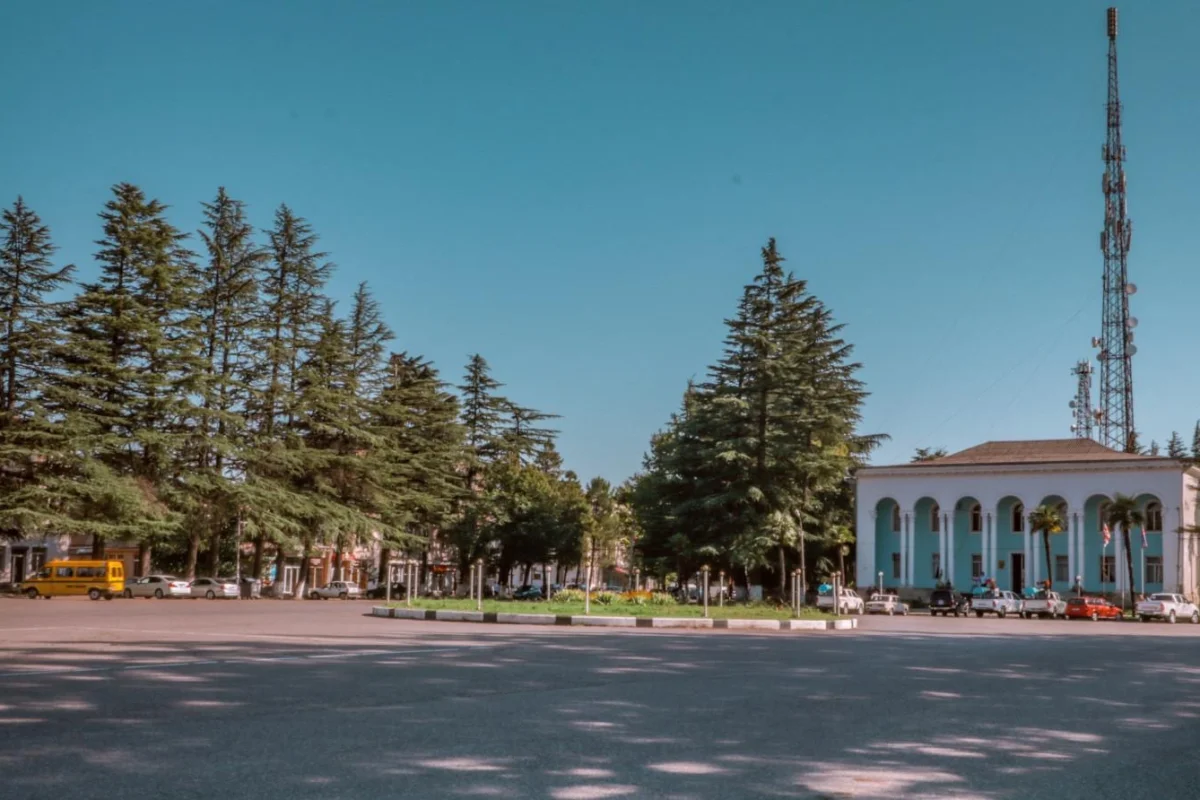
About Khoni
ExploreKhoni — History and Town Development
Khoni is a town in western Georgia, in the Imereti region, and the administrative center of Khoni Municipality. Set in the lowland landscape of Imereti and closely linked to the Tskhenistsqali river area, Khoni’s setting has long shaped how the town functions—as a practical hub and as a local cultural center.
Khoni’s identity is best read through three connected themes:
geography and route logic (a lowland town tied to river-valley movement and regional connections);
a cultural-town biography (theatre and music traditions, plus a local museum);
the municipal-center role, anchoring services and everyday life in Lower Imereti.
Landscape and settlement logic: Imereti lowlands and the Tskhenistsqali setting
Encyclopedic summaries describe Khoni as a lowland town associated with the Tskhenistsqali river area. This geography creates practical advantages: lowlands support agricultural hinterlands; a river valley provides a natural movement corridor; and nearby regional nodes strengthen Khoni’s role as a “connected town” rather than an isolated one.
In this reading, Khoni’s development is not defined by a single era. Instead, it is a place where municipal-center functions and regional mobility reinforce one another.
A cultural-town biography: theatre, music, and an urban tradition (1865 → 1907 → 1890)
A distinctive thread in Khoni’s story is its cultural life. Official travel overviews highlight Khoni as a city of theatre and musical traditions: they note a first theatre production in 1865, the formation of a small theatre troupe in 1907, and the continuation of theatre activity in the town.
The same narrative links Khoni to the creation of Georgia’s first brass orchestra (cited in travel materials as 1890). Together, these references frame Khoni not only through geography and administration, but as a recognizable cultural point in western Georgia.
A museum as the town’s memory: the Khoni Historical (Local Lore) Museum
Khoni’s cultural map also includes the Khoni Historical Museum (often presented as a local-lore museum). Official and travel descriptions present it as a place preserving artifacts related to regional history—such as coins, weapons, manuscripts, and other materials—turning the town’s past into an accessible, curated narrative.
For a small municipal center, such a museum matters: it positions Khoni as a place with a preserved heritage record, not only a transit or service node.
Administrative context: municipality, the “Tulukidze” name period, and today’s role
Khoni is the administrative center of Khoni Municipality. Municipal and encyclopedic references also note Soviet-era administrative naming—sources record a period when the district/town context was linked to the name Tulukidze. This remains part of the town’s historical memory as an “era of names,” tied to broader Soviet administrative practice.
Today, Khoni functions clearly as a municipal center: governance, services, education/culture, and regional connectivity shape the town’s day-to-day rhythm.
Khoni today: culture + connectivity + a calm lowland town
Modern Khoni is often perceived as calm yet meaningful: cultural memory (theatre, music, museum) and geographical connectivity (lowland setting and river-area routes) combine into one coherent identity. That makes Khoni both a small standalone destination and a practical base for short trips across Imereti and nearby regional borders.
FAQ
Q: Where is Khoni located?
A: In western Georgia’s Imereti region, in the Imereti lowlands; it is the administrative center of Khoni Municipality.
Q: What is Khoni known for culturally?
A: Official travel overviews highlight theatre and music traditions: a theatre production in 1865, a troupe formed in 1907, and a first brass-orchestra connection dated to 1890.
Q: What can you see at the Khoni museum?
A: Descriptions present the museum as preserving coins, weapons, manuscripts, and other heritage items linked to regional history.
Q: What is Khoni’s administrative status?
A: Khoni is the administrative center of Khoni Municipality.
Q: How does “Tulukidze” relate to Khoni?
A: Sources record a Soviet-era period when the district context used the name “Tulukidze,” which remains part of the town’s historical timeline.
Sources
Encyclopedic & general overview (location + history)
Wikipedia — Khoni
https://en.wikipedia.org/wiki/KhoniWikipedia — Khoni Municipality
https://en.wikipedia.org/wiki/Khoni_Municipality
Official travel overview (culture, theatre, orchestra)
Georgia Travel — Khoni
https://georgia.travel/cities-towns/khoni
Museum
Georgia Travel — Khoni Historical Museum
https://georgia.travel/khoni-historical-museum
Additional context (overview)
Georgian Travel Guide — Khoni
https://georgiantravelguide.com/en/khoni