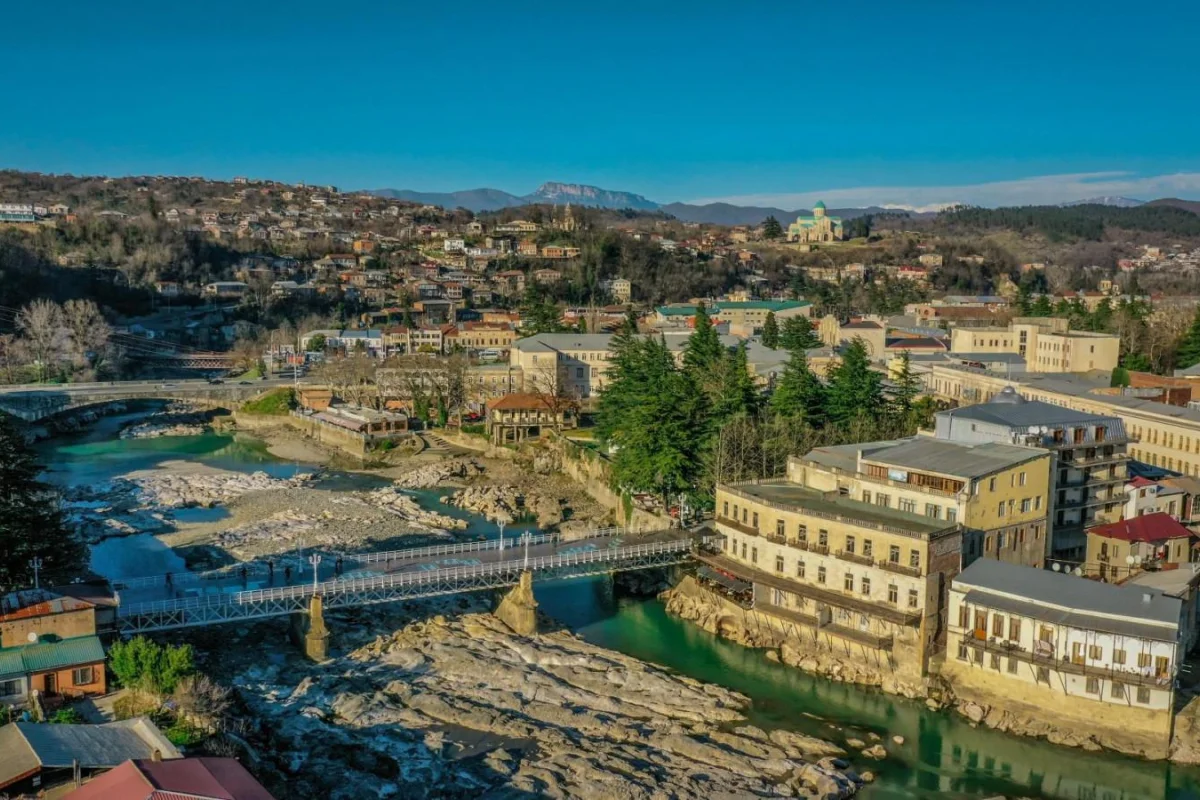
About Kutaisi
ExploreKutaisi — History and City Development
Kutaisi is the principal city of Imereti and one of Georgia’s oldest urban centers, shaped by the geography of the Rioni River and the changing political map of western Georgia. The city stands where the Rioni emerges from the Caucasus foothills into the lowlands—an advantageous position that historically supported movement, trade, and regional control. This river-corridor setting helps explain why Kutaisi repeatedly gained prominence as a political and cultural hub in different eras.
Ancient background: the Colchis world and the Rioni valley
Kutaisi’s earliest historical framing is closely tied to Colchis, the ancient region on the eastern Black Sea that included the valley of the Phasis (modern Rioni). Classical traditions describe Colchis as a land connected to river routes, maritime exchange, and fertile landscapes—elements that also define Kutaisi’s broader environment. In Greek myth, Colchis is linked with Medea and the Argonauts; while myth is not a factual chronicle, it shows how deeply the region entered the ancient imagination and how central the Rioni basin was to that story-world.
Archaeological and historical discussions commonly place Kutaisi among the key centers of western Georgia’s early development, with the city’s importance growing from its access to river movement and its role in connecting mountain foothills with lowland routes.
Late antiquity and early medieval transitions: a regional center in flux
As political realities shifted in late antiquity and the early Middle Ages, western Georgian polities changed names, borders, and alliances. In such contexts, cities like Kutaisi mattered not only for local administration but also for military logistics, taxation, and communication. Sources describe Kutaisi as a major historic city that, across time, served as a political center for successive Georgian kingdoms in the west.
Capital periods: why Kutaisi repeatedly became “the center”
Kutaisi’s historical weight is especially clear in its repeated role as a capital. Encyclopaedia Britannica notes that it served at various periods as the capital of successive kingdoms in Georgia, including Colchis, Iberia (Kartli), Abkhazia, and Imeretia. This isn’t merely a ceremonial label: capital status typically accelerates urban growth, strengthens markets and crafts, attracts elites and clergy, and concentrates symbolic architecture (cathedrals, palaces, fortified hills).
A key medieval phase is the era when Kutaisi functioned as a political center before the royal capital shifted to Tbilisi. Wikipedia’s overview of Kutaisi’s history similarly highlights long capital periods, including medieval and later Imeretian eras.
Bagrati Cathedral (completed in 1003): an architectural statement of unity
One of Kutaisi’s defining landmarks is Bagrati Cathedral, built in the reign of King Bagrat III and completed in 1003. UNESCO documentation explicitly places the cathedral in the context of Bagrat III’s unification of Georgia and notes its completion date, framing Bagrati as part of a wider cultural revival and state consolidation.
Beyond dates, Bagrati’s significance for Kutaisi is urban and symbolic: it anchors the city’s skyline and communicates the medieval ambition to build not just a church, but a monumental “signature” of sovereignty and identity. Contemporary heritage sources and guides consistently emphasize Bagrati as a primary medieval monument associated with Kutaisi’s peak political role.
Gelati Monastery (begun in 1106): the Golden Age near Kutaisi
Just outside Kutaisi stands Gelati Monastery, one of Georgia’s most important medieval complexes. UNESCO states that King David IV (“the Builder”) began building Gelati in 1106 near his capital Kutaisi and describes the monastery as an expression of Georgia’s medieval “Golden Age,” with the main church completed in 1130 under his successor. This positions the Kutaisi area as more than a political center—it becomes a cultural and intellectual landscape.
Gelati’s reputation is built on the idea of a monastery that also functioned as a center of learning and artistic production. UNESCO’s description emphasizes Gelati’s role as a major monument of the period, reinforcing Kutaisi’s surrounding region as a concentrated zone of medieval heritage rather than a single isolated landmark.
Later centuries: Imereti, empire, and the city’s modern layers
After the fragmentation of a unified Georgian kingdom, Kutaisi remained deeply associated with western Georgian statehood, especially through Imereti’s political history. Over time, the city’s role also expanded into a more modern administrative framework; Britannica notes that after the Russian conquest, Kutaisi became a provincial seat—another layer that shaped its civic institutions and urban growth.
Kutaisi today: a living city built on multiple historical layers
Modern Kutaisi is best understood as a city where distinct layers coexist:
Ancient regional context tied to the Colchis world and the Rioni valley;
Medieval state symbolism in Bagrati (1003);
Golden Age heritage in Gelati (begun 1106);
Later administrative and civic development through early modern and imperial transformations.
This combination is why Kutaisi works so well for “deep travel”: you can read Georgian history through geography (river + hills), through architecture (cathedral + monastery), and through the city’s continuing role as the heart of Imereti.
FAQ (EN)
Q: Why is Kutaisi considered one of Georgia’s most historic cities?
A: It’s one of the oldest major cities in Transcaucasia and served at various times as the capital of successive Georgian kingdoms.
Q: What is the importance of Bagrati Cathedral?
A: UNESCO documentation notes it was built by King Bagrat III and completed in 1003, linked to Georgia’s political unification and cultural revival.
Q: Why is Gelati Monastery so significant?
A: UNESCO states Gelati was begun in 1106 near Kutaisi and reflects Georgia’s medieval “Golden Age,” with the main church completed in 1130.
Q: How does the Rioni River shape Kutaisi’s identity?
A: Kutaisi lies along the Rioni where it exits the foothills into the lowland—historically a natural corridor for movement and trade.