About Rustavi
ExploreRustavi — History
Rustavi is one of the key cities of Kvemo Kartli and a major symbol of Georgia’s twentieth-century industrial transformation. Yet Rustavi’s story is not limited to the Soviet period: the city’s name and local landscape connect it to Old Rustavi, a historic fortified site on the Mtkvari (Kura) River, where archaeological research continues to reveal medieval—and possibly earlier—layers of settlement. In this sense, Rustavi is a city of two narratives: an older strategic river-corridor settlement and a modern planned industrial center built around heavy industry.
Geography: the Mtkvari corridor and strategic continuity
Rustavi stands in the Mtkvari valley southeast of Tbilisi—an environment that historically functioned as a natural corridor linking inner eastern Georgia with broader South Caucasus routes. Such corridors tend to generate two types of hubs: commercial nodes (transport, trade, services) and strategic nodes (fortresses, river crossings, controlled passages). This geographical logic helps explain why the Rustavi area carried significance across multiple periods.
Old Rustavi: fortress site and archaeology
Recent reporting on the Rustavi fortress area highlights active archaeological work aimed at studying important remains, including a complex dated to the 9th–12th centuries. Additional official coverage notes that the oldest settlement traces on the fortress territory may reach back to the Middle Bronze Age and that Rustavi appears in historical tradition as a city from late antiquity.
This gives Rustavi historical depth: behind the modern industrial skyline lies a layered landscape tied to river-route control and regional administration.
Soviet-era Rustavi: a planned industrial city
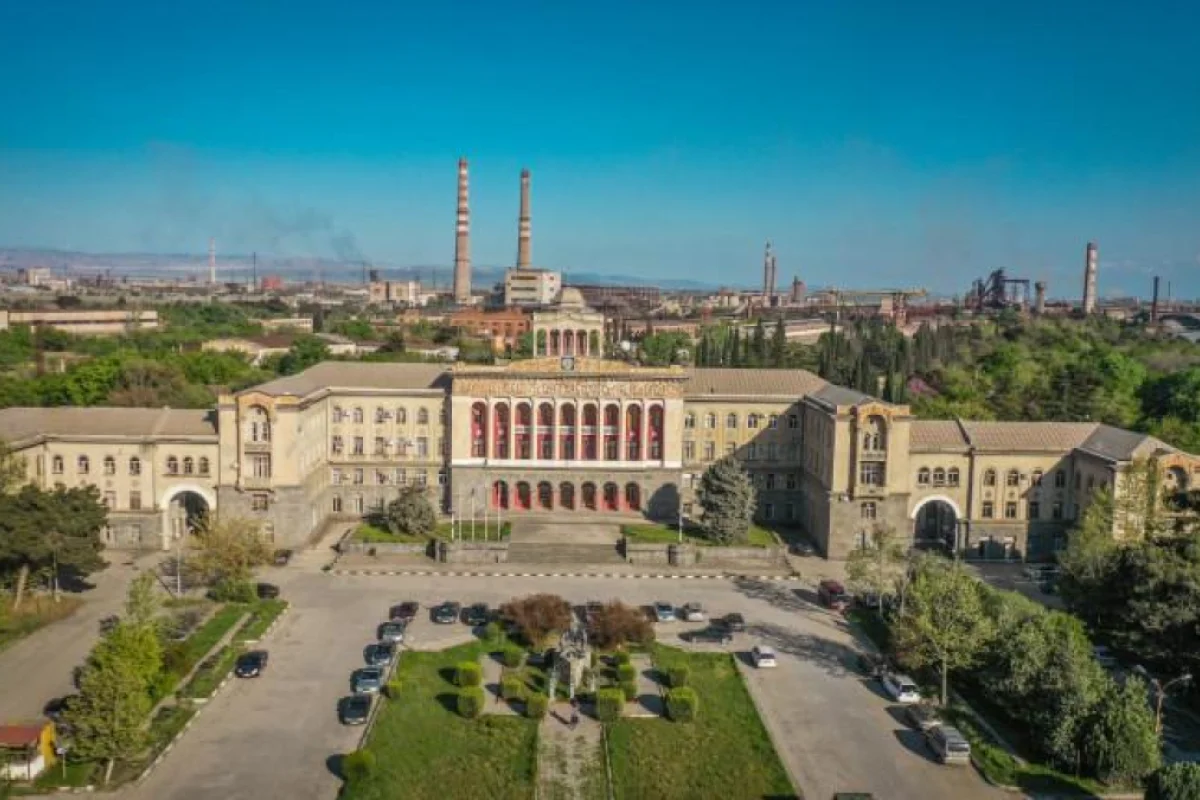
Modern Rustavi was rebuilt and developed as a major industrial center during the Soviet era. The cornerstone of this transformation was the Rustavi Metallurgical Plant, whose construction is commonly dated to 1941–1950.
The city expanded as an integrated industrial-urban system—housing, transport, and social infrastructure aligned to serve metallurgy and related production. Britannica emphasizes Rustavi’s post-World War II development with the establishment of large iron and steel works and notes a significant chemical industry as well.
A decisive institutional milestone came in 1948, when Rustavi was formally declared a town of republican importance in Soviet Georgia—effectively the city’s official status within that administrative framework.
Urban identity: “Old” and “New” Rustavi
Rustavi’s cityscape reflects phased growth: it is often described through “older” and “newer” districts shaped by Soviet planning, from earlier monumental axes and public spaces to later residential block patterns.
After 1991: decline and redefinition
With the collapse of the Soviet system, Rustavi—highly dependent on integrated industrial chains—faced severe economic disruption. Sources describe the scale of industrial decline and the social consequences during the transition period.
In recent years, Rustavi has been seeking a new balance: maintaining an industrial legacy, leveraging proximity to Tbilisi, and expanding the cultural-heritage dimension through the renewed attention to the fortress site.
FAQ
Q: Why is Rustavi called Georgia’s industrial city?
A: Rustavi was rebuilt as a Soviet-era industrial hub centered on metallurgy and major heavy industry.
Q: When did Rustavi get official city status?
A: In 1948, by decree of the Georgian SSR’s Supreme Soviet.
Q: What is “Old Rustavi” and why does it matter?
A: It refers to the historic fortress area where archaeological expeditions study medieval (9th–12th c.) remains and earlier settlement traces.
Q: What changed after 1991?
A: Industrial decline after the Soviet collapse triggered serious economic and social challenges, followed by gradual redefinition.
Sources
Wikipedia — Rustavi (overview, dates, industrial development)
1TV Georgia — Archaeological expedition begins on Rustavi Fortress territory (Jul 18, 2025)
Rustavi2 — Largest archaeological expedition in Rustavi’s history (2025)
Georgian Travel Guide — Rustavi Fortress (visitor-oriented overview)
UNDP Georgia — Re-imagining Rustavi (urban transformation context)