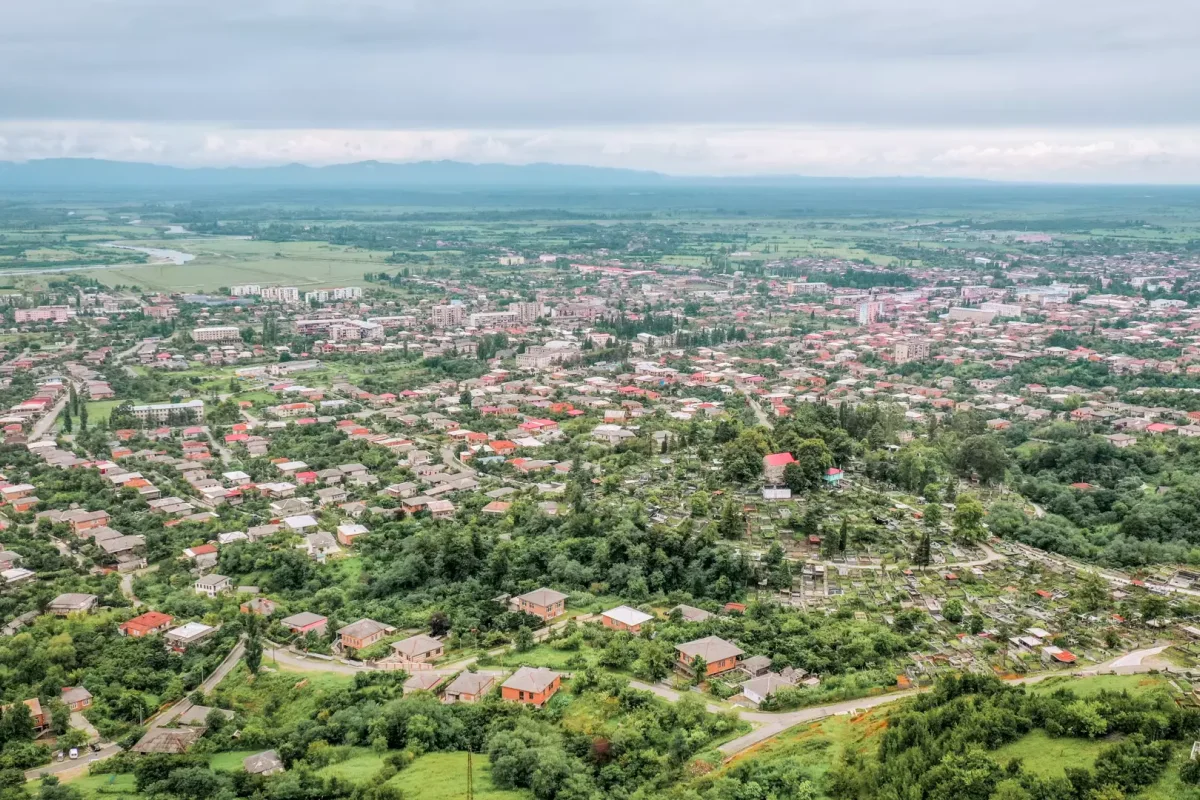
About Senaki
ExploreSenaki — History and City Development
Senaki is a city in Georgia’s Samegrelo–Zemo Svaneti region and the administrative center of Senaki Municipality. It lies in western Georgia on the Kolkhian Lowland, and its urban “biography” is best read as the story of a transport and regional service town. In Senaki’s case, development was often driven not by a single medieval fortress core, but by the logic of railway infrastructure, roads, and a junction location—a place where movement concentrates and services grow around it.
(Wikipedia, Senaki.)
From Old Senaki to a railway-built “new” city
Georgian historical summaries often distinguish the earlier center commonly referred to as Old Senaki from the modern city that expanded around a railway station. In this narrative, the decisive turning point is the railway era: the Poti–Tbilisi railway was built in the late 19th century, and the choice to place a station and related infrastructure in the area created a new urban-type settlement. Over time, this new settlement strengthened its functional role and effectively became the main city center, while the older locality remained as “Old Senaki.”
(Wikipedia, Senaki.)
This pattern is important because it explains why Senaki feels “practical” in its identity: the city grew around connectivity, flows, logistics, and regional services.
City status: 1921 as a milestone of consolidation
Georgian references state that in 1921 the new settlement was officially granted city status. This date matters not just as a formal label: it signals that by the early 20th century the settlement formed around the station had already become a stable urban center with administrative and service functions for the wider area.
(Wikipedia, Senaki; Georgia Travel — Senaki.)
Soviet-era naming and administrative shifts
Senaki’s biography also shows the marks of political periods through name changes and administrative terminology. Georgian sources note that Senaki was renamed Tskhakaia in the Soviet era (in honor of Mikheil Tskhakaia) and later returned to its historical name.
(Wikipedia, Senaki.)
On the municipal/district level, Georgian summaries also describe changes in administrative naming: the district/municipality existed under different Soviet-era formulations (including the period when it was called Tskhakaia District) and later became known as Senaki Municipality.
(Wikipedia, Senaki Municipality.)
The “junction city”: station, routes, and regional services
Senaki’s everyday urban rhythm is strongly shaped by transport. The official tourism overview emphasizes the city’s link to the Tbilisi–Poti railway corridor and presents Senaki as a place whose growth was tied to the emergence of a railway-connected center.
(Georgia Travel — Senaki.)
Georgian encyclopedic summaries also highlight that Senaki developed a service-and-production profile typical for such nodes: where transport concentrates, the city tends to gain employment, trade circulation, and a local industrial/service layer that follows the needs of a connected region.
(Wikipedia, Senaki.)
Senaki and Nokalakevi: a powerful “old city” layer nearby
Senaki’s cultural and historical value is strengthened by the fact that Nokalakevi lies close to the city. In Georgian references, Nokalakevi is associated with names such as Tsikhegoji and Archaeopolis (“old city”), emphasizing its significance as a multi-layered historical site.
(Georgian Wikipedia — Nokalakevi.)
The official tourism platform also states that Nokalakevi Museum-Reserve is located about 16 km from Senaki, and functions today as a museum-reserve site.
(Georgia Travel (KA) — Nokalakevi Museum-Reserve.)
This proximity gives Senaki a strong, practical tourism logic: the city can serve as a comfortable base for short trips—combining western Georgia routes with a visit to one of the region’s major archaeological landscapes.
Senaki today: a practical regional center in western Georgia
Today Senaki remains the administrative center of the municipality and continues to hold a practical importance through connectivity—a crossroads-style location, reliable access to nearby destinations, and a transport-linked city profile that has shaped its development for more than a century.
(Wikipedia, Senaki.)
FAQ
Q: Why was the railway so decisive for Senaki’s development?
A: Because a new settlement grew around the railway station and transport infrastructure, becoming the dominant urban center compared to “Old Senaki.” (Wikipedia, Senaki.)
Q: When was Senaki granted city status?
A: 1921, according to Georgian references and official tourism summaries. (Wikipedia, Senaki; Georgia Travel — Senaki.)
Q: How close is Nokalakevi to Senaki?
A: The official tourism platform notes it is about 16 km from Senaki. (Georgia Travel (KA) — Nokalakevi Museum-Reserve.)
Sources
Encyclopedic & general overview
Wikipedia — Senaki
https://en.wikipedia.org/wiki/Senaki
Official tourism overview
Georgia Travel (Official) — Senaki
https://georgia.travel/cities-towns/senaki
Nearby heritage (Nokalakevi / Archaeopolis context)
Wikipedia — Nokalakevi
https://en.wikipedia.org/wiki/Nokalakevi