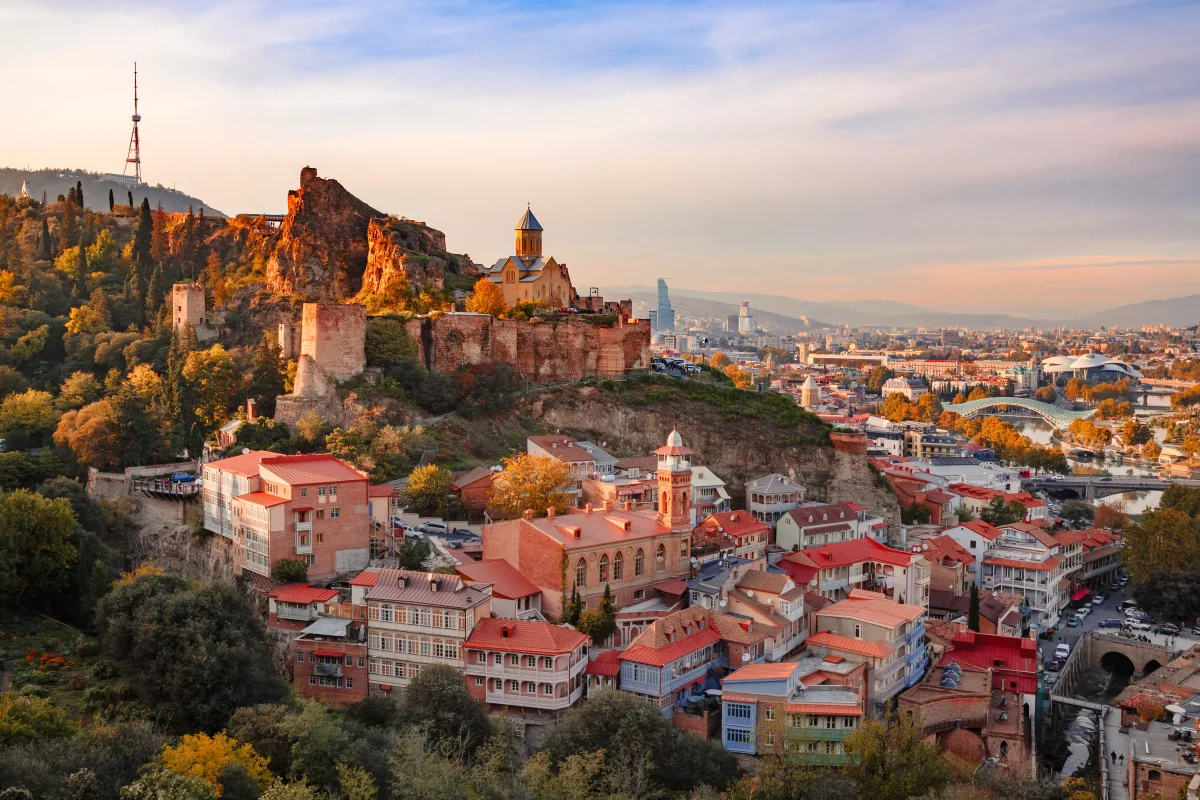
About Tbilisi
ExploreTbilisi is the capital of Georgia and one of the most historically layered cities in the South Caucasus. Its development was shaped by three factors working together over centuries: geography (a strategic position in the Kura/Mtkvari River valley), natural resources (notably sulfur hot springs), and regional power struggles that repeatedly shifted political control and influenced the city’s growth.
Geography and strategic role
The Mtkvari valley formed a natural corridor linking the eastern Georgian lowlands with routes toward the south and the wider region. Mountain ridges and steep riverbanks created defensible positions and natural “gates,” making Tbilisi a logical place for a fortified settlement that could oversee movement and trade. Over time, this corridor-and-fortress logic turned Tbilisi into both a commercial hub and a strategic stronghold.
Early habitation and archaeology
Written sources for the earliest periods are limited, so archaeological evidence is crucial for understanding Tbilisi’s deep past. Finds from prehistoric and early historic periods in the city area and its surroundings show that the valley was a long-standing zone of habitation and movement. Because Tbilisi is densely built, major excavations are difficult; many discoveries historically occurred during construction and infrastructure works. Even so, the overall picture suggests a continuity of settlement and growing regional significance long before the city’s political prominence is documented in detail.
Origins, name, and the hot springs
Tbilisi’s name is widely linked to the Georgian root tbili (“warm”), reflecting the city’s famous sulfur springs and the long tradition of bath culture—most visibly in Abanotubani. The hot springs were not only a local landmark but a defining urban resource, shaping daily life and the city’s identity as a place of healing, social gathering, and commerce.
A well-known founding legend connects Tbilisi to King Vakhtang I Gorgasali (5th century). While legendary in form, the story points to a practical reality: a settlement at this site would naturally develop around warm springs and a strategic corridor.
Late Antiquity and Early Middle Ages (5th–7th centuries)
From late antiquity into the early medieval era, Tbilisi evolved from a fortified nucleus into a more complex urban settlement. By the early medieval period, the city’s political role increased, while nearby Mtskheta retained major ecclesiastical importance. The broader region experienced shifting pressures and rivalries, and Tbilisi’s position ensured it remained central to administration, defense, and trade.
The Emirate of Tbilisi and a multicultural trading city (8th–11th centuries)
From the 8th century, Tbilisi became associated with Arab influence and the polity commonly referred to as the Emirate of Tbilisi. In this period, the city strengthened as a trade and crafts center, linking the Caucasus to wider commercial networks. Tbilisi’s urban life reflected diversity—religious communities and cultural influences coexisted and shaped the city’s social fabric, adding to the “crossroads” character that would define it in later centuries as well.
1122 and the integration into a unified Georgian kingdom
A major turning point came in 1122, when King David IV “the Builder” took Tbilisi and brought it firmly into the core of a unified Georgian state. This shift had practical consequences: the city became a key center for governance, commerce, and regional strategy. The 12th–13th centuries are often described as a period of growth and vitality, when Tbilisi flourished within the broader context of Georgia’s medieval high point.
13th–15th centuries: political shocks and instability
From the 13th century onward, the region entered a more turbulent phase. Tbilisi experienced the consequences of large-scale political changes (including Mongol domination in the wider region) and recurring military pressures. These centuries shaped a pattern common in the city’s history: periods of expansion interrupted by crisis, followed by rebuilding and adaptation.
16th–18th centuries: imperial rivalry in the region
In the early modern period, Tbilisi often lay within the orbit of competing imperial interests, especially amid Ottoman–Iranian rivalry. Control and influence could change, and the city’s security and economy were frequently tested. Yet Tbilisi remained the principal urban center of eastern Georgia and retained its administrative and commercial importance.
1795: a defining trauma
The events of 1795, associated with the Battle of Krtsanisi, brought severe damage to Tbilisi and marked one of the city’s most painful historical episodes. The shock of this period influenced later political thinking about security and geopolitical alignment.
19th century: “Tiflis” under the Russian Empire
From the early 19th century, Tbilisi (often called Tiflis) became a major administrative and cultural center of the Russian Empire’s Caucasian territories. The city’s urban landscape modernized: infrastructure expanded, streets and public spaces developed, and institutions of education and culture grew. Tbilisi’s multiethnic character became especially pronounced, with diverse communities contributing to a vibrant city life.
1918–1921: capital of the First Republic
After the collapse of imperial rule, Tbilisi became the political heart of the Democratic Republic of Georgia (1918–1921). The city concentrated government institutions, diplomacy, press and publishing, and cultural activity, functioning as a regional “hub” at a time of rapid geopolitical change.
Soviet period (1921–1991): urbanization and civic turning points
Under Soviet rule, Tbilisi expanded dramatically, gaining new residential districts, industrial zones, universities, and research infrastructure. It also remained a key stage for civic mobilization. The tragedy of 9 April 1989 became a crucial milestone in Georgian public memory and a powerful symbol on the road toward renewed independence.
Since 1991: modern capital of independent Georgia
Since independence, Tbilisi has undergone major transformation—economic shifts, infrastructure upgrades, renewed cultural visibility, and growing international tourism. Today it is a layered city where historic neighborhoods, 19th–20th century heritage, and contemporary development coexist—an urban identity built on centuries of crossroads, resilience, and reinvention.
FAQ
Q: Why is the city called Tbilisi?
A: The name is commonly linked to the Georgian root “tbili” (“warm”), referring to the city’s sulfur hot springs.
Q: What was the Emirate of Tbilisi?
A: A medieval polity associated with Arab influence, during which Tbilisi grew as a trade and crafts center in the region.
Q: Why is 1122 important in Tbilisi’s history?
A: In 1122, King David IV “the Builder” took Tbilisi and made it a core center of a unified Georgian kingdom.
Q: What happened in 1795?
A: The events around the Battle of Krtsanisi led to severe damage to Tbilisi and became a major historical trauma.
Q: What is the significance of April 9, 1989?
A: It marks a tragic Soviet crackdown in Tbilisi that became a key symbol in Georgia’s independence movement.
Encyclopedic & general overview