About Telavi
ExploreTelavi — History and City Development
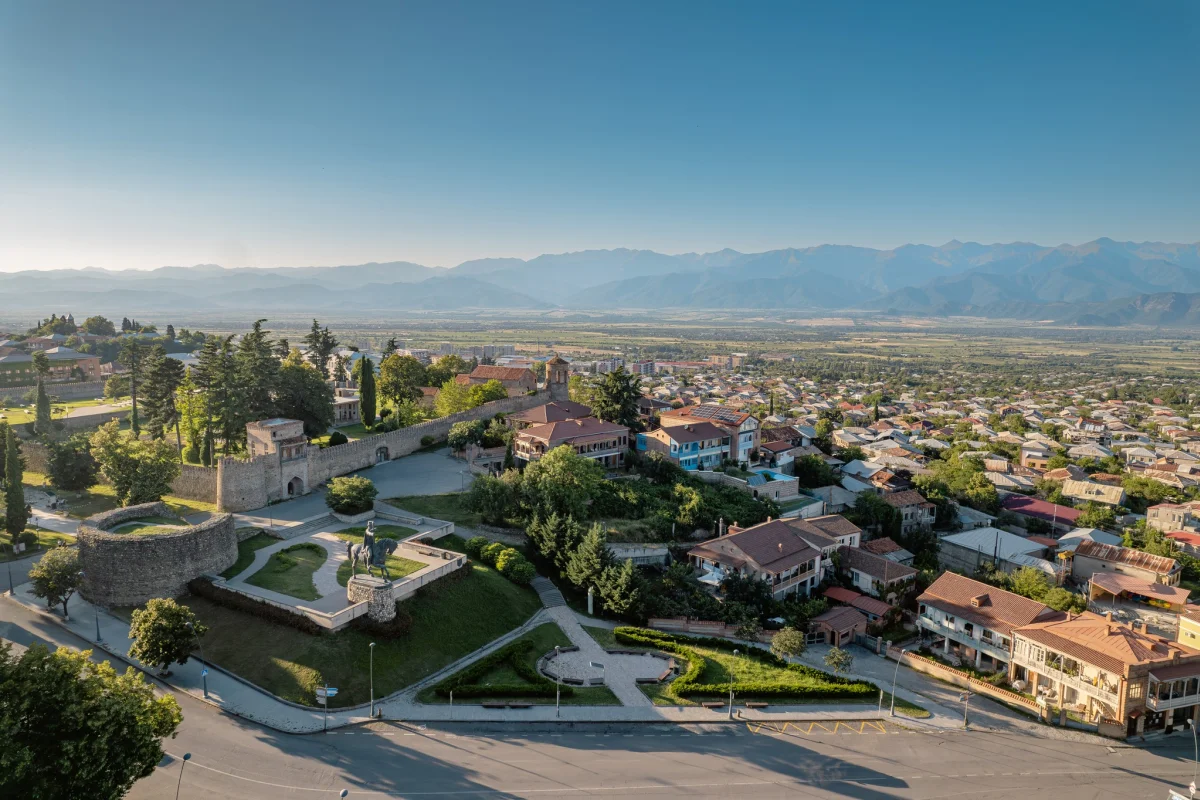
Telavi is the main city of Kakheti and the administrative center of Telavi Municipality. It sits on the foothills of the Tsiv-Gombori Range, where the terrain begins to rise toward the mountains, while the Alazani Valley opens up to the northeast—one of Kakheti’s defining landscapes. This geography shaped Telavi’s character over time: it became a place where a royal residence, a regional administrative hub, and a cultural center tied to Kakheti’s wine country could coexist in one city.
Early layers: archaeology and the name in classical sources
Telavi’s surroundings have been inhabited since ancient times. Encyclopedic overviews note archaeological traces reaching back to the Late Bronze Age.
One of the earliest written references is linked to Claudius Ptolemy (2nd century AD), who mentions a place called Teleda, commonly associated with Telavi in later historical interpretations.
This matters because Telavi is not a “new” modern town—it stands on a long continuity of settlement, later developing into a political and cultural center in eastern Georgia.
From a regional center to a royal city: medieval and early modern Telavi
Over the centuries Telavi’s importance grew as Kakheti’s internal political landscape evolved. Modern summaries often describe Telavi as a major center of Kakheti’s historical administration and power—especially as the region shifted between different political formations and capitals.
Telavi’s setting—between the Alazani lowlands and the protective mountain slopes—helped it function as both a practical base for agriculture/trade and a defensible seat of authority.
Batonis Tsikhe: the royal residence that defined the city’s core
A key symbol of Telavi’s “royal city” identity is Batonis Tsikhe (Batonis Castle)—a 17th–18th century palace-fortress complex in the city center. It served as a residence for the kings of Kakheti and remains one of the most recognizable heritage sites in Telavi today.
The complex is especially tied to the era of King Erekle (Heraclius) II, when parts of the ensemble were reconstructed and the site functioned as a royal seat.
19th century and later: a stable regional hub
After major political shifts in the 19th century, Telavi continued as a regional center—its role increasingly balanced between administration, local economy, and cultural life. In modern terms, Telavi’s identity is also strengthened by its position in Kakheti’s wine region, with the Alazani Valley and surrounding routes making it a natural base for exploration.
Telavi today: heritage, views, and Kakheti’s cultural capital feel
Today Telavi is simultaneously:
Kakheti’s main administrative city,
a heritage destination (Batonis Tsikhe and related historical sites),
and a gateway city to the Alazani Valley and Kakheti’s wine routes.
Its story reads like a meeting point between “royal Kakheti” and modern Kakheti—history in the city center, landscapes and vineyards on the horizon.
FAQ
Q: Where is Telavi located geographically?
A: On the foothills of the Tsiv-Gombori Range, overlooking the Alazani Valley area.
Q: What is an early written reference linked to Telavi?
A: Ptolemy’s mention of Teleda is commonly associated with Telavi in modern summaries.
Q: What is Batonis Tsikhe?
A: A 17th–18th century palace-fortress complex in Telavi, historically tied to the kings of Kakheti.
Sources
Encyclopedic & general overview (location + history)
Wikipedia — Telavi
https://en.wikipedia.org/wiki/Telavi
Early mentions / Teleda (Ptolemy)
Orexca — Telavi (Teleda reference; Late Bronze Age settlement note)
https://www.orexca.com/georgia/telavi.htmWikivoyage — Telavi (Teleda / Ptolemy mention)
https://en.wikivoyage.org/wiki/Telavi
Royal residence / Batonis Tsikhe
Wikipedia — Batonis Castle
https://en.wikipedia.org/wiki/Batonis_CastleGeorgia Travel (Official) — Batoni Fortress (Batonistsikhe)
https://georgia.travel/batoni-fortress
Modern Kakheti context (Telavi as a key city)
The Times — Kakheti travel narrative mentioning Telavi & Erekle II / royal palace context
https://www.thetimes.co.uk/article/why-youll-love-europes-oldest-wine-region-with-new-direct-flights-lmg608m6c