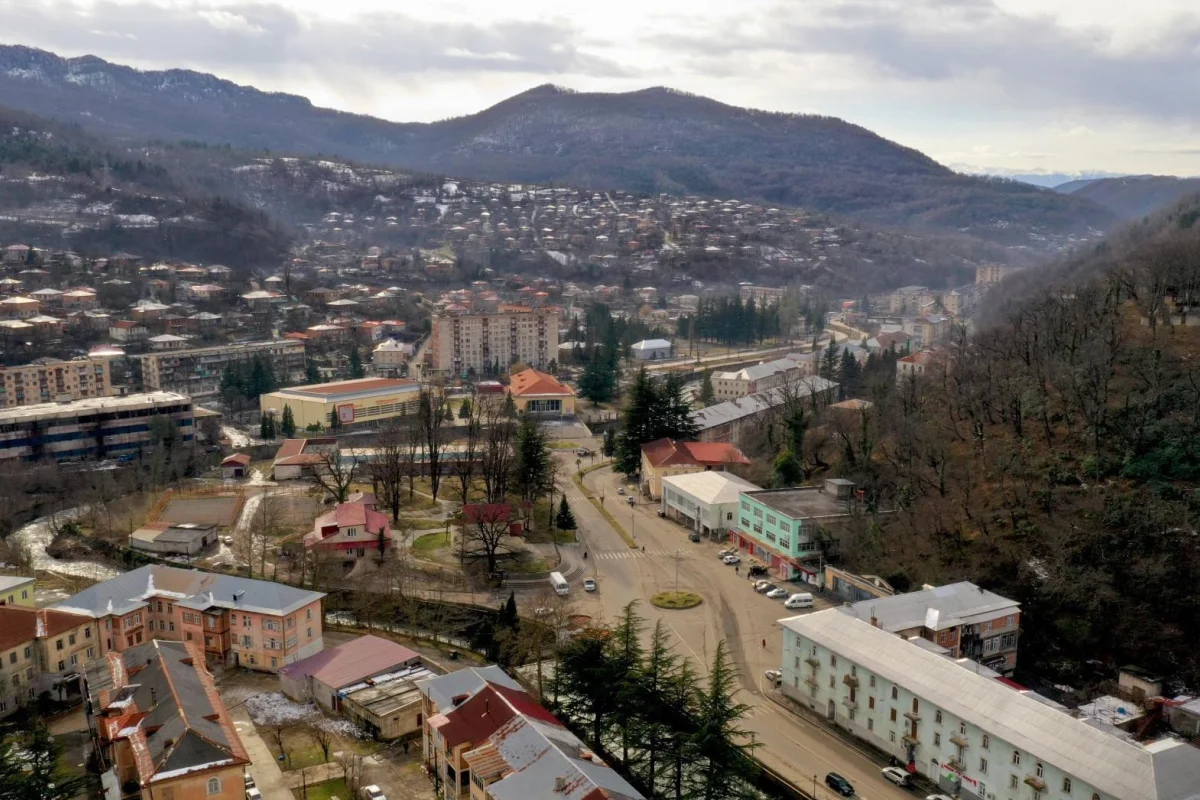
About Tkibuli
ExploreTkibuli — History and Town Development
Tkibuli is a town in western Georgia, in the Imereti region, and the administrative center of Tkibuli Municipality. Its identity is best read through two major lines that naturally connect into one story:
the Okriba historical–geographical context (Tkibuli as a core town of the Okriba basin), and
an industrial town biography shaped above all by coal mining, which influenced Tkibuli’s urban form and social rhythm for decades.
Tkibuli is often described as a place where “energy and water” frame the landscape: the town sits near a reservoir system, and the surrounding relief and hydropower infrastructure create a setting where industrial memory and nature are visible in the same scene.
Early layers and Okriba: a region that predates the town narrative
Tkibuli’s wider area is closely linked to Okriba, a historical sub-region considered part of Imereti and covering what is now Tkibuli Municipality. This matters because Tkibuli’s story is not only a set of administrative dates: the region carries older geographical identity, and the name “Okriba” remains active in local toponymy and public references.
Read this way, Tkibuli is where a historical region and a modern administrative town overlap. The Okriba basin functions like a natural “bowl,” and Tkibuli developed in its center as an administrative and economic hub.
Coal and urban growth: extraction → consolidation → city status (1846 → 1939)
Tkibuli’s urban development is strongly tied to the Tkibuli–Shaori coal deposit and coal industry in general. Encyclopedic summaries note that Tkibuli became a coal-mining center, and a key milestone in modern chronology is city status in 1939.
This industrial base shaped Tkibuli as a “working town”: population growth, expansion of residential quarters, and consolidation of services often follow the logic of a production-centered economy. In Tkibuli’s case, coal is not just one sector—it is a defining factor in how the town formed and functioned.
The Soviet era and the 1990s transition: from an industrial town to a difficult reset
During the Soviet period, Tkibuli clearly functioned as an industrial town whose urban structure served production cycles and related everyday life. The 1990s brought a difficult transition across many industrial centers in Georgia; Tkibuli is frequently referenced as a place where the mining-driven rhythm changed and the town’s socio-economic dynamics had to adapt.
In contemporary discussions, coal remains present in the local economy narrative, while public sources also raise broader questions about workplace safety and standards as a modern challenge—discussed in general terms, without focusing on graphic detail.
A “town of water”: Tkibuli Reservoir and the energy landscape
A second strong layer of Tkibuli’s identity is the Tkibuli Reservoir, located in the Okriba basin within Tkibuli Municipality. Descriptions highlight that it is a man-made reservoir formed by an embankment dam and fed by the Tkibuli River; its bays and small islands add to the town’s distinctive landscape.
This proximity supports an “energy-and-nature” reading of Tkibuli: industrial history and hydrological infrastructure are visible alongside forests and basin views. Today, this often translates into itinerary logic—Tkibuli can work as a base for short trips to the reservoir, viewpoints, and the surrounding wooded slopes.
Tkibuli today: industrial memory + natural scenery in one place
Modern Tkibuli stands out because its two main themes reinforce each other:
coal-mining history and industrial-town memory, and
the reservoir / energy landscape within the Okriba basin.
Together they make Tkibuli a distinct Imereti destination: clearly defined urban biography, plus a strong natural setting.
FAQ
Q: Where is Tkibuli located?
A: In western Georgia, in the Imereti region; it is the administrative center of Tkibuli Municipality.
Q: What shaped Tkibuli’s urban development most strongly?
A: Coal mining and the broader context of the Tkibuli–Shaori deposit.
Q: What is Tkibuli Reservoir and where is it?
A: A reservoir in Tkibuli Municipality, in the Okriba basin; it is fed by the Tkibuli River.
Q: What does “Okriba” mean in the Tkibuli context?
A: A historical region in western Georgia (part of Imereti) that covers the territory of Tkibuli Municipality.
Q: When did Tkibuli gain city status?
A: Encyclopedic sources commonly cite 1939.
Sources
Encyclopedic & general overview (location + history)
Wikipedia — Tkibuli
https://en.wikipedia.org/wiki/TkibuliWikipedia — Tkibuli Municipality
https://en.wikipedia.org/wiki/Tkibuli_Municipality
Historical–geographical context (Okriba)
Wikipedia — Okriba (linked via municipal context / regional references)
https://en.wikipedia.org/wiki/Tkibuli_Municipality
Coal & industrial context
Georgian Travel Guide (EN) — Tkibuli (economy, coal timeline)
https://georgiantravelguide.com/en/tkibuliChaikhana — The town refused to die: Georgia's struggling coal mines (Tkibuli)
https://chaikhana.media/en/stories/1339/the-town-refused-to-die-georgias-struggling-coal-mines
Reservoir / landscape
Georgian Travel Guide (EN) — Tkibuli Reservoir
https://georgiantravelguide.com/en/tqibulis-tsqalsatsavi