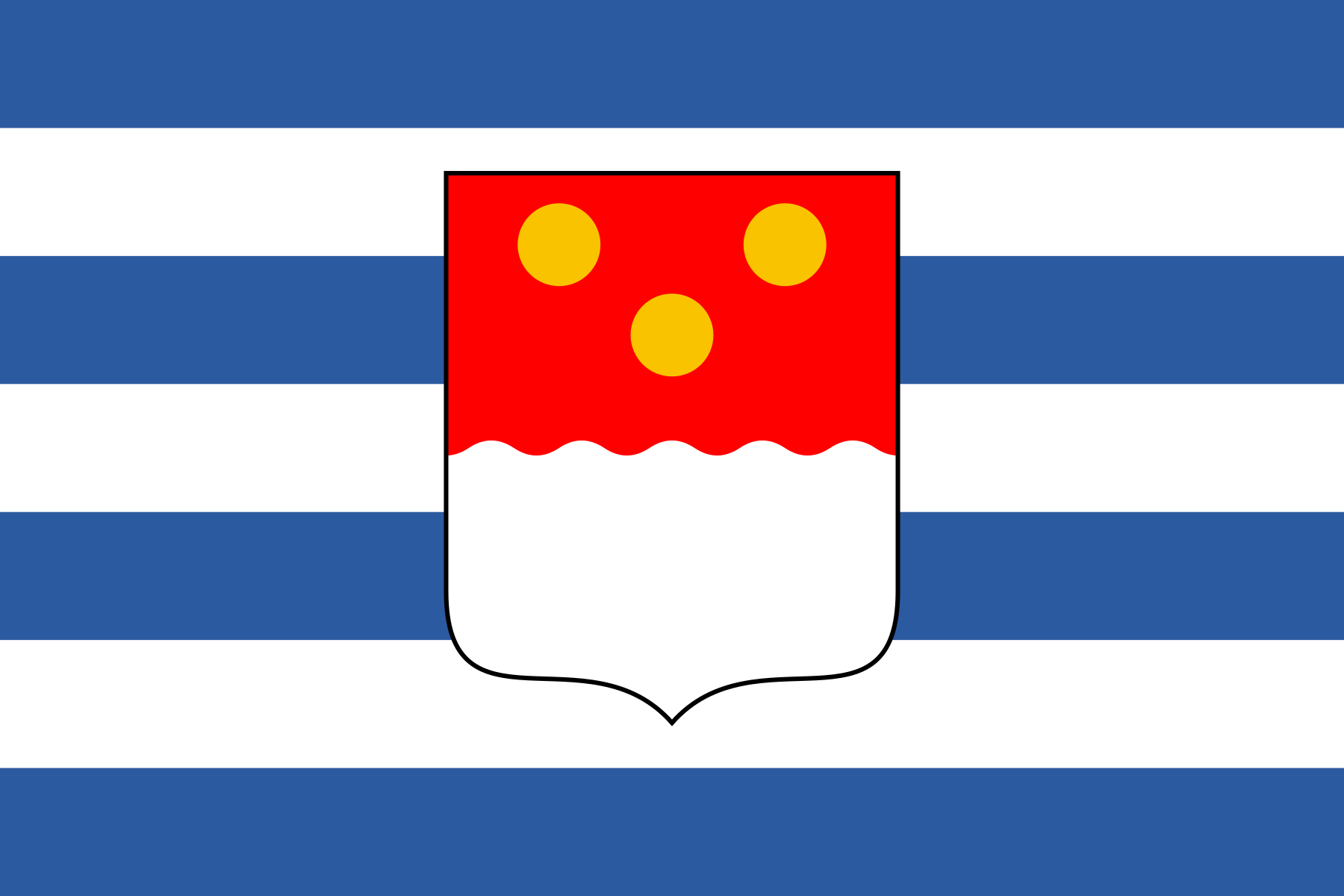
Batumi
Batumi — overview
History
Batumi Municipality (the city of Batumi) is a self-governing urban unit on Georgia’s Black Sea coast and the administrative centre of Adjara. Over the long run, Batumi’s identity has been shaped by one constant: the harbour—a coastal gateway that linked inland routes to maritime trade, later adding a strong resort-and-tourism layer. Georgia Travel’s “Old Batumi” overview highlights the idea of Batumi as a city built around a deep harbour and describes key turning points that accelerated urban growth.
From coastal node to borderland port
As part of the wider south-eastern Black Sea corridor, Batumi functioned as a coastal node where commerce and movement concentrated around the shoreline. Over time, the city also became a borderland space: Georgia Travel notes that from the 16th century Batumi fell under Ottoman rule “from time to time,” and by 1712 it officially became part of the province of Trabzon—an example of how strategic ports often shift between larger powers.
1878 and the freeport idea (porto-franco)
A widely cited modern turning point is 1878, when Batumi became part of the Russian Empire. Georgia Travel adds that Batumi received porto-franco status—duty-free trade—until the late 1880s, reinforcing the port-driven economy. A related overview of the seaport history also describes a 1878–1885 porto-franco (freeport) period and connects Batumi’s rapid growth to the expansion of oil transit and infrastructure upgrades.
Rail, oil, and rapid modernization
The late 19th century is where Batumi’s port logic becomes a modernization engine. Georgia Travel states that the Baku–Batumi railway (1883) and then the oil pipeline (1897–1907) contributed to rapid development, with the port gaining international importance on the Black Sea; it also notes that population patterns and the city’s architecture and planning changed markedly in that period.
Soviet period and the resort layer
In the 20th century, Batumi’s profile combined port-and-industry functions with a seaside resort identity. Georgia Travel’s text frames Batumi as both a port/industrial city and a tourism city, with tourism expanding strongly in the 21st century.
Today: self-governing city and urban management
Batumi’s municipal governance is visible through official structures (City Hall departments and service centres). The City Hall site presents the city administration and service network as the operational backbone for public services and urban management—relevant for a municipality page focusing on the “today” layer of the story.
Batumi city-centre coordinates commonly used for maps are lng 41.64167, lat 41.64583.
FAQ
Where is Batumi Municipality located?
Batumi Municipality is in southwest Georgia, on the eastern coast of the Black Sea, in Adjara.What type of administrative unit is Batumi Municipality?
It is a self-governing city (Municipality/City) and also Adjara’s administrative centre.What is the administrative centre of Batumi Municipality?
The administrative centre is the city of Batumi.Which coordinates can I use for the map (city centre)?
You can use: lng 41.64167, lat 41.64583.Which year is often treated as a major turning point for Batumi’s development?
The year 1878 is often treated as a turning point, when Batumi joined the Russian Empire and received porto-franco status.What role did the Baku–Batumi railway and the oil pipeline play?
The railway (1883) and the oil pipeline (1897–1907) helped drive rapid growth and increased the port’s international importance.Why is Batumi economically important?
Batumi is an important port and transit hub on the Black Sea coast.What is Batumi best known for today?
Batumi is known as a seaside tourism city, Adjara’s administrative centre, and an important port.