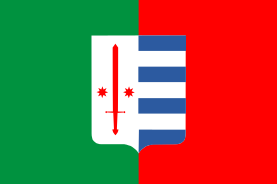
Khulo Municipality
Khulo Municipality — overview
History
Khulo Municipality is a highland municipality in Georgia’s Autonomous Republic of Adjara, with Khulo as its administrative centre. The area sits in and around the Adjaristsqali valley and the Arsiani range, where steep relief, forest belts and alpine zones have historically shaped settlement patterns and everyday life. Because of its position between inland highlands and the Black Sea hinterland, Khulo’s wider territory has long been connected to routes linking mountainous Adjara with neighbouring regions and the coastal zone—an important backdrop for trade, seasonal movement, and cultural exchange.
Archaeological and cultural references point to very early habitation in and around Khulo, while the medieval period left a stronger, more visible imprint through fortifications, bridges, and religious architecture spread across mountain ridges and valleys. This layered heritage reflects a landscape that was never “remote” in a simple sense: it was strategically valuable, traversed, and continuously adapted to changing political and economic realities.
From the 16th century onward, Khulo—together with the rest of Adjara—fell within the orbit of Ottoman influence. This era is closely associated with religious and social change, including a regional process of Islamisation, while local communities retained the Georgian language and many markers of Georgian identity. After the Russo-Ottoman War, Adjara became part of the Russian Empire in 1878, which brought new administrative structures and further transformations in public life.
During the Soviet period, state policies around collectivisation and religion deeply affected mountainous Adjara. Historical accounts note the 1929 uprising in mountainous Adjara and its suppression, followed by repression and deportations. Later, modern administrative boundaries were consolidated in the mid-20th century, and Khulo’s district/municipal configuration is generally tied to the 1960s era of territorial administration.
Today, Khulo’s identity is strongly associated with highland culture and nature: summer mountain settlements, forest resources, and a growing tourism profile. The Goderdzi direction is a key anchor for this: the pass and resort area connect Adjara’s mountains with the Samtskhe-Javakheti side, while the surrounding alpine landscapes support hiking, camping, and winter activities. Nearby, Green Lake is a popular nature stop close to Goderdzi, and Beshumi is a well-known high-altitude summer resort area around 2000 m. Together, these natural highlights complement the municipality’s cultural heritage and make Khulo one of the most distinctive destinations in mountainous Adjara.
FAQ
1) Where is Khulo Municipality located?
In the highlands of Adjara (south-west Georgia), around the Adjaristsqali valley and Arsiani range.
2) What is the administrative centre?
Khulo.
3) What is Goderdzi known for?
A mountain pass and resort area in Khulo Municipality, popular for alpine scenery and winter sports.
4) What is Green Lake?
A popular alpine lake near Goderdzi Pass in Khulo Municipality, often visited for picnics/camping.
5) What is Beshumi?
A high-altitude summer resort area in Khulo Municipality (around 2000 m).
6) Which empires/states shaped Khulo’s modern history?
Ottoman influence from the 16th century; later incorporation into the Russian Empire after 1878; then Soviet rule.
7) Was there a notable Soviet-era uprising?
Accounts describe a 1929 uprising in mountainous Adjara and its suppression.
8) Is there an official municipal website?
Yes—Khulo Municipality has an official website.
9) What kinds of tourism fit Khulo best?
Hiking, nature trips, alpine lakes, summer mountain settlements, and winter activities around Goderdzi.
10) Where can I find a list of things to do?
Travel guides and the Visit Batumi page provide curated highlights.