About Batumi
ExploreBatumi — History (From Ancient Times to the Present)
Batumi is the capital of Adjara and Georgia’s principal city on the Black Sea. Its historical trajectory has been determined by a combination of factors that rarely align in one place: a deep and sheltered natural harbor, access to coastal and inland trade routes, and a location on a long-contested frontier where regional powers repeatedly competed for influence. Across centuries, Batumi shifted from a coastal settlement and trading point to a strategic port-city with regional administrative functions, and eventually to a modern urban center whose identity blends maritime economy, tourism, and layered cultural heritage.
Geography and the logic of a port-city
Batumi lies on a protected bay near the contemporary Georgian–Turkish border. The city’s most consistent advantage has been the sea itself: a harbor capable of supporting anchorage, loading and unloading, and later large-scale port infrastructure. This geographic asset positioned Batumi as a gateway between maritime routes across the Black Sea and overland corridors into Adjara and the wider South Caucasus. In historical terms, Batumi’s development followed a familiar pattern for port cities: security and trade created growth, growth required stronger administration and fortifications, and infrastructure tied the city ever more tightly to regional and international markets.
Early traces and antiquity
The broader coastal zone of western Georgia belongs to the historical world of Colchis, known in classical traditions for maritime trade and connectivity. In many accounts, Batumi’s early identity is connected to the idea of a “deep harbor,” a phrase often discussed in relation to the city’s name and geographic character. While the details of early urban formation remain complex, the region’s antiquity is vividly represented by nearby Roman-era military architecture: the Gonio Fortress (Apsaros). Its presence reflects the strategic value of this coastline within ancient defensive and communication networks and highlights the long-standing importance of the Batumi area as a coastal node.
Medieval centuries: a coastal frontier
In the medieval period, Black Sea coastal settlements were strongly influenced by shifts in maritime control and the security of trade. Batumi’s broader region experienced changing political realities typical of western Georgia: local rule, external pressure, and the constant need to manage coastal access. In such contexts, Batumi’s value derived less from monumental inland fortifications and more from its maritime function—an entry point for goods, ideas, and influence arriving by sea.
Ottoman period: long-term coastal control
From the early modern era, Batumi fell within the Ottoman sphere for an extended period. As a coastal center, it gained importance as part of a wider system of maritime administration and border security. This period influenced the region’s demographic and cultural composition and consolidated Batumi’s role as a gateway city—connected simultaneously to local hinterlands and broader Black Sea dynamics.
1878 and the city’s modern transformation
A defining turning point came in 1878, after the Russo–Turkish War, when Batumi entered the Russian imperial system. This change opened a period of rapid modernization. For a time, Batumi was associated with a free port (porto franco)regime, which stimulated trade and commercial activity and made the harbor an increasingly attractive point for investment and logistics.
By the late 19th and early 20th centuries, Batumi’s strategic importance expanded further through major infrastructure that linked it directly to transregional networks. Rail connections strengthened the port’s role as an outlet for inland production and regional trade. The completion of the Baku–Batumi oil pipeline (1907) reinforced Batumi’s position as a key export gateway for Caspian oil to Black Sea shipping routes. Alongside economic expansion, the city’s urban fabric changed: regular street grids and new public spaces appeared in parts of the city, and the seaside recreational concept—later embodied by the boulevard tradition—became a notable element of Batumi’s identity.
20th century: political shifts and Soviet-era development
The early 20th century brought political instability across the region, and Batumi experienced periods of rapid change in governance and security. Under Soviet rule, the city developed simultaneously as a major port, an industrial and logistical center, and a seaside resort. Urban expansion produced new residential districts and infrastructure, while the port remained central to the city’s economy and strategic value.
Since 1991: modern Batumi
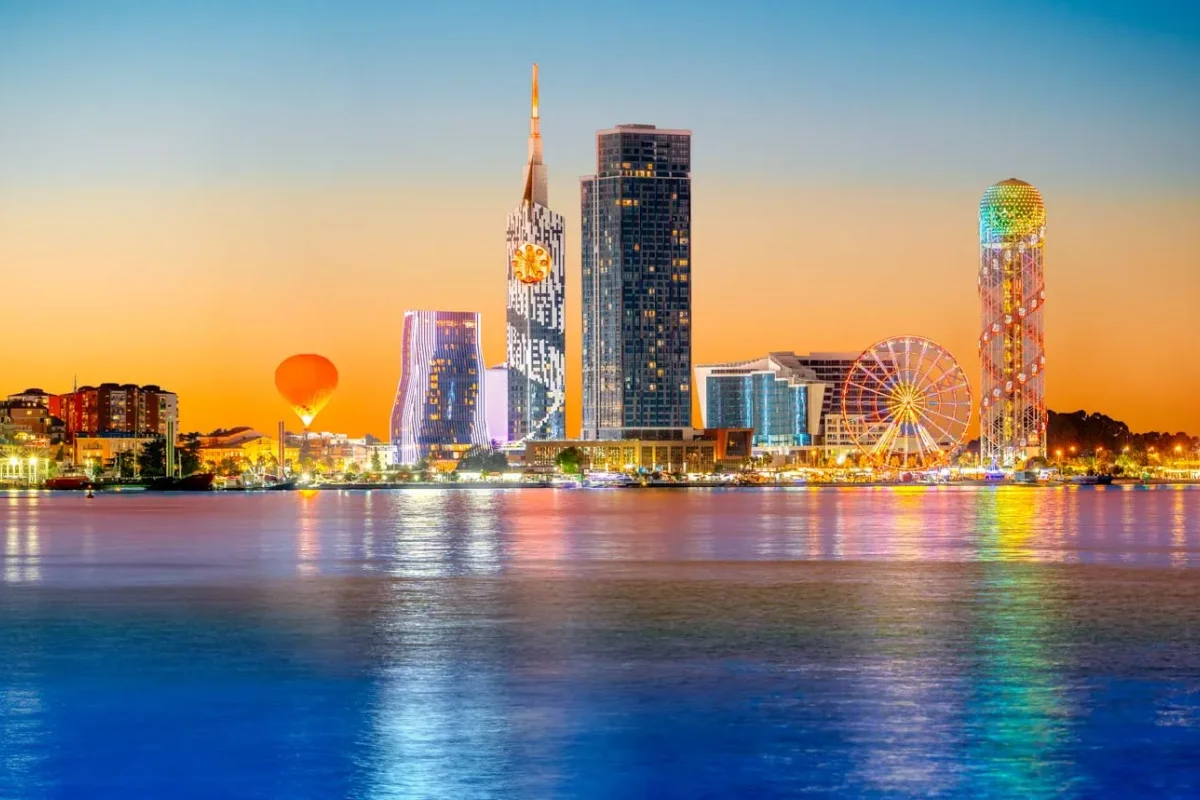
In independent Georgia, Batumi has undergone a visible transformation driven by tourism, services, investment in urban infrastructure, and the continuing role of the port. Contemporary Batumi is recognized for the contrast—and coexistence—between historic quarters and modern architecture. The city’s narrative remains anchored in the same long-term advantage that shaped it from the beginning: the Black Sea, the harbor, and Batumi’s role as a coastal gateway for Adjara and Georgia as a whole.
FAQ
Q: Why is Batumi often linked to the idea of a “deep harbor”?
A: Batumi’s bay is naturally sheltered and deep, which historically made it a convenient and strategic anchorage and later a major port.
Q: What is the significance of Gonio Fortress near Batumi?
A: Gonio (Apsaros) reflects the region’s Roman-era military presence and shows the strategic value of the Black Sea coastline near Batumi.
Q: When did Batumi become part of the Russian Empire?
A: In 1878, after the Russo–Turkish War and the related settlement.
Q: What was Batumi’s “free port” (porto franco) status?
A: A trade-friendly regime that encouraged commerce and investment in the port area during the late 19th century.
Q: Why is 1907 important in Batumi’s modern history?
A: The Baku–Batumi oil pipeline was completed in 1907, strengthening Batumi as a key export gateway to the Black Sea.
Q: How did Batumi change after 1991?
A: Batumi rapidly transformed through tourism growth, urban investment, and modernization, while the port remained a major economic asset.
Encyclopedic & general overview