About nokalakevi
ExploreThe Ancient City (Archaeopolis) — Nokalakevi
Location
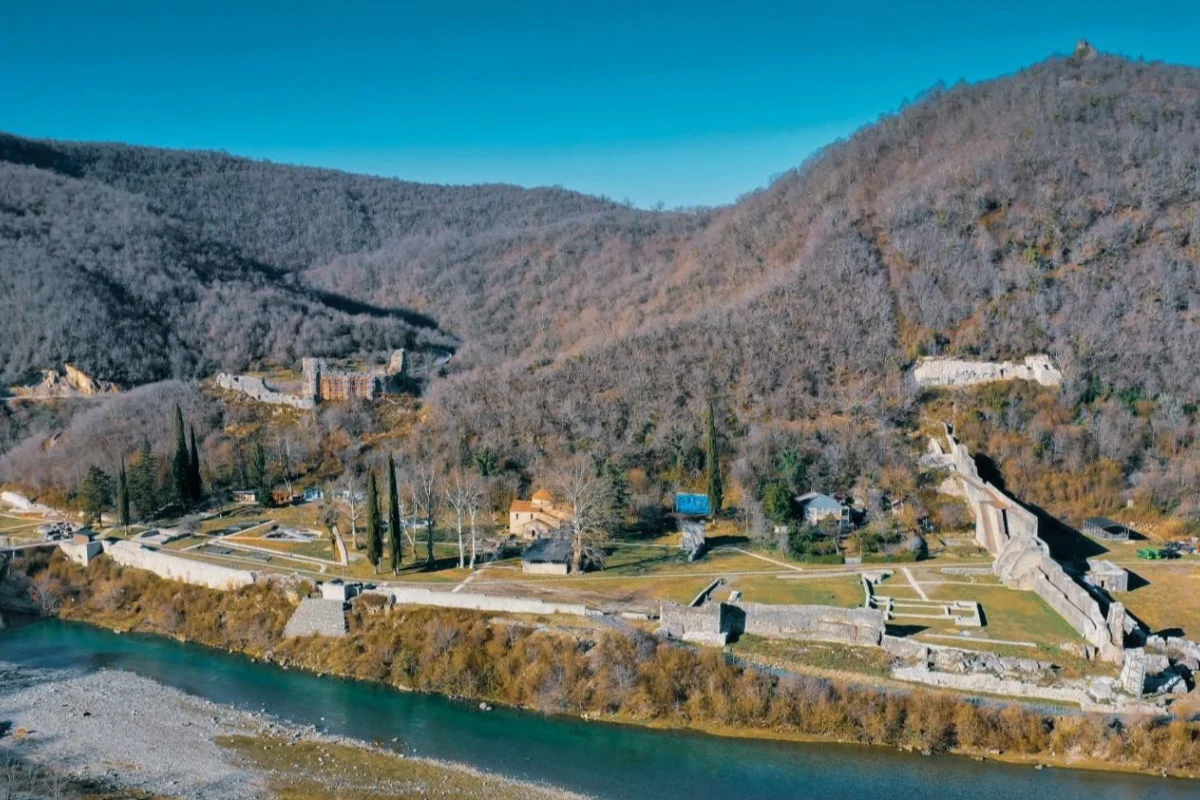
Nokalakevi is located in western Georgia, in the Samegrelo–Zemo Svaneti region, Senaki Municipality, on the left bank of the Tekhuri River, near the village of Jikha.
The ruins and the fortress complex
On the Tekhuri’s riverbank, in the village of Nokalakevi, monumental remains of an ancient fortified settlement have survived, including:
a massive defensive wall,
monumental towers,
and a fortification line that begins by the river, follows the mountain slopes, and connects to equally impressive ruins on a plateau near the summit.
This upper section forms the so-called “Upper Fortress” — the Acropolis, which local residents call “Jikha.”
Written tradition and names
According to information preserved in Georgian and foreign historical writing, Nokalakevi was an important and well-known center from ancient times.
The 11th-century Georgian historian Leonti Mroveli attributes the construction of this ancient city to Kuji, the ruler (eristavi) of Egrisi and Svaneti (3rd century BCE). In Georgian tradition the site is associated with Tsikhegoji (“Kuji’s fortress”), and another variant name “Jikhakvinji” is also mentioned in the text. Historical sources place Tsikhegoji among Georgian towns of the Early Hellenistic period.
In Greek and Byzantine tradition, the settlement is known as “Archaeopolis.” Two historians—Procopius of Caesareaand Agathias—are cited as conveying this name. The components are explained as: “archai(a)” = “old” and “polis” = “city,” meaning “Old City.” The text further notes that Greeks often translated local names into Greek (e.g., Vardtsikhe → Rodopolis, Tskhenistsqali → Hippos, etc.).
The text also states that Justinian’s Novels describe Archaeopolis and Rodopolis as among the greatest and most ancient fortresses.
Pseudo-Scylax and the “great barbarian city”
A passage attributed to Pseudo-Scylax (6th century BCE) is referenced, listing peoples, rivers, and cities along the Black Sea coast, and mentioning a “great barbarian city” located 180 stadia (~33 km) upriver from Phasis (Poti).
The text presents two competing interpretations:
one view links it to Kutaisi, though Kutaisi is not 33 km from Poti;
another view links it to Nokalakevi, although Nokalakevi is not situated on the Rioni/Phasis riverbank.
It adds that, according to Simon Janashia, the river called “Risi” by Pseudo-Scylax might in fact be the Tekhuri River(a tributary of the Rioni). The text notes that neither interpretation can yet be confirmed conclusively due to the lack of sufficiently targeted archaeological research.
Archaeology and historical timeline
The text argues it is likely that an urban settlement existed here even before Kuji’s era, which is supported by the “Old City” name tradition (Archaeopolis) and by archaeological results. Evidence of habitation on Nokalakevi’s territory is confirmed by materials dating to the 8th–7th centuries BCE.
From the 3rd century BCE, Nokalakevi (Tsikhegoji) is described as one of the centers of Colchis.
Around the turn of the 3rd–4th centuries CE, it becomes the capital of the Kingdom of Egrisi (Lazika).
The city continued until the 530s of the 8th century, and was destroyed during Marwan ibn Muhammad’s campaign (“Murvan Qru”).
Modern attention, popularity, and museum-reserve status
Excavation results have been widely covered in the media, and numerous works have been published on expedition findings. Today, Nokalakevi is a popular destination and hosts various events.
The text also mentions British researcher and traveler Tim Severin, who attempted to retrace the legendary route of the Argonauts using a reconstructed ship similar to the “Argo,” arriving first at Poti and then at Nokalakevi; his impressions were recorded in his book.
An archaeological museum operates on the site, and the area enjoys the status of a museum-reserve.
FAQ
Where is Nokalakevi located?
In western Georgia (Samegrelo–Zemo Svaneti), Senaki Municipality, on the left bank of the Tekhuri River.What does “Archaeopolis” mean?
It is the Byzantine name meaning “Old City,” used for the fortified settlement.What is Tsikhegoji?
A Georgian name for Nokalakevi, commonly explained as “Kuji’s fortress” in Georgian tradition.Which periods shaped the site most?
Its late antique and early medieval phases are central, especially the 4th–6th centuries CE.How is it linked to the Lazic War?
Archaeopolis is frequently described as a key stronghold in the Byzantine–Sasanian struggle during the Lazic War (c. 540–562).What can you see on site today?
Large fortification walls, gates, and structural remains across lower and upper defensive zones.Why was the location strategic?
The Tekhuri’s course and the rugged terrain create natural defenses and help control river crossings and routes.Is it a museum-reserve?
Yes—Nokalakevi is presented as a museum-reserve site in general references.Who studies Nokalakevi today?
A major long-running project is the Anglo-Georgian Expedition to Nokalakevi.
Sources / Bibliography
Andria Apakidze — Article: “The Ancient City — Archaeopolis — Nokalakevi”, journal “Dzeglis Megobari”(Issue/Collection 19), National Library Archive.
T. Qaukhchishvili — “Greek Writers’ Accounts on Georgia”, 1967.
Nodar Lomouri — “Archaeopolis — Nokalakevi”, journal “Dzeglis Megobari” (Issue/Collection 4), National Library Archive, 1999.