



Besleti Bridge
Link copied
Photograph: Михайлов К. А. (Public domain), Daxure at Russian Wikipedia (Public domain), daxure (Public domain)
A single-arched stone bridge of the eleventh to twelfth centuries over the Besleti river a few kilometres from Sukhumi, with an inscription in asomtavruli script; known also as Queen Tamar's bridge, it still carries loads today.
About
The Besleti bridge, also called Queen Tamar's bridge, crosses the Besleti (Basla) river in the village of Besleti, 5–6 kilometres from the centre of Sukhumi, in Sokhumi Municipality. It is the only surviving monument of its kind of Georgian civil architecture of the eleventh and twelfth centuries in Abkhazia.
The bridge has a single arch. The arch is 13.2–13.3 metres long, the bridge 35 metres long overall and 4.7 metres wide; the arch rises 8.4 metres above the river, 5.9 metres in the clear. A narrow rocky neck of the river was chosen for it. The arch is built of large wedge-cut blocks of hard limestone, up to a metre long and 0.35 metres wide, with two courses of thin, well-fired brick laid between the stones; over the centuries the lime mortar has set as hard as the stone. The bridge still bears loads of 7–8 tonnes.
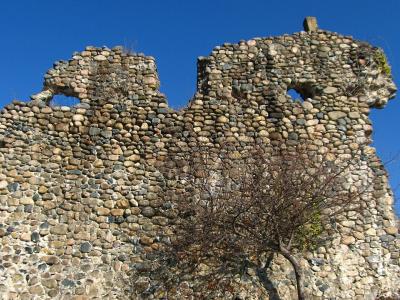
On the western edge runs a one-line inscription in asomtavruli script: "Christ the Lord, glorify in every way in both lives…"; the letters, 25 centimetres high, belong palaeographically to the eleventh or twelfth century, and the inscription names a King Bagrat, either Bagrat III or Bagrat IV. On the lower part of the left-bank pier an engraved cross and a Greek "Τ" survive. Near the bridge are the ruins of the tower of the Besleti fort, which guarded the entrance to the city through the narrow gorge; a stone stele with a Georgian inscription that stood at the head of the bridge was lost at the beginning of the 1990s.
- Construction period
- 11th–12th centuries, by palaeographic and structural evidence
- Material
- Dressed limestone blocks with two courses of thin brick, set in lime mortar
History
The bridge was built in the eleventh or twelfth century, and the road into the mountain valleys passed over it; it also had military importance, as the ruins of the tower that guarded it from the seaward side show. Popular tradition credits the bridge to Queen Tamar (1184–1213), but the palaeography of the inscription, the masonry and the materials place it in the eleventh century, and the Bagrat named in the inscription must be Bagrat III (978–1014) or Bagrat IV (1027–1072).
The Georgian asomtavruli inscription was noticed in 1935 by the local historian Ioseb Adzinba, who also cleared the bridge of the plants that were damaging it; in 1939 the bridge was restored for the first time. The academicians Nikolai Severov and Giorgi Chubinashvili dated the inscription to the eleventh or twelfth century. On 7 November 2006 a decree of the President of Georgia listed the Besleti bridge as an immovable cultural monument of national significance. Under the occupation Georgia can neither study nor restore the monument; the bridge needs clearing of vegetation.
Visit info
The bridge stands in the village of Besleti, 5–6 kilometres from the centre of Sukhumi, about 10 minutes by car.
Abkhazia is an occupied territory. Under Georgian law entry to the region is lawful only through the Enguri crossing; entry from Russia is a breach of Georgian law. Check the current conditions of movement before travelling.
Safety
The stone is slippery after rain: keep away from the edges. The river rises quickly after rain, so go down to the bed only at low water. Consular assistance in the occupied territory is limited.
Tip
The inscription is on the western edge of the arch; side light brings the letters out best. Look for the cross and the Greek letter on the left-bank pier. The bridge combines well in one day with the Sukhumi botanical garden and the fortress.
Sources
Nearby places
All places in the region
Nearby settlements