



Kamani Monastery
Link copied
Photograph: P.Kinareevski (CC BY 2.5), Trio7 (CC BY-SA 2.5), Trio7 (Public domain)
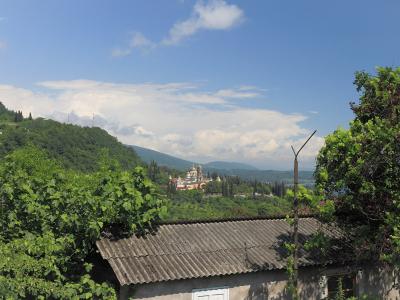
A monastery north of Sukhumi in the village of Kamani, which tradition links with the death and first burial of St John Chrysostom: rebuilt in the 1980s on the foundations of a medieval church and marked by the tragedy of 1993.
About
The Kamani monastery stands in the village of Kamani north of Sukhumi, on the Sukhumi–Atsra road, 20–25 minutes' drive from the city; the village is in Sokhumi Municipality. The place, also called Komani, is linked in local Abkhazian-Georgian tradition with St John Chrysostom: exiled from Constantinople towards the Black Sea coast, the saint, so the tradition says, died here and was buried here until his relics were taken to Constantinople in 438. In 1884 the Greek scholar Konstantinos Vrissis conjectured that Chrysostom died not at Comana in Pontus but at Kamani; historical sources do not confirm the tradition.
Of the medieval stone building only the foundations survive, those of a single-nave hall church without a projecting apse and with a semicircular sanctuary inside; it was lit by two narrow windows in the sanctuary and the west wall. During the building of the bell tower a sarcophagus cut from a single block of limestone, weighing about a tonne, was found in the ground. The present church was rebuilt on these foundations in the 1980s; in the church of St John Chrysostom stands a stone tomb which tradition calls the saint's, and an icon with a particle of his relics. Up to 50,000 pilgrims and tourists visit the monastery each year.
- Tradition / order
- Orthodox; dedicated to St John Chrysostom
History
In the Russian imperial period, in 1898, a convent of St Basiliscus of Comana and St John Chrysostom was founded at Kamani; its main church was built on the foundations of the old one and consecrated to St Basiliscus in 1900, and in 1901 the coenobitic convent opened, with up to 200 nuns by 1906. The convent had stone buildings, a mill and an apiary. After the revolution it was closed, the church fell into ruin and the buildings were put to various uses.
At the end of the 1980s the church was rebuilt through the efforts of the Abkhazian Yuri Anua, and in 1990 Ilia II, Catholicos-Patriarch of All Georgia, consecrated it. In July 1993, during the war in Abkhazia, armed formations stormed the monastery; Yuri Anua and the Georgian priest Andria Kurashvili were killed, an event known as the Kamani massacre. Since 2001 monks have lived at the monastery again, and on 10 February 2011 the de facto authorities handed it to a church body not recognised by the Georgian Orthodox Church. Georgia has listed the church as cultural heritage and in 2015 assessed its physical condition as poor.
Visit info
The monastery is 20–25 minutes from Sukhumi by the Atsra road; the church is in use.
Abkhazia is an occupied territory. Under Georgian law entry to the region is lawful only through the Enguri crossing; entry from Russia is a breach of Georgian law. Check the current conditions of movement before travelling.
Safety
Dress rules are observed in the working church. Consular assistance in the occupied territory is limited.
Tip
The flow of pilgrims is greatest on feast days; for a quiet visit choose a weekday morning. In the church of St John Chrysostom look for the stone tomb that tradition calls the saint's and the icon with a particle of his relics.
Sources
Nearby places
All places in the region
Places of the same kind
Monastery — all places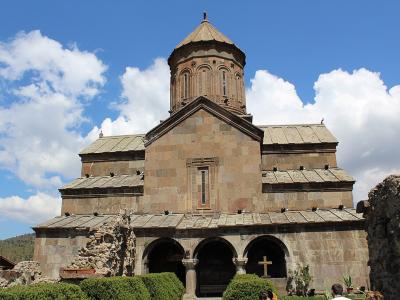
Nearby settlements