



Shekvetili Beach and Parks
Link copied
Photograph: Iscream icecream (CC BY-SA 4.0), Gaga.vaa (CC BY-SA 4.0), M. (CC BY-SA 4.0), Unknown author (Public domain), Marie-Frédéric Dubois de Montpéreux (Public domain)
Between Ureki and Kobuleti at the mouth of the Natanebi, in a 5-kilometre strip of pines: the young resort of Guria with magnetic sand, the Black Sea Arena (2016, 10,000 seats), the Tsitsinatela amusement park, the Miniature, Musicians' and 60-hectare dendrological parks, on the site of Fort St Nicholas and one of the first battles of the Crimean War.
About
Shekvetili is a village and seaside resort in Ozurgeti Municipality on the Black Sea shore at the mouth of the Natanebi, 2 metres above sea level, 21 kilometres from Ozurgeti, 3 from the Kvemo Natanebi railway station and midway between Ureki and Kobuleti; the S2 highway bounds it on the east, the Choloki on the south, and the Sepa divides it from Ureki to the north, and the census of 2014 counted 175 inhabitants. The resort is a 5-kilometre strip of shore dominated by the pines planted from 1949; winters are mild and snowless, summers warm and humid, with a mean August temperature of 22.6 degrees, 2,096 millimetres of rain a year and 78 per cent humidity. The healing factors are the humid subtropical air, the sea water and magnetic sand like Ureki's, and air, sun and sand baths are prescribed for functional diseases of the cardiovascular and nervous systems, secondary anaemia, rickets and diseases of the joints.
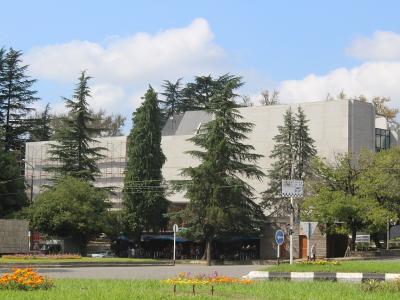
Since the 2010s Shekvetili has been the entertainment centre of Guria: here are the amusement park Tsitsinatela, the 10,000-seat concert hall Black Sea Arena opened on 31 July 2016, the largest in the South Caucasus, and beside it the Musicians' Park with sculptures of Georgian and foreign musicians, the Miniature Park with open-air scale models of Georgia's architectural monuments, and the Shekvetili Dendrological Park opened on 15 July 2020: 60 hectares, of which 18 are given to trees endemic to Georgia and 42 to exotic woody plants brought from five continents, created by Bidzina Ivanishvili, whose transplanting of century-old trees from the Georgian coast drew protests from environmentalists.
- Access notes
- The S2 highway bounds the village on the east; the nearest station is Kvemo Natanebi, 3 kilometres away
- Safety notes
- Avoid bathing at the mouth of the Natanebi; do not cross the highway on foot except at the crossings
History
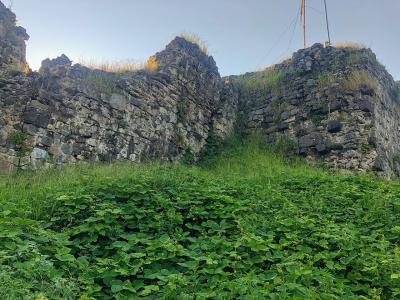
In the eighteenth century Shekvetili was one of the important trading posts of western Georgia: from 1723 an Ottoman garrison held its fort, it appears on the map of the Kingdom of Imereti of 1737, and in 1788–1792 Simon III Gurieli granted its customs to the Nakashidze family. By the Treaty of Bucharest of 1812 Shekvetili passed under the Russian Empire, with the Ottoman border running just to its south; in 1813–1814 Mamia V Gurieli built Fort St Nicholas at the mouths of the Natanebi and the Choloki, Shefketil to the Turks, a centre of fishing and of trade in maize and Gurian timber. In the war of 1828–1829 the fort was a base for operations into "Turkish Guria": on 15 October 1828 General Karl Hesse beat the Ottomans at Shekvetili, and on 5 March 1829 with 1,200 Russian regulars and 1,500 Gurian militiamen he stormed the fortified Ottoman camp at Limani. In 1833 Dubois de Montpéreux saw 5–6 cannon and one wooden tower here, with Ottoman ships from Batumi and Trebizond calling for boxwood. In the Gurian uprising of 1841 the rebels held the fort from 10 August to 13 September.
In the Crimean War, on the night of 15–16 October 1853, up to 5,000 Ottoman regulars and bashi-bazouks under Hasan Bey Tavdgiridze stormed Fort St Nicholas, defended by 500 men, Russian jaegers and 345 Gurian militiamen under Giorgi Gurieli and his son Ese; in seven hours of fighting the mortally wounded Giorgi handed command to the 16-year-old Ese, the garrison was almost wholly destroyed, and the battle opened the Caucasus front of the Crimean War. In the 1860s and 1870s a customs post worked at Shekvetili, after the annexation of Batumi in 1878 its importance fell, from the 1890s it was used for sea bathing, in 1918 Old Believers settled, and in the 1920s the fort was demolished and its stones used for a factory at Kvemo Natanebi. In 1949 a resort zone was planned on the Gurian coast and the pines planted, and in 2016–2020 the arena, the parks and the arboretum were built.
Visit info
Shekvetili is on the S2 highway, 50 minutes by car from Batumi, an hour and a half from Kutaisi and half an hour from Ozurgeti, from where minibuses also run; by train to Kvemo Natanebi station, then 3 kilometres. Entry to the Musicians' Park is free; check beach services and the hours and prices of Tsitsinatela and the dendrological park locally.
Safety
Avoid bathing at the mouths of the Natanebi and the Choloki; the highway does not divide the village from the sea, but crossing it on foot is dangerous. The summer sun and humid heat are hard, so keep to water and shade.
Tip
Walk the arboretum in the morning before the heat, among sequoias, cedars, magnolias and trees more than 300 years old; the Miniature Park is a good introduction to Georgia's monuments for children. For the summer concerts at the arena, get tickets and a room ahead.
Sources
Nearby places
All places in the region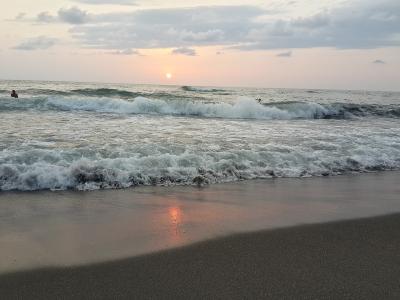
Nearby settlements