


Abrskil Cave
Link copied
A karst cave of nearly two kilometres near the village of Otap, in the southern foothills of the Kodori range: an underground river, halls up to 40 metres high hung with stalactites and curtains, and the legend of Abrskil, the Abkhazian Prometheus, who was chained to a pillar here.
About
The Abrskil Cave, also called the Otap Cave, lies near the village of Otap in Ochamchire Municipality, in the basin of the Mokvi, in the southern foothills of the Kodori range. The entrance is 1.5 kilometres from the village at 260 metres above sea level. The cave is cut in limestones of Neogene age; from it issues the Achkytizgo stream, which joins the Otap, a right tributary of the Mokvi. It is described as the second-longest cave in Abkhazia.
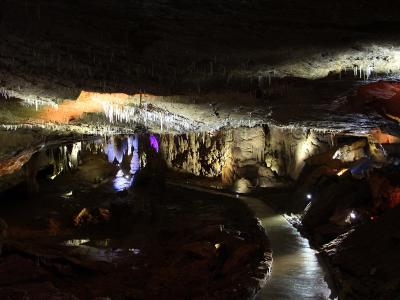
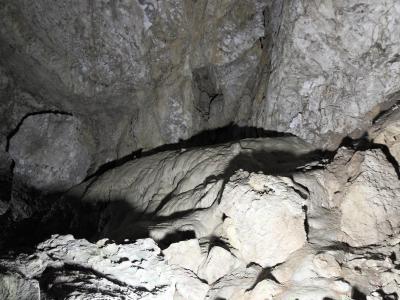
The cave is an underground valley of nearly two kilometres, and up to three with its branches; between 1.5 and 1.7 kilometres of it are open to visitors. The gallery winds in many meanders and opens into several spacious halls up to 40 metres high, with stalactites, stalagmites, columns, curtains and other forms of dripstone; the Hall of Curtains, the Meander Hall and the Abrskil Hall, where by tradition the legendary hero was chained to a giant stalactite, are famed for their beauty. Some halls hold deposits of clay; 360 metres from the entrance bones of a cave bear, including a skull, were found. The halls are lit, and at the entrance stand a waterfall and the towers of the Abkhazian Wall.
The cave is named after Abrskil, the hero of the Abkhazian epic, a god-fighter akin to the Greek Prometheus and the Georgian Amirani. In the legend the hero, born of a maiden, defied God, roamed freely between the mountains and the sea on his horse Arash and protected the people; God's servants made his horse slip on slippery ox-hides spread by the shore, seized him and chained him with the horse to a pillar in this cave. For seven days and nights the chained hero tried in vain to break free; then a bird perched on the pillar; he struck at it with his hammer, the hammer stuck fast in the pillar, and so Abrskil remained in the cave for ever.
History
The tale of Abrskil belongs to Abkhazian folk tradition, and the cave takes its name from it. Its geographical and speleological description was given by Levan Maruashvili in 1963 in the first volume of "Caves and Grottoes of Georgia", in his survey of the karst belt of western Georgia. The cave was later lit and fitted out for visitors.
On 6 June 2010 the de facto leader Sergei Bagapsh visited Otap and the cave and pledged help in restoring the tourist route; the cave is supplied with electricity by the company Chernomorenergo, and the income of the village depends largely on the cave's visitors. Because of the occupation Georgia cannot study the monument.
Visit info
Otap lies north-east of Ochamchire, up the Mokvi valley; the cave entrance is 1.5 kilometres from the village. The Achkytizgo stream flows out of the cave. Check opening hours, prices and tour arrangements locally.
Abkhazia is an occupied territory. Under Georgian law entry to the region is lawful only through the Enguri crossing; entry from Russia is a breach of Georgian law. Check the current conditions of movement before travelling.
Safety
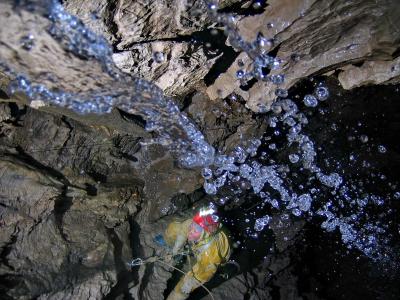
A stream runs through the cave, so expect a wet and slippery floor. Do not fall behind the group or enter unlit side passages. Consular assistance in the occupied territory is limited.
Tip
It is cold inside at any time of year, so take a jacket and spare socks. For photographs inside you will need a tripod or a high ISO. The cave fits into one day with the cathedrals of Mokvi and Ilori.