



Bedia Cathedral
Link copied
Photograph: Leonrid (CC BY-SA 4.0), Public domainPublic domainfalsefalse This work is in the public domain in its country of origin and other countries and areas where the copyright term is the author's life plus 100 years or fewer. You must also include a United States public domain tag to indicate why this work is in the public domain in the United States. This file has been identified as being free of known restrictions under copyright law, including all related and neighboring rights. https://creativecommons.org/publicdomain/mark/1.0/PDMCreative Commons Public Domain Mark 1.0falsefalse (Public domain), Giorgi Barateli (Public domain), Фото переснято И.Е.Алексеевым 5 октября 2010 г. (Public domain)
An episcopal cathedral in the village of Bedia consecrated in 999 by Bagrat III, the burial place of the first king of united Georgia and of his mother Gurandukht, with three layers of frescoes, asomtavruli inscriptions and the ruins of the palace of the metropolitans of Bedia.
About
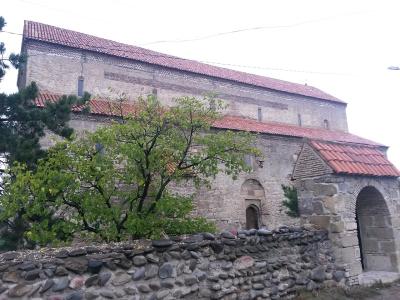
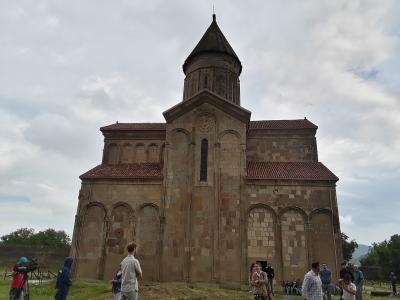
The cathedral of the Mother of God at Bedia stands in the centre of the village of Bedia, 25 kilometres from Ochamchire. In Georgia's administrative division the village belongs to Gali Municipality of the Autonomous Republic of Abkhazia (Georgian encyclopaedic sources assign it to Ochamchire Municipality; in the de facto administration it lies in Tkvarcheli district). The monastic complex was enclosed by a wall and, besides the cathedral, comprises the bell tower and the remains of the two-storey palace of the metropolitans of Bedia.
The cathedral is a cross-domed building of the inscribed-cross type: a cross set within a rectangle, its eastern arm ending in an apse and the others rectangular. The dome rested on the walls of the sanctuary to the east and on two free-standing piers to the west; the fourteen-sided dome and its drum have collapsed. Over the northern and southern aisles runs a gallery. The façades are faced with dressed sandstone and were decorated with carved portals, window surrounds and cornices; some of the carved blocks now lie inside the church or on the ground. On the façades, in the frescoes and on church objects survive inscriptions in the asomtavruli script that record the building and its renewals.
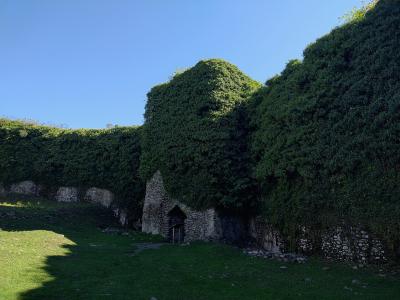
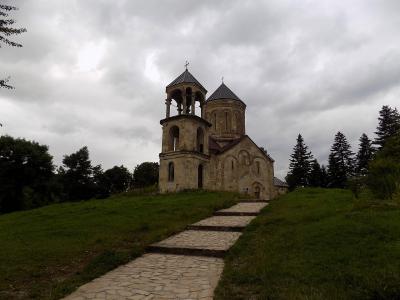
The interior holds three layers of painting, of the tenth–eleventh, thirteenth–fourteenth and sixteenth–seventeenth centuries; on the south wall are portraits of Bagrat III and of members of the Dadiani house. 50–100 metres west of the cathedral are the ruins of the metropolitans' palace: a lower floor of vaults and columns that held the refectory and an assembly hall, and an unfinished upper floor where the bishops lived; the bell tower adjoins the palace on the north, and its ground floor is the gateway to the precinct. The Bedia chalice, with chased inscriptions of King Bagrat and Queen Gurandukht, also comes from here.
- Century
- Consecrated in 999; the present building dates from the 13th–14th centuries
History
By the historical sources the Bedia complex was built at the close of the tenth century, around 999, by Bagrat III, king of the Abkhazians and then the first king of united Georgia. He made the church "a cathedral and a bishop's seat", endowed it with many villages, adorned it "with every ornament" and was finally buried here; his mother Queen Gurandukht is buried at Bedia too. Bagrat's building survives at foundation level and has been partly studied by archaeologists; the present church was rebuilt at the turn of the fourteenth century with the carved blocks of its predecessor and altered again in the fifteenth. The bell tower is of the twelfth to fourteenth centuries; its western façade bears a fourteenth-century inscription naming Giorgi Dadiani and King Constantine.
In the Middle Ages the see of Bedia was one of the most important ecclesiastical and cultural centres of Georgia. David the Builder gave Simeon, archbishop of Bedia, the honorary title of Bedieli-Alaverdeli, underlining the unity of the churches of western and eastern Georgia. In the fifteenth and sixteenth centuries Metropolitan Anton Zhuanisdze built the palace and founded a rich library where manuscripts were restored and theological works translated. Services ceased in the seventeenth century and resumed in the second half of the nineteenth; by the end of that century the church stood overgrown, most of the dome still intact, but at the beginning of the twentieth century Russian monks, in the name of "renewal", took the damaged dome down entirely.
In 1968–1969 the palace was partly restored. On 7 November 2006 a decree of the President of Georgia listed the Bedia monastery as an immovable cultural monument of national significance. Canonically the cathedral belongs to the Bichvinta and Tskhum-Abkhazeti eparchy of the Georgian Orthodox Church; as of 2022 no services are held, and the monument is neglected and in need of restoration.
Visit info
The cathedral stands in the centre of the village of Bedia, 25 kilometres from Ochamchire. No services are held and the monument is neglected; the dome is gone, and the frescoes survive in fragments. Check access locally.
Abkhazia is an occupied territory. Under Georgian law entry to the region is lawful only through the Enguri crossing; entry from Russia is a breach of Georgian law. Check the current conditions of movement before travelling.
Safety
The building has lost its dome and is in need of restoration: do not climb the walls or the gallery, and watch for carved stones lying on the ground. Consular assistance in the occupied territory is limited.
Tip
Look for the carved portals and window surrounds, the carved blocks moved inside the church, and the asomtavruli inscriptions; take a torch for the frescoes. Do not miss the palace ruins and the bell tower to the west. The cathedral of Mokvi and the church of Ilori are each about an hour's drive away.
Sources
Nearby places
All places in the region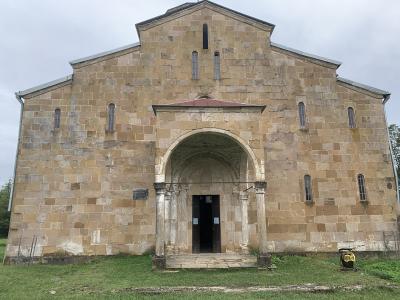
Places of the same kind
Cathedral — all places
Nearby settlements