



Krubera Cave
Link copied
Photograph: Yuri Kasyan (CC BY-SA 4.0), PJakopin (CC BY-SA 4.0), Enrique Baquero (CC BY-SA 3.0)
One of the deepest caves on Earth, and since 2024 again the deepest: a system of shafts and galleries 2,224 metres deep in the Arabika karst massif, discovered by Georgian speleologists in 1960 and named after Alexander Kruber, and taken below two kilometres for the first time by Ukrainian cavers in 2004.
About
The Krubera Cave, also called Voronya (Crows') Cave, lies in Gagra Municipality in the high-mountain karst massif of Arabika, on the Berchil ridge at the head of the Ortobalagan trough. The main entrance is at about 2,250–2,320 metres above sea level. It is a karst cavity of sub-vertical type, a chain of shafts joined by climbs and galleries, cut in Lower Cretaceous and Upper Jurassic limestones; the deepest vertical pitches are 115, 110 and 152 metres. At 200 metres the cave divides into two main branches, the Nekuibyshevskaya (1,697 metres) and the main branch, which from 1,300 metres splits into many others; in the bottom section there are more than eight sumps between 1,400 and 2,144 metres, and below 1,600 metres the limestone is black. The cave's waters are thought to drain through the Reprua and Agepsta springs, which rise on the beach at Gagra, and through submarine springs. Inside are miniature stalactites, stalagmites and curtains, streams and small lakes; the fauna includes wingless arthropods found only here, Plutomurus ortobalaganensis among them, and the stygobiont amphipod Kruberia abchasica.
The depth of the cave, the difference between its highest entrance (Arbaika) and its deepest explored point, stood at 2,224 metres as of August 2024. In 2015 the Krubera system was connected with the neighbouring Kuybyshevskaya cave, and the united system, with five entrances, was named Krubera-Voronya-Arabikskaya. The Arabika massif is bounded on the north and east by the deep canyons of the Sandripsh, Kutushara, Gega and Bzyb; the river Bzyb divides it from the Bzyb massif, home of the Snezhnaya abyss (1,753 metres).
- Access notes
- Closed to tourists; speleological expeditions only. The entrances lie in the Ortobalagan trough on the Arabika massif at 2,250 metres
- Safety notes
- Vertical shafts of hundreds of metres and sumps; entry only for experienced, equipped teams
History
The cave was discovered in 1960 by a speleological expedition of the Vakhushti Bagrationi Institute of Geography led by Levan Maruashvili, which explored it to 95 metres (by another account, in 1963 by Shalva Kipiani's group, to 57 metres); it was named after Alexander Kruber, the founder of Russian karst studies, and entered in 1966 in the "Cadastre of the Karst Caves of Georgia" by Kipiani, Tintilozov, Okrojanashvili and Jishkariani. In 1968 the forgotten cave was explored to 210 metres by cavers from Krasnoyarsk, who called it "Siberian", and in 1982–1987 Kyiv cavers reached 340 metres and named it Voronya after the crows nesting in the entrance pit; only later did it emerge that all three groups had been exploring the same cave. After the war of 1992–1993 the massif was closed to speleologists for years.
Work resumed in August 1999, when the Kyiv team reached 700 metres in a single expedition; in 2000 it reached 1,410 metres, and in January 2001 an expedition of the Ukrainian Speleological Association with Moscow cavers set a world record at 1,710 metres. In August 2004 came 1,840 metres, and on 19 October the two-kilometre mark was passed for the first time in the history of speleology, at 2,080 metres. In the following years the rival teams Cavex and the Ukrainian association dived the sumps at the bottom: Gennadiy Samokhin of Simferopol reached 2,191 metres in 2007 and 2,197 in 2012–2013. In 2014 a Moscow University team, climbing up from 230 metres, found a new entrance, Arbaika, three metres above the main one, and in 2015 the system was connected with the Kuybyshevskaya cave. In August 2017 the title of deepest cave passed to Veryovkina Cave (2,212 metres) in the same massif; in August 2024 the bottom of Krubera was measured at 2,224 metres and the record returned to it.
Visit info
The cave is not a tourist site: the entrance lies at 2,250 metres on the Arabika plateau, and only speleological expeditions with multi-day camps enter the cave itself. All that is open to the amateur is the landscape of the Ortobalagan trough and the entrance pits, and even that needs a guide and high-mountain equipment.
Abkhazia is an occupied territory. Under Georgian law entry to the region is lawful only through the Enguri crossing; entry from Russia is a breach of Georgian law. Check the current conditions of movement before travelling.
Safety
The entrance pits are hundreds of metres deep: keep away from the edges. Weather on the plateau changes fast, and the karst funnels are dangerous in fog. The cave is entered only as part of an expedition, with full equipment and a rescue plan. Consular assistance in the occupied territory is limited.
Tip
The cave's story can be followed without going there: the photo reports of the Ukrainian Speleological Association's expeditions and the 2005 documentary "Speleology. Journey to the Centre of the Earth" show the descent to the bottom. Most expeditions have gone down the cave in summer and early autumn.
Sources
Nearby places
All places in the region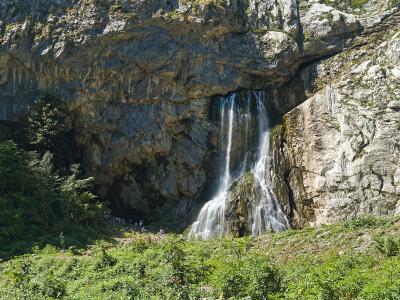
Places of the same kind
Cave — all places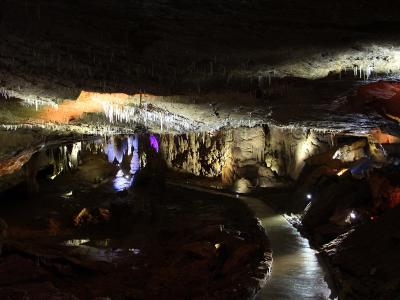
Nearby settlements