



Mokvi Cathedral
Link copied
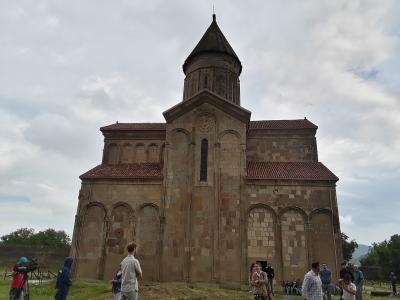
Photograph: Leonrid (CC BY-SA 4.0)
A cathedral built in 957–967 by Leon III, king of the Abkhazians, in the village of Mokvi: the seat of the bishops of Mokvi, a centre of Georgian letters from which the Mokvi Gospels of 1300 come, and the family burial place of the Shervashidze princes.
About
The cathedral of the Dormition of the Mother of God at Mokvi stands in the village of Mokvi, in Ochamchire Municipality. It is a cross-domed building whose side aisles are flanked by rows of chapels, so that it is also described as five-aisled; on the east it has three projecting apses. The central apse of the sanctuary is horseshoe-shaped inside and five-sided outside. The dome rests on four piers raised in the centre of the building, the transition from the square to the drum is made by pendentives, and the twelve-sided drum is low. The building is faced with dressed stone; the façades are plain, without any carving, and the smooth surfaces are divided only by the two tiers of windows.
The cathedral had a rich library, and the manuscripts that have come down from it keep the names of those who worked at Mokvi. The most precious is the Mokvi Four Gospels, copied in 1300 by the monk Ephrem at the behest of Daniel, bishop of Mokvi. The church was rich in inscriptions too, but today only the inscription on the bell tower survives. Inside, before the sanctuary, lie the white marble tombstones of the family of Mikhail Shervashidze, the last prince of Abkhazia, among them those of Alexander Shervashidze and his wife Alexandra Dadiani, with inscriptions in asomtavruli. In the 1980s fragments of painting, presumably of the fifteenth century, and many Georgian inscriptions were found in the church.
- Century
- Third quarter of the 10th century (957–967)
History
The cathedral was built in the third quarter of the tenth century, in the reign of Leon III, king of the Abkhazians (957–967); the king was buried in it in 967. The see of Mokvi was founded in the tenth century, and from the thirteenth century especially Mokvi rose to be one of the most important centres of Georgian culture: here worked the bishops Grigol, Daniel and Abraam of Mokvi, Eptvime Sakvarelidze, Pilipe Chkhetidze and others, who copied manuscripts and renewed old codices. In the time of David IV the Builder (1089–1125) the cathedral was thoroughly repaired and painted: in 1659 Dositheos II, patriarch of Jerusalem, visiting Mokvi, saw a now lost inscription linking the renewal with the reigns of the Byzantine emperor Alexios I Komnenos and of David; no trace of the painting of that time remains. The bishop of Mokvi held the see until at least the seventeenth century.
By the end of the seventeenth century the cathedral stood abandoned. In 1848 Marie-Félicité Brosset described it; in the 1850s it was repaired and made the burial place of the Shervashidze, princes of Abkhazia, and the last prince, Mikhail Shervashidze, was buried here. On 7 November 2006 a decree of the President of Georgia listed the cathedral as an immovable cultural monument of national significance. Since 2019 services have been held in it by a church body not recognised by the Georgian Orthodox Church. Because of the occupation Georgia can neither study nor maintain the monument.
Visit info
Mokvi lies north-east of Ochamchire. The church is in use and open to visitors; the interior is remarkable for its size, and the tombstones lie before the sanctuary.
Abkhazia is an occupied territory. Under Georgian law entry to the region is lawful only through the Enguri crossing; entry from Russia is a breach of Georgian law. Check the current conditions of movement before travelling.
Safety
Dress rules are observed in the working church. Consular assistance in the occupied territory is limited.
Tip
Besides the cathedral itself, look for the inscription on the bell tower, the only one of the church's inscriptions that survives. Ilori lies about 22 kilometres by road from Mokvi, some 40 minutes' drive, and Bedia about 15 kilometres beyond Ilori, so the three can be seen in one day.
Sources
Nearby places
All places in the region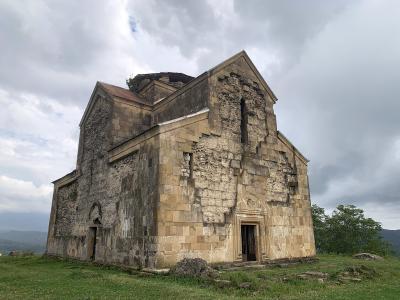
Places of the same kind
Cathedral — all places
Nearby settlements