



Anakopia Fortress
Link copied
Photograph: SKas (CC BY-SA 4.0), Hons084 (CC BY-SA 4.0)
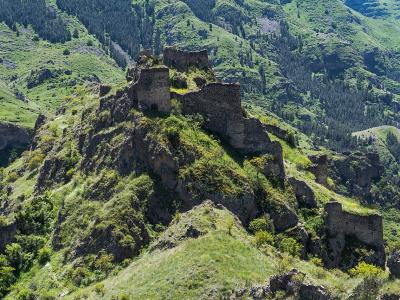
The remains of a fortified town on the summit of the Iverian Mountain above New Athos, the seat of the Abazgian eristavi in the eighth century and then of the Kingdom of Abkhazia, where the army of Marwan ibn Muhammad was turned back in 736–737.
About
Anakopia fortress stands on the summit of the Iverian Mountain (344 m) above the town of New Athos, in Gudauta Municipality; from Sokhumi it is about 22 kilometres by the coast road. It is the most completely preserved early medieval stronghold of the eastern Black Sea coast. The fortified town covered about 7 hectares; the hilltop citadel measures 450 by 150 metres.
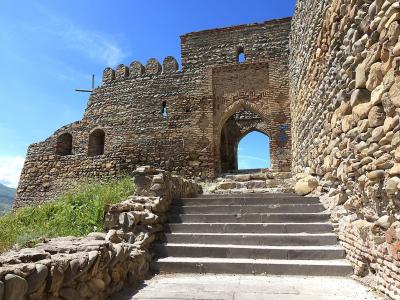
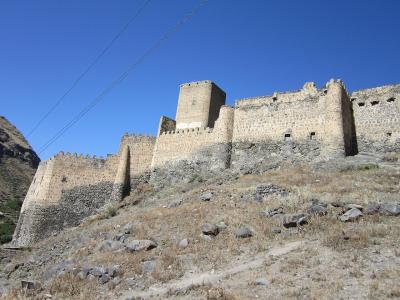
The walls are built of large, well-dressed limestone blocks. On the gentler southern slope the wall is strengthened by seven towers, square where the approach was difficult and round where siege engines could be brought up. The gate is formed of three limestone monoliths and was raised well above the ground, so that the fortress could be entered only by a wooden ladder; from the round western tower the approaches could be shot at through an arc of almost 290 degrees.
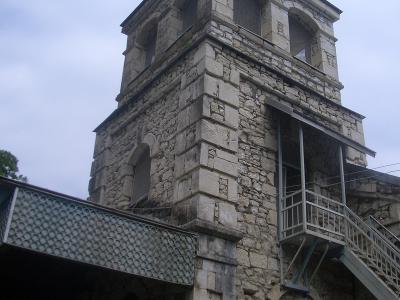
In the centre of the citadel stands the four-storey eastern tower, the last refuge and lookout of the garrison, which in its present form belongs to the middle of the eleventh century; in the fourteenth century the Genoese were also active here. Beside it is a small single-nave church of the seventh to eighth centuries, in which the stone altar and fragments of fresco with a cross and fishes survive; next to the church is a cistern believed to have been made by the builders of Anakopia, 3.9 metres deep and 5 by 3.5 metres across, which never runs dry. On the slope of the mountain are the remains of a second church.
From the tower the view opens over the Black Sea and along the coast from Cape Pitsunda to Sokhumi.
- Construction period
- Late 7th to 11th century (walls and towers), Genoese alterations in the 14th century
- Restoration notes
- The main eastern tower was restored in 2008 and serves as a lookout
History
A military post appeared on the Iverian Mountain between the second and fourth centuries, and the main wall of the citadel was raised at the end of the seventh century with the involvement of the Byzantines, alarmed by the Arab advance. In the seventh and eighth centuries Anakopia was the political centre of the Abazgian eristavate. Georgian written sources first mention it in connection with the campaign of Marwan ibn Muhammad: in 736–737 an Arab army of 60,000 men besieged the fortress, where the kings of Kartli, Mir and Archil, had taken refuge with Leon, eristavi of the Abkhazians. According to the Georgian chronicle the fortress was held by 1,000 Kartlians and 2,000 Abkhazians; an epidemic in the Arab camp killed 35,000 men, 3,000 fell in the assault, and Anakopia was not taken. The defence is counted among the turning points in the history of the region.
From the end of the eighth century Anakopia was the chief town of the newly formed Kingdom of Abkhazia and kept its importance after Kutaisi became the capital; after the unification of Georgia it was, in the words of the chronicle, "the foremost of the fortresses of Abkhazia". In 1032 the Byzantines took the fortress, and in 1074 it returned to Georgia. From the fourteenth century the town declined; in the fourteenth and fifteenth centuries the Genoese built a fort at the mouth of the Psyrtskha and founded a trading post, and in the seventeenth Levan Dadiani, prince of Samegrelo, walled Anakopia round. Vakhushti Bagrationi describes it as a fine town built out over the sea, whose columns "are still visible in the water".
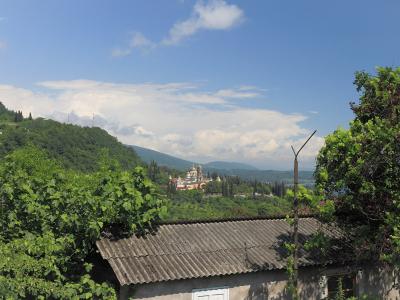
In 1875 the New Athos Monastery was founded beside the ruins; at the end of the nineteenth century the monks laid a stone-paved road up the mountain and terraced its slopes. Excavations of 1957–1958 under M. Trapsh uncovered the towered wall, the basilica, the well, dwellings and farm buildings of the seventh to twelfth centuries, a lime kiln, glass and clay vessels and traces of a Hellenistic settlement. The eastern tower was restored in 2008.
Visit info
The fortress is reached on foot from New Athos by the stone-paved serpentine road laid by the monks; the climb takes about an hour. The site is a protected area and admission is charged. The tower is open as a viewing platform.
Abkhazia is an occupied territory. Under Georgian law entry to the region is lawful only through the Enguri crossing; entry from Russia is a breach of Georgian law. Check the current conditions of movement before travelling.
Safety
Keep away from the edges of the walls and the tower and hold children by the hand; take care on the stone-paved road after rain. Consular assistance in the occupied territory is limited.
Tip
In summer climb early in the morning or towards evening, when it is cooler. Take water with you. The fortress, the monastery and the cave can be seen in one day.
Sources
Nearby places
All places in the region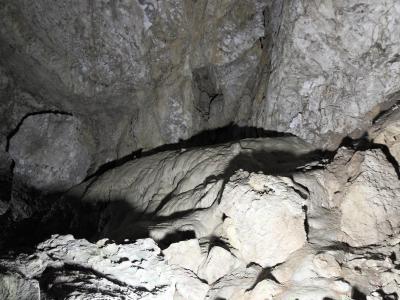
Places of the same kind
Fortress — all places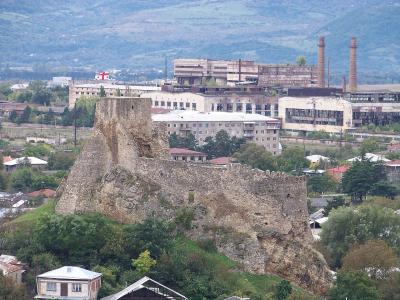
Nearby settlements