



Surami Fortress
Link copied
Photograph: Jaba1977 (CC BY-SA 4.0), Yasuhiro Kojima (CC BY-SA 2.0), Lika Kharazishvili (CC BY-SA 4.0), Grigory Gagarin (Public domain)
A medieval fortress on a rocky hill in the northern part of the town of Surami in Khashuri municipality, on the left bank of the Suramula, where the road west over the Likhi passes met the road south through the Borjomi gorge. Its origins are uncertain: modern historians date it to the eleventh–thirteenth centuries and link it with the Surameli, the dukes of Kartli; the fortress was thoroughly repaired in the sixteenth century and rebuilt in the seventeenth and eighteenth. Fought over by Georgians, Persians and Ottomans, it is best known for the legend of Zurab, the only son walled up alive so that the fortress would stand, a story that Daniel Chonkadze turned into a novella and Sergei Parajanov into a film.
About
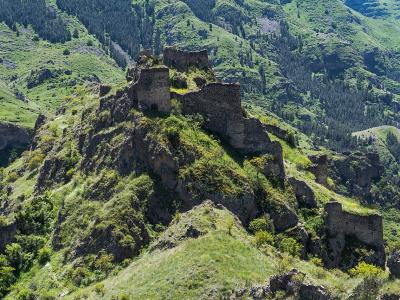
Surami Fortress stands on a rocky hill in the northern part of the town of Surami in Khashuri municipality, on the left bank of the Suramula river. It guarded the meeting of two main roads: one led west over the passes of the Likhi range, the other south through the Borjomi gorge. Prince Vakhushti wrote of it: "in the middle is a fortress, on a high rock, strong". The complex brings together several buildings: the enclosure wall, the fortress proper, the church of Saint George and a palace; in the past a tunnel also linked the fortress with a cave on the Suramula, so that water could be brought up safely in wartime.
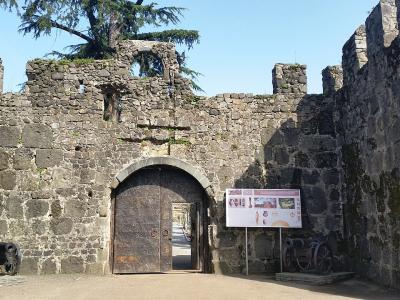
The enclosure wall follows the relief and has a complex outline, because its builders used every part of the rocky cape; it is built of rubble and dressed stone, and several building layers can be told apart. The entrance is in the middle of the north wall, where steps are cut into the rock, and the upper part of this stretch has narrow gun loops. The western part of the wall is destroyed: only a stretch 8 metres long and 2 metres high survives, against which the palace was built on the side of the yard, and this stretch was restored in the 1980s. On the east the enclosure takes in the wall of the inner fortress, which is less damaged; by legend it is in this very wall that Zurab was built in. The battlements of the original wall are roughly made and unevenly spaced, while those of the later walls are frequent, narrow and rounded and evenly set.
The fortress covers 1,200 square metres and is in two parts: the inner fortress, or citadel, which takes up the top of the hill, and the lower yard on its slopes. The citadel is an irregular polygon in plan (52.4 × 29.3 metres) made up of a wall and a pyramidal tower (21.2 × 12.7 metres); its ground is covered with ruins. Only two storeys of the tower had survived, but at the end of the 1980s it was restored and the whole tower was rebuilt, together with the west and east walls of the fortress. The tower is entered from the yard, its second storey has narrow windows in its thick walls, and the building is faced with dressed stone.
The church of Saint George was built in the eleventh–twelfth century and stood in the south-eastern part of the lower yard, set directly on the rocky cape. It is a hall church of dressed stone (5.9 × 6.1 metres) with two doors, on the west and north; a wide arch divided it into two equal parts, the southern ending in an apse and the northern rectangular, both covered by a single barrel vault. Inside were damaged fragments of medieval painting: the Deesis in the conch with the figure of the Mother of God, the Communion of the Apostles below it, the Ascension on the vault, the Raising of Lazarus on the west wall and angels' wings in the vault of the north nave, small figures drawn in a graphic manner in reddish-brick, dark blue, reddish-brown, greyish-white and yellow. The earthquake of April 1991 brought down the whole roof of the church and destroyed the surviving painting. On the north side is a small vaulted annex (2 × 3 metres), entered from the west. In 2015 a scientific expedition found on the church a seven-line asomtavruli building inscription, dated by its script to the fifteenth–sixteenth century: it says the church was built for the souls of Giorgi Ghaghanidze and Tamar Kvabulisdze, their parents and their descendants. The palace stood in the southern part of the lower yard; it is badly damaged, and only the ruins of two vaulted storeys remain, with deep niches and fragments of arches in the east wall.
- Construction period
- Origins uncertain: modern historians date it to the eleventh–thirteenth centuries; thoroughly repaired in the second half of the sixteenth century, the other parts rebuilt in the seventeenth and eighteenth centuries
- Material
- Rubble and dressed stone; the tower faced with dressed stone
- Restoration notes
- At the end of the 1980s the tower and the west and east walls of the fortress were restored; the earthquake of April 1991 brought down the roof of the church of Saint George and destroyed its painting
History
When and by whom Surami Fortress was built is not known, and Georgian historical sources are silent on the matter. By the nineteenth-century historian Platon Ioseliani, Surami and its fortress were built by King Parnajom in the first half of the second century BC, 200 years before the birth of Christ, a dating that no one else in Georgian historical scholarship gives. The seventeenth-century Turkish traveller Evliya Çelebi linked the building of the fortress with the Persian king Khosrow I Anushirvan (531–579), and the Persian historian Iskandar Munshi credited it to Shah Abbas in the second decade of the seventeenth century, which more likely means a repair: the shah's court historian Malik Shah-Husayn Sistani writes that at that time the fortresses of Gori, Surami and others were put in order. Modern Georgian historians hold that the present fortress was built at the beginning of developed feudalism, in the eleventh century; it is also linked with the Surameli family, who ruled the duchy of Kartli in the twelfth–thirteenth centuries and whose residence it is thought to have been, and from the 1170s to the late fourteenth century Surami was the hereditary fief of these dukes.
In Georgian historical sources the fortress appears as a strategic point from 1625, when Giorgi Saakadze fortified it to defend himself against the Persians. Evliya Çelebi described it as a small fortress on a hill but an extremely strong one, whose towers and walls reached the sky, and called it one of the oldest fortresses of Georgia; the French traveller Jean Chardin, who was in Georgia in 1672–1673, wrote that near the small town of Surami stood a large, well-built fortress with a garrison of a hundred men. After it was rebuilt under Rostom, the Safavid-appointed king of Kartli, Iranian soldiers garrisoned it. In the sixteenth–eighteenth centuries great battles were fought around Surami, which lay in the sphere of interest of both the Ottomans and Persia: in 1692 the fortress was in Turkish hands, and from 1701 it was held by Prince Vakhtang.
The middle of the eighteenth century was a hard time for the fortress. In the uprising of 1742–1745 against the Qizilbash, Surami became the main stronghold of Givi Amilakhvari, head of the banner of Upper Kartli: the Ottomans helped him to strengthen it, while Persia tried to seize it quickly. After a long fight and negotiations at Surami, Amilakhvari would trust only Queen Tamar: when she came to Surami he left the fortress and followed her to Tbilisi, and King Teimuraz II obtained Nadir Shah's pardon for him. Not trusting the Georgians, however, the shah ordered Amilakhvari's fortresses to be pulled down, and Surami was demolished together with the fortress of Kekhvi. It was restored in 1756, when Erekle II was holding Tamaz, the mouravi of Kiziki, prisoner here. The fortress stayed in Georgian hands until 1783, held now by the Chkheidzes of Itria and now by the Murvanishvilis of Surami, and in 1764 King Erekle temporarily handed it, together with the fortress of Osiauri, to the Tarkhanovs.
After the Treaty of Georgievsk a Russian garrison was stationed here, alongside Georgian guards, to defend the kingdom's western border; it was withdrawn in 1787, when a new Russo-Turkish war broke out. In Erekle II's testament of 1791 Surami is again named among the chief fortresses of Georgia. In the last two decades of the eighteenth century it was one of the main strongpoints against the Lek raids in Upper Kartli, and records from after 1801 and from the following decades show the fortress still in use. After the annexation of the Akhaltsikhe region in 1829 the border moved far away, and Surami Fortress gradually lost the purpose for which it had been built on this spot.
Since old times a legend has told that the fortress cannot be taken because a mother's only son is walled up alive in it. However often it was built, the fortress fell down, and to make it stand Zurab, his mother's only son, had to be built into it; on the side where Zurab was immured, they say, his mother's clear tears still seep out drop by drop, and on every moonlit night a woman wrapped in black comes out by the fortress and cries to the ruins: "Fortress of Surami, I look on you with longing: my Zurab is in there, keep him well". On this legend Daniel Chonkadze wrote "The Surami Fortress", and the Surami writer Davit Suliashvili his long story "Zurab's Fortress". Similar legends are told of Minda Fortress in Racha, of Sighnaghi fortress, the Church of St George of Ilori and the Kelasuri Wall, and specialists count the victim built into a wall among the wandering plots of world folklore. Two feature films were made from Chonkadze's story: the first in 1922 by Ivane Perestiani, with Eugene Lanceray and Valerian Sidamon-Eristavi as its designers, and the second by Sergei Parajanov, with Veriko Anjaparidze and Sofiko Chiaureli in the cast, a film that won prizes at many festivals.
Visit info
The fortress is in the northern part of the town of Surami: by road it is about 6 kilometres from Khashuri, 57 kilometres from Gori and 135 kilometres from Tbilisi. Surami lies on the southern slopes of the Likhi range. The fortress is an open ruin on a rocky hill climbed by steps cut into the rock; check opening hours and any entry fee locally.
Safety
The hill is rocky and the way to the entrance climbs steps cut into the rock, and inside much of the ground is covered with ruins: wear shoes with a good grip, keep children close and do not climb on the walls and battlements.
Tip
Look at the battlements: beside the rough, unevenly spaced merlons of the original wall stand the narrow, rounded, evenly set ones of the later walls. Find the east wall of the inner fortress, which legend links with Zurab, the restored pyramidal tower and, in the lower yard, the remains of the church of Saint George and of the palace. The town also has the church complex of the Mother of God of the sixteenth–seventeenth century and the house museum of the Ukrainian poet Lesya Ukrainka, who spent the last months of her life in Surami.
Sources
Nearby places
All places in the region
Places of the same kind
Fortress — all places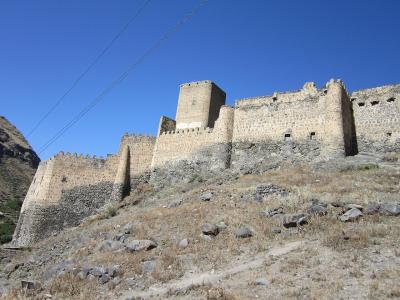
Nearby settlements