



Khertvisi Fortress
Link copied
Photograph: Soghomon Matevosyan (CC BY-SA 4.0)
A medieval fortress by the village of Khertvisi in Aspindza municipality, on a high rocky cape where the Paravani flows into the Mtkvari: one of the oldest fortresses in Georgia, it remained in use throughout the feudal age. Its tower and enclosure wall were built in 1354–1356, and a small church of Saint George stands in its western part. Since 2007 Khertvisi Fortress has been on the UNESCO tentative list together with Vardzia.
About
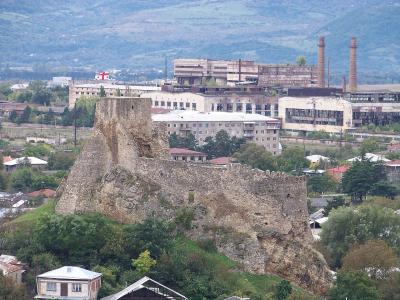
Khertvisi Fortress stands by the village of Khertvisi on a high rocky mountain in a deep valley, where the Paravani river flows into the Mtkvari. Its name says as much: it goes back to the khanmeti period of the Georgian language and means the confluence (kh-ertvis). The fortress seems to grow out of the cliff, and it is hard to tell where the rock ends and the wall begins. Khertvisi lay on an important highway and controlled two valleys, and the settlements of the country around the Paravani and the Mtkvari were subject to it.
The plan of the fortress follows the outline of the rocky cape, and its walls are built of rubble stone. Most of it is taken up by the citadel, which repeats the natural shape of the long rock, has several powerful towers built into it and cannot be approached from the north-east. A lower yard surrounds the citadel on the south and east; on the south, towards the Mtkvari valley, there was also a second line of the enclosure wall, part of which has been restored. Water reached the fortress through a tunnel cut to the north-west. Khertvisi was not only a stronghold: the feudal lords also had a residence here. Its owners kept renewing and rebuilding it, so it is hard to assign it to a single age: the fortress is made up of many building layers, from an early period up to the nineteenth century, and its main buildings date from the tenth–fourteenth centuries.
In the western part of the fortress, on a small square on the site of an older church, stands the hall chapel of Saint George, built of dressed tuff blocks. It measures 2.7 × 4.3 metres outside and has a single entrance on the west. The lower part of the apse and the floor of the sanctuary, raised by one step, are cut into the rock. The façades are plain, with a shelf-like cornice, and the roof is covered with tiles. The east façade rises on the rock, and in its lower part a fragment of the masonry of the older church can be seen.
- Construction period
- Main buildings of the tenth–fourteenth centuries, small additions of the sixteenth–eighteenth
- Material
- Rubble stone; the church of dressed tuff blocks
- Restoration notes
- In 2017–2018 the administrative building and the visitor centre were repaired, a paved path laid, the gates restored, and water supply and a car park built; the facilities are adapted for people with disabilities
History
According to the chronicler Leonti Mroveli, who seems to have relied on oral tradition, Alexander the Great saw Khertvisi along with other Georgian fortress-towns during his eastern campaign in the fourth century BC; historical scholarship does not accept that account of the campaign. The original date of the fortress is unknown. Written records mention Khertvisi from the tenth–eleventh centuries, when it was the centre of Meskheti. In his notes to the history of Vakhushti Batonishvili, Dimitri Bakradze cites two inscriptions from the time of Bagrat III; one, dated 985, belonged to the church of Khertvisi Fortress and mentioned a "king of kings". That inscription is now considered lost. In the twelfth century Khertvisi became a town; in the thirteenth the Mongols destroyed it, and until the fifteenth century it lost its former power.
A new wall rose on the site of the old walls destroyed by the earthquake of 1283. In 1832 the Swiss traveller Dubois de Montpéreux found a long Asomtavruli inscription above the entrance of the fortress; it was first read by Marie Brosset and published in 1909 by Ekvtime Takaishvili. By the inscription, Zakaria, son of Kamkamishvili, "chief treasurer of the king of kings", began building (or rebuilding) the tower and the enclosure wall in 1354 and finished in 1356. From the end of the thirteenth century to the fifteenth the fortress belonged to the Jaqeli, lords of Meskheti, and in the sixteenth century it was held in turn by the Kamkamisdze, the Khertvisari, the Amatakiani or the Shalikashvili. A legend tells that Queen Tamar announced a contest for the finest tower at Khertvisi; a master builder was outdone by his own apprentice and in his shame leapt from the tower to his death.
In the sixteenth century the Ottomans invaded southern Georgia: in 1578 Arpaksad, son of Iotam, surrendered Khertvisi to them together with the other fortresses of Javakheti, and the fortress then became the centre of an Ottoman administrative unit. From then on the Ottomans held Khertvisi; in 1624 Giorgi Saakadze took it for a time, and in October 1771 King Erekle II did the same. During the Russo-Ottoman war of 1828–1829, on 22 September 1828, Russian troops took the fortress, and the Treaty of Adrianople gave it to the Russian Empire. After that Khertvisi, like the other fortresses of the region, lost its defensive role and remained a monument. On 24 October 2007 it was entered on the UNESCO tentative list together with Vardzia, and in 2017–2018 the site was improved.
Visit info
The fortress is by the village of Khertvisi, about 14 kilometres by road from Aspindza and about 46 kilometres from Akhaltsikhe. A footpath climbs from the village to the fortress, and there are facilities for visitors: in 2017–2018 the visitor centre was repaired and a car park built, and the facilities are adapted for people with disabilities. Check the opening hours and entry conditions on site.
Safety
The fortress stands on a steep cliff above two rivers: keep away from the edges of the walls and towers and hold children by the hand. The path and stone steps are slippery after rain, so wear shoes with a good grip.
Tip
From the fortress there is a good view of the confluence of the Paravani and the Mtkvari and of the two valleys Khertvisi controlled. In the western part, look for the little church of Saint George with its sanctuary cut into the rock. From Khertvisi the road follows the Mtkvari valley to Vardzia, about 16 kilometres away; Vanis Kvabebi and Tmogvi Fortress are on the same road.
Sources
Nearby places
All places in the region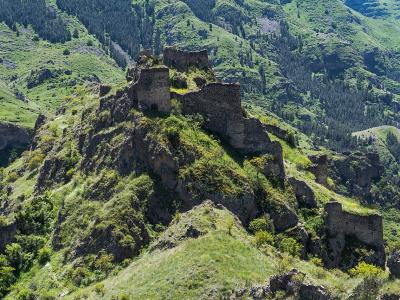
Places of the same kind
Fortress — all places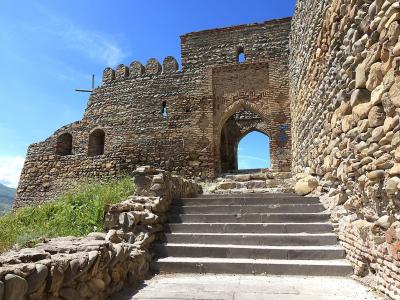
Nearby settlements