



Church of St Simon the Canaanite
Link copied
Photograph: Hons084 (CC BY-SA 4.0), Ovchinnikov dmitriy (CC BY-SA 4.0), Alaexis (CC BY-SA 2.5), Unknown author (Public domain)
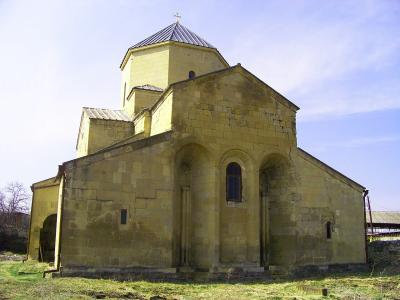
A cross-domed church of the ninth and tenth centuries in New Athos, in the Psyrtskha valley, dedicated to the apostle Simon the Canaanite, who by tradition was martyred in the grotto nearby: an episcopal seat in the age of the Kingdom of the Abkhazians, raised from ruins in the nineteenth century.
About
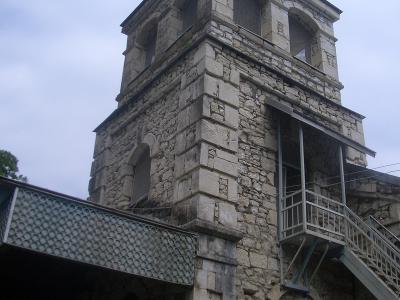
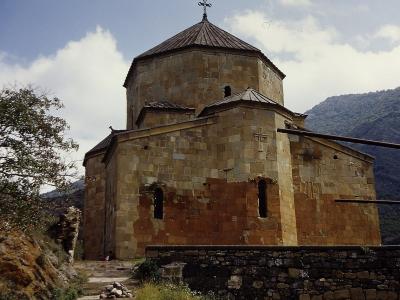
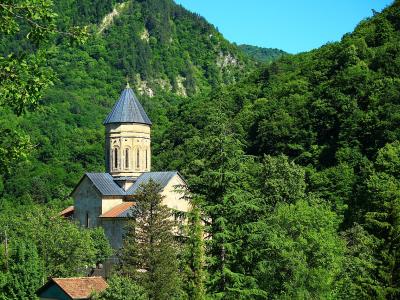
The church of St Simon the Canaanite stands within New Athos on Mount Iveria, on the left bank of the Psyrtskha. It is a three-apsed cross-domed church whose present building is an example of Georgian architecture of the ninth and tenth centuries under Byzantine and Georgian influence; an earlier church stood on the site, dated to the seventh and eighth centuries. The original porches are lost; the walls inside were plastered and painted, but the frescoes have not survived. The church is built of white dressed stone, and its architectural ornament is notable for reliefs of Christian symbols, a fish, a lion and a cross.
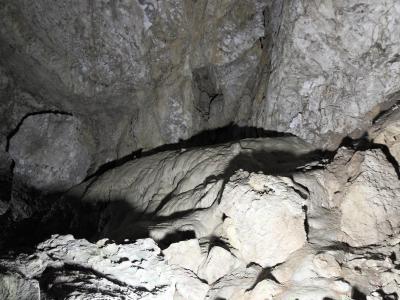
The church is dedicated to the apostle Simon the Canaanite, who according to the Georgian chronicles of the eleventh century preached in Abkhazia and Egrisi in the first century together with Andrew the First-Called, died and was buried at the town of Nikopsia near the northern border of historical Georgia; popular tradition names the grotto near the church as the place of his martyrdom. Together with the New Athos Monastery the church is one of the chief goals of pilgrims.
- Denomination
- Georgian Orthodox (canonically); held de facto by an unrecognised church body
- Century
- 9th–10th century (on the site of an earlier church of the 7th–8th); rebuilt in the 1880s
- Dress code
- Shoulders and knees covered; a headscarf for women
History
By tradition a small church, probably of wood, was built here in the fourth century in the apostle's name; in the following centuries a church of white dressed stone rose, whose present form belongs to the ninth and tenth centuries. In the age of the Kingdom of the Abkhazians the church was an episcopal seat and the burial place of the clergy of the diocese of Tskhumi: until the end of the nineteenth century a gravestone with a Greek inscription lay under the south gate, "Mother of God, save George of Tskhumi", the tomb of Metropolitan George. In the first half of the nineteenth century the church was described by the pilgrim Muravyov and other travellers; in the 1850s, when Dimitri Bakradze visited it, the church was abandoned but still standing except for the collapsed dome. The local landowner, Major Hasan Margania, took its stones to build his own house and badly damaged the building.
In August 1875, with the permission of the viceroy of the Caucasus, monks of the Russian monastery of St Panteleimon on Mount Athos arrived and on 6 September chose the site of a new monastery; it was then, before the Russo-Turkish war of 1877–1878, that the ruins of the church, overgrown with vegetation, were discovered. In the 1880s the church was rebuilt with blocks of white hewn stone and given its present form; in 1882 Grand Duke Michael Nikolaevich visited it, and in 1889 Gennady (Pavlinsky), bishop of Sukhumi, was buried here. On 7 November 2006 a decree of the President of Georgia listed the church as an immovable cultural monument of national significance; because of the occupation Georgia cannot study its condition.
Visit info
The church stands in New Athos, in the Psyrtskha valley, on the left bank of the river. Nearby is the grotto that popular tradition links with the martyrdom of Simon the Canaanite; check the conditions of entry locally.
Abkhazia is an occupied territory. Under Georgian law entry to the region is lawful only through the Enguri crossing; entry from Russia is a breach of Georgian law. Check the current conditions of movement before travelling.
Safety
Paths in the Psyrtskha valley can be slippery after rain. Dress rules are observed in the working church. Consular assistance in the occupied territory is limited.
Tip
Look for the reliefs of the fish, the lion and the cross, Christian symbols carved in the stone. The New Athos Monastery, the cave and Anakopia fit into one day.
Sources
Nearby places
All places in the region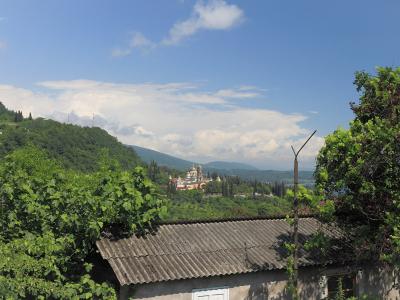
Places of the same kind
Church — all places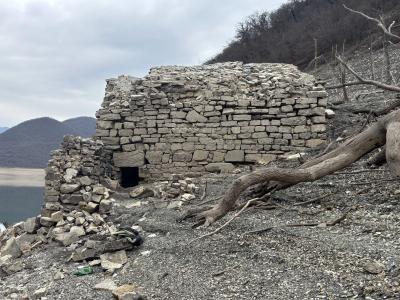
Nearby settlements