



Bakhmaro
Link copied
Photograph: Alexey Komarov (CC BY-SA 4.0), M. (CC BY-SA 4.0), Grigol (CC BY-SA 3.0)
The high mountain climatic resort of Guria in a hollow of the Meskheti range at 1,926–2,050 metres, where mountain and sea air meet: discovered in 1892 by the Ozurgeti doctor Artem Davidiants and declared a resort in 1923; wooden summer houses on stilts, a June to September season, the horse race of 19 August and sunrise from Mount Gadrekili.
About
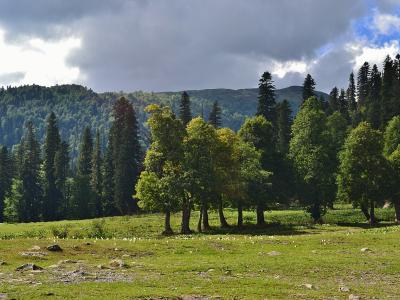
Bakhmaro is a township and high mountain climatic resort in Chokhatauri Municipality on the Meskheti range, in the valley of the Bakhvistskali at the upper edge of the forest zone, 1,926–2,050 metres above sea level, 50 kilometres in a straight line from the Black Sea, 52 from Chokhatauri and 72 from Ozurgeti, the nearest railway station. The resort lies in a hollow ringed by evergreen forest of oriental spruce, Caucasian fir and pine; the hollow is open to the west, and the warm sea breeze pushes up the valley, producing the rare mixture of mountain and sea air that is Bakhmaro's chief healing factor. Mountain and valley winds (2–3 metres a second) keep the air always clean and transparent, and the diffuse ultraviolet radiation is high. The mean annual temperature is 3.4 degrees, January's −5.2 and August's 13.4; the snow cover sometimes reaches 4–5 metres and lies for six months, from November to May; the sun shines 1,975 hours a year, 1,900 millimetres of precipitation fall, and 102 days are foggy. The resort is prescribed for non-tuberculous diseases of the respiratory organs, anaemia, neurasthenia and lymphadenitis, locals holding that 21 days are needed for the full effect, and since 1932 it has been discussed as a winter resort too, though the season today, as 150 years ago, is the month and a half or two of summer.
Bakhmaro's look is made by its low summer houses on wooden posts, roofed with shingles and wrapped in balconies, the posts raising them one and a half to two metres off the ground; by the rules in force only houses faced with wood and natural stone may be built. Above the forest come the crooked subalpine birch and rowan, then the Colchic tall herbs and the alpine meadows. By one reading of the name, "bakh" is a pass in Svan and "maro" a man; by legend the princely daughter Maro, carried off by Turks, was left stabbed for her pursuers with the words written on a stone in her own blood, "bakh Maro", "behold your Maro".
History
Bakhmaro and the 30,000 desyatinas (about 33,000 hectares) of land around it belonged to the Eristavi feudal lords of Guria, who took a "grass tax" on the cattle driven up from the Ghorjomi valley. The place was first noticed as a cure by Artem Davidiants, the district doctor of Ozurgeti: he learned from shepherds that the air of the summer pastures kept off fever, sent fever patients into the mountains of Guria in 1892 and tuberculosis patients the next year, and when they came back cured he toured the mountains himself and chose Bakhmaro, built a small house there and urged the Gurians to build summer houses. By 1894 summer houses stood, in 1895 up to a hundred holidaymakers, mostly the intelligentsia of Guria, were staying, in 1896 the ethnographer Tedo Sakhokia described a handful of houses and the land passed to the treasury. A folk theatre opened in 1899 (burnt in 1905, rebuilt in 1913), in 1900 the "Bakhmaro Consumers' Society Health" was formed, in 1908–1914 spring water was piped to the quarters, and in 1913–1917 the string orchestra of the composer Viktor Dolidze played.
In 1923 Bakhmaro was declared a resort of republican significance; in 1932–1933 Professor Gavrilenko's expedition spent a whole year at the resort with ten children and concluded that winter conditions were even more effective for treatment. By 1934 a clinic, a pharmacy and a sanatorium were working; on 16 August 1938 the first car climbed to Bakhmaro, taking 4 hours and 20 minutes from Chokhatauri. A book of 1940 set Bakhmaro above the highest resorts of Europe: St Moritz at 1,855 metres, Arosa at 1,720, Davos at 1,560, Bakhmaro at 2,050. In the late 1940s the young Eduard Shevardnadze was treated for tuberculosis here. An asphalt road was laid in the 1980s, a church built in 1997, a hotel and cinema in 2012, a new master plan approved in 2017, the power supply renewed in 2019–2021, and from 1 January 2020 Bakhmaro is a township.
Visit info
Bakhmaro is 52 kilometres from Chokhatauri, about an hour by car. From October to May the road is closed by snow. The season is June to September; lodging is in local summer houses and hotels, and transport and services are best checked locally. Walking and riding paths lead up from Vakijvari (23 kilometres), Mtispiri (28) and Khidistavi (29).
Safety
At 2,000 metres the weather changes fast, with 102 foggy days a year, and the ultraviolet radiation is high. The mountain road is steep and winding, so take care after rain, and on race day keep clear of the stream of horses and cars. Open fire is dangerous in the wooden houses.
Tip
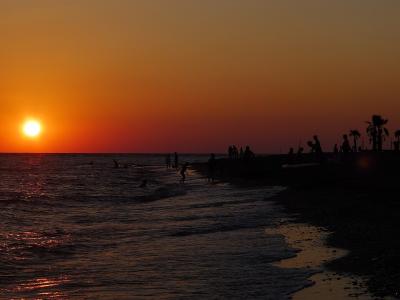
Sunrise from Mount Gadrekili and sunset from the "sunset hills" of Sakasaria are the ritual of Bakhmaro. On 19 August, the Transfiguration, the horse race that closes the season is run in the stony bed of the Bakhvistskali; arrive the day before to find a good place to watch. The mean August temperature is 13.4 degrees, so warm clothes are needed even in summer.
Sources
Nearby places
All places in the region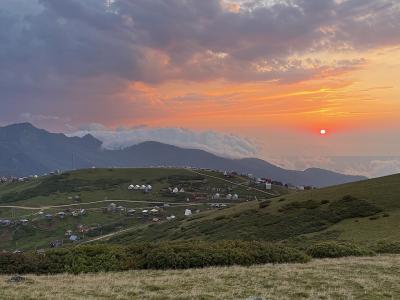
Places of the same kind
Resort — all places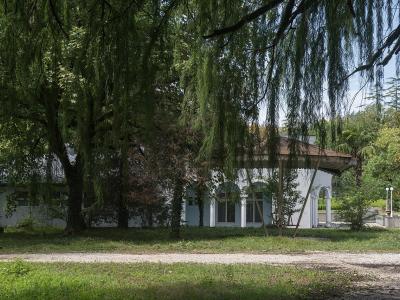
Nearby settlements