



Askana Fortress
Link copied
Photograph: Grigol (CC BY-SA 3.0), Frédéric Dubois de Montpéreux (Public domain), Anton Gogiashvili (Public domain), M. (CC BY-SA 4.0), Unknown author (Public domain), Teramo Castelli (Public domain)
"Queen Tamar's castle" on a rock of the left bank of the Bakhvistskali between the Delemuri and Tapuriati mountains: a fortress built from the fourth to the nineteenth century and never yet studied, the treasury and chief prison of the principality of Guria, with the legend of Murvan the Deaf, the Ottoman sieges of the 1770s and Sopio Gurieli's last resistance in 1828; walls 2 metres thick, a well with a tunnel to the river and a banqueting table hewn from a boulder.
About
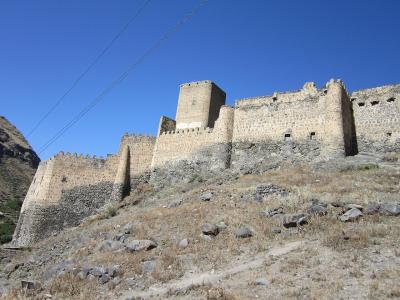
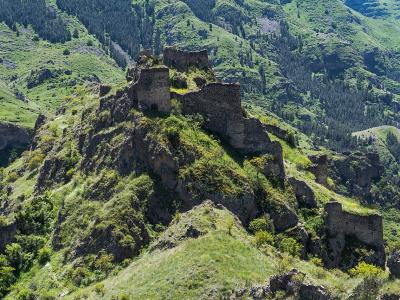
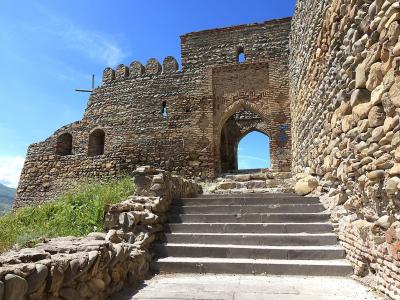
The Askana fortress, also called Queen Tamar's castle, is a fortress of the feudal age in Ozurgeti Municipality on the left bank of the Bakhvistskali in the village of Mtispiri, between the Delemuri and Tapuriati mountains, on the site of the abandoned hamlet of Tsikhisubani where bentonite clay is now quarried; it is named after Askana because Mtispiri historically belonged to the Askana community. Several building layers are distinguished in the monument, the oldest of the fourth century and the latest of the nineteenth, but no scientific expedition has ever worked at the fortress and it remains unstudied. By an account of 1833 the fortress consisted of two towers, a chapel built of red marble and several wooden huts; it is built of rubble stone and lime mortar, and the much damaged curtain walls are more than 2 metres thick and more than 6 metres high. The entrance is in the south-western part, with a deep well to its left from which a tunnel ran down to the Bakhvistskali, the well now filled with rubble. By a description of 1889 two great stone jars stood inside the fortress, one called the "water gauge", and a banqueting table of stone 4 metres high and 2 metres wide; in 1910 four huge boulders survived, three serving as water cisterns and one as a table, together with a hall and a church that still had its roof, an eastern window and painting. On the high rock stood the palace of the fortress, and beside it a basilica of the fifth to seventh centuries built of dressed stone; the cannon of the fortress were taken to Ozurgeti in the 1930s. Today nothing of the wooden buildings survives and the curtain walls are badly damaged; the monument is registered on the cultural heritage portal as no. 9263.
- Construction period
- Several building layers from the 4th to the 19th century; the basilica of the 5th–7th centuries
- Material
- Rubble stone in lime mortar; the chapel in red marble
History
By Ivane Rostomashvili's account the fortress was built in the fourth century, and the basilica is of the fifth to seventh. By tradition Murvan the Deaf marched against the fortress in the eighth century: finding it hard to take, he ordered the saddles stripped from the horses and piled to climb the wall, the defenders set the saddles alight with red-hot arrows, the army turned back, and in the fight Murvan lost his helmet, which was long kept in the fortress church; Murvan's campaign in Guria is confirmed by the "Life of Kartli". The fortress was the treasury of the principality of Guria; in the mid-eighteenth century the office of castellan was held by the Manvelishvili and then the Asatiani family, in 1770 and 1774 the Ottomans took it, but both times Mamia IV Gurieli and Solomon I recovered it. In 1804 Kaikhosro Gurieli failed to wrest the fortress from the rebellious castellan David Asatiani in a six-week siege, until the impoverished nobleman Bezhan Beridze lured him out by treachery and Kaikhosro's men killed him; Kaikhosro made Svimon Takaishvili castellan, renewed the fortress and turned it into the principality's chief prison.
In 1819 Ahmed Pasha Khimshiashvili raided the village with an Ottoman detachment and carried off several inhabitants, but Mamia Gurieli's Gurians cut off their road, killed the agha and 34 men, captured some 90 and brought the captives home. In 1828 Sopio Gurieli, who fought against the establishment of Russian rule in Guria, made her stand in the Askana fortress, and on 30 September Russian troops occupied it. In the first half of the nineteenth century Dubois de Montpéreux drew the fortress, in the 1870s it still held valuables, money, furniture, a water cistern, a prisoners' cell and a cannon, and in 1884 Virubov, head of the Ozurgeti district, had a corner of the wall broken out to test its thickness. In 1967 the journal "Dzeglis Megobari" published the article "Let us save the Askana fortress"; a view of the village of Askana was drawn in the seventeenth century by the Italian missionary Teramo Castelli.
Visit info
The fortress lies east of Ozurgeti in the Bakhvistskali valley by the village of Mtispiri, some 17 kilometres from Ozurgeti, about half an hour by car; the fortress stands on a high rock. Ask local people for the path up the rock.
Safety
The curtain walls are badly damaged and the fortress stands on a high rock, so keep from the edge and hold children by the hand. The path can be slippery after rain. Keep clear of the machinery of the bentonite quarry.
Tip
Look for the filled well beside the south-western entrance and the table hewn from the boulders. Every year on 30 August Askana holds its village festival, Askanoba, with a horse race, sports contests and a concert.
Sources
Nearby places
All places in the region
Places of the same kind
Fortress — all places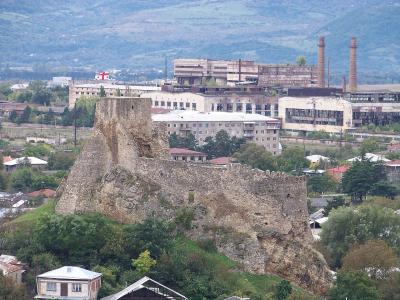
Nearby settlements