



Shemokmedi Monastery
Link copied
Photograph: Jaba1977 (CC BY-SA 4.0), Frédéric Dubois de Montpéreux (Public domain), Unknown author (CC0), Dmitri Yermakov (Public domain), Unknown master of the 10th century (Public domain)
The burial ground of the Gurielis and from the fifteenth century a metropolitan see, on a hill above the Bzhuzhi 7–8 kilometres from Ozurgeti: the thirteenth- to fourteenth-century basilica of the Saviour with the fresco of Mamia II Gurieli, the domed "Zarzma" church built in the 1570s for the Transfiguration icon of 886 rescued from Zarzma, and a bell tower renewed in 1831; a treasury of the Georgian church, whose surviving part is in the National Museum.
About
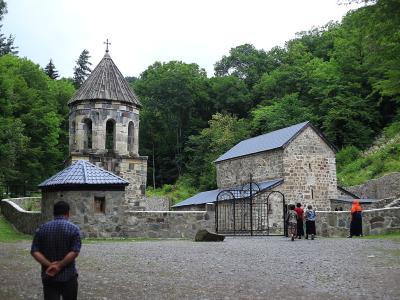
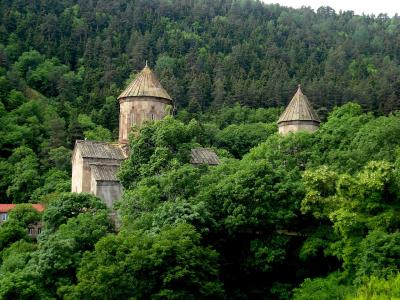
The Shemokmedi monastery complex stands in the village of Shemokmedi in Ozurgeti Municipality on a small hill above the left bank of the Bzhuzhi, 7–8 kilometres south-west of Ozurgeti, and is the centre of the Shemokmedi diocese; the complex consists of two churches built against each other, a bell tower, a wall and a cave, and is an immovable cultural monument of national significance. The church of the Saviour is a three-nave domeless basilica of 10 by 13 metres, built of ashlar inside and out, lined with bluestone and floored with white marble; it is thought to be of the thirteenth or fourteenth century, and in Vakhtang Beridze's view was originally single-naved, its long walls later broken through and aisles added, after which it was reclad and faced with stones of different colours laid chequerwise; the western façade carries carving around the window, the interior was once wholly frescoed, and the surviving fragments show Mamia II Gurieli (died 1627) and his wife Tinatin with Georgian inscriptions. Built against it, the church of the Transfiguration, "Zarzma", measures 9 by 7 metres, a single nave crowned by a dome on an eight-windowed drum, faced with bluish porphyry quarried near the monastery, entered from the west, with a cross between six- and five-pointed stars on the door lintel; on the walls survive fragments of Georgian and Greek inscriptions and a fresco of the first bishop of Shemokmedi, Besarion Machutadze, and in 1961 an inscription of the eleventh to fifteenth centuries naming "Grigol Bandasdze, master of masons" was found. The bell tower is of the sixteenth century, was restored in 1831 by the abbot, Archimandrite Arsen Mgaloblishvili, and gives entry to the monastery.
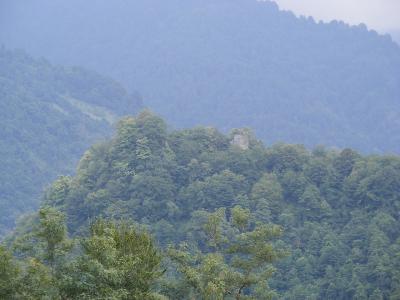
On the right bank of the Bzhuzhi below the church is a two-chambered cave where hermit monks once lived; 1.2 kilometres south-east of the monastery on a hill stands a walled ruined church that Ekvtime Takaishvili thought had been domed, and 1.5 kilometres north-east the recently restored Gorisperdi church. Buried in the cathedral are Rostom Gurieli (died 1564), Mamia III (1714) and Mamia V Gurieli, and in the yard the bishops of Shemokmedi.
- Tradition / order
- Georgian Orthodox Church, cathedral of the Shemokmedi diocese
History
For centuries Shemokmedi was the burial ground of the Gurielis, and under Kakhaber II Gurieli (1479–1483) became a metropolitan see, one of the three bishoprics of the principality of Guria (with Jumati and Khino), whose prelates bore the name Shemokmedeli. At the end of the sixteenth century, after the Ottoman conquest of Samtskhe, Vakhtang I Gurieli built the domed church "Zarzma" to house the Transfiguration icon of 886 rescued from the Zarzma monastery, the oldest of Georgian icons, and other treasures, among them the eleventh-century Laklakidze icon of the Virgin, and granted the monastery 80 peasant households. At the close of the seventeenth century Bishop Jakob Dumbadze of Shemokmedi travelled to Europe in 1687 and met Pope Innocent XI. After the death of Metropolitan Ioseb Takaishvili in 1794 the see fell dormant and the monastery passed to Kaikhosro Gurieli; in 1820, in crushing his insurrection, General Velyaminov blew up the Shemokmedi fortress and the monastic buildings within its walls.
In the nineteenth century the monastery was robbed again and again: Dubois de Montpéreux described it in 1833, Muslim Adjarians plundered it in 1861, Dimitri Bakradze compiled the first scholarly description of the collection in 1873, including the 1,004-leaf "Shemokmedi Gulani" (1512–1749) and the "Putkari", in 1875 the antiquities lay neglected in boxes, in 1881 the photographer Stepane Sabin-Gus removed them "for restoration" with the permission of the synodal office and never returned them, in 1889 Nikodim Kondakov catalogued what survived, in 1895 Oliver and Marjory Wardrop visited, in 1913 Ekvtime Takaishvili came, and in 1919 treasures worth 30 million roubles were carried off through Batumi to the Ottoman Empire. In 1920 the see was restored as the diocese of Batumi and Shemokmedi, since 1924 the surviving objects have been in the Georgian National Museum, from 1963 to 1967 the bishop of Shemokmedi was the present Catholicos-Patriarch Ilia II, in 1995 the Shemokmedi diocese was re-established in its own right, covering all three municipalities of Guria, and in 2007 the monastery was listed as a monument of national significance.
Visit info
Shemokmedi is 7–8 kilometres south-west of Ozurgeti, about 12 minutes by car; the monastery stands on the hill above the village, and the way in is through the bell tower. It is a working monastery and the centre of the Shemokmedi diocese; opening times, access and dress rules are best checked locally.
Safety
This is a working monastery; dress and photography rules are best asked about locally. The hillside is slippery after rain, and the cave below the church is abandoned.
Tip
Look for the cross and two stars on the "Zarzma" door lintel and the chequered facing of the church of the Saviour; most of the surviving treasury has been in the Georgian National Museum since 1924. From the hill the Bzhuzhi valley opens, and below on the right bank is the monks' cave. Shemokmedi, Likhauri and Jumati fit easily into one day from Ozurgeti.
Sources
Nearby places
All places in the region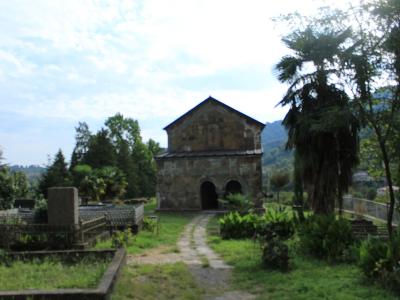
Places of the same kind
Monastery — all places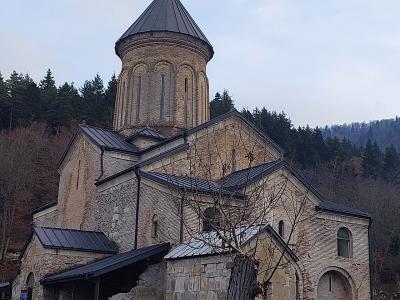
Nearby settlements