



Tskaltubo Spa Resort
Link copied
Photograph: Alexey Komarov (CC BY-SA 4.0), MiSHock (CC BY-SA 3.0), Ilkin85 (CC BY-SA 3.0), Hélène Veilleux (CC BY-SA 2.0), Daniel-tbs (CC BY-SA 3.0)
The balneological resort of Imereti 9 kilometres from Kutaisi at 120 metres, where radon-carbonate water rises from the ground at 33–35 degrees and needs no heating: an all-Union resort from 1931, 19 sanatoria and 9 bathhouses set in a ring around the central park by the radial plan of 1950–1951, Stalin's bathhouse at Spring No. 6, a shelter for refugees from Abkhazia since the 1990s and today a partly revived spa town.
About
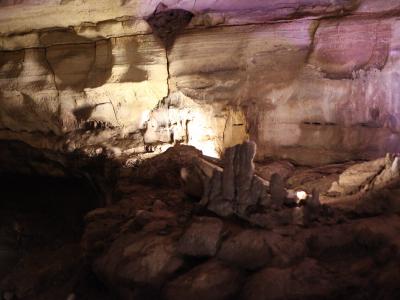
Tskaltubo lies 9 kilometres north-west of Kutaisi, at 120 metres above sea level, in a broad hollow whose centre is the mineral-water park. The resort's wealth is its radon-carbonate water, soft, clear and odourless, which rises from the ground at 33–35 °C: it needs neither heating nor cooling for the baths, so the patient sits straight in the running spring water. This property made Tskaltubo a rarity among the balneological resorts of Europe. The water is prescribed for diseases of the circulation, the nervous system, the joints and spine, gynaecological and skin conditions; a course lasts 20–24 days, and since the 1970s the resort has also practised speleotherapy, in which patients with pulmonary diseases spend hours in the cool, dust-free air of the nearby caves.
The town plan is the fruit of the radial project of 1950–1951: 19 sanatoria, 9 bathhouses and a branch of the Scientific Institute of Balneology were set in a circle around the central park and the baths. The buildings blend Stalinist classicism with Georgian decorative architecture: columned porticoes, mosaics, carved façades and broad staircases. The bathhouse at Spring No. 6 was built in 1950–1951 for Stalin alone, and his private pool can still be seen; the frieze of Bathhouse No. 9 shows the leader himself. In the 1960s and 1970s the town held 22 sanatoria and 5,800 beds, received 125,000 visitors a year and had a direct train from Moscow.
The collapse of the Soviet Union in 1991 stopped the resort, and from 1993 some 9,000 people displaced from Abkhazia, mostly women and children, moved into the empty sanatoria. Today's Tskaltubo is a blend of those two layers: working bathhouses, a renewed park and a handful of restored hotels on one side, the abandoned Megobroba, Tbilisi, Meshakhte and Imereti on the other, where the forest breaks through the façades and mosaics disappear into the green. It is this contrast that draws photographers and lovers of urban heritage.
- Price range
- Mid-range
- Parking
- Yes
- Amenities
- Food, Parking, Toilet, Water, First aid, Playground, Picnic
History
The waters of Tskaltubo are first mentioned in the seventh to ninth centuries, and in the thirteenth century the land belonged to the Gelati monastery. For European science the springs were described by Johann Güldenstädt, the German traveller and member of the St Petersburg Academy, who was here on 14 August 1772; his travel journal was published in Berlin in 1782. The chemistry of the water was studied by Klaproth in 1815, Struve in 1898 and Kuptsis in 1913, and it was this last study that confirmed its curative properties.
In 1920 the land around the springs passed to the state and Tskaltubo took on the role of a balneological resort; the first treatment building rose in 1925, and from 1926 large-scale sanatoria began to be built. In 1931 the government of Georgia declared Tskaltubo a resort and a centre of balneotherapy, and Stalin visited that same year. The village became a township in 1938 and in 1953 a town and a resort of all-Union importance. The master plan of 1950–1951 laid out a radial town: Megobroba (1937–1940), Tbilisi (1951), Meshakhte (1952), Metalurgi (1957), Imereti (1961) and others took their places in a ring around the park. In the 1930s the damming of the little river Tskaltubo created the artificial Cold Lake.
With the collapse of the Soviet Union in 1991 the resort emptied, and from 1993 the sanatoria became housing for people displaced from Abkhazia. A rehabilitation project was announced on 14 September 2012, in 2014 it was proposed to list 12 of the 16 historic buildings as monuments, and a government order of 19 December 2019 commissioned a new urban plan for the town. The rehousing of the displaced families and the handover of the sanatoria to investors continues to this day.
Visit info
Tskaltubo is about 20 minutes by car from Kutaisi, and marshrutkas run from the central bus station of Kutaisi; Kutaisi airport is about 22 kilometres away. The mineral-water park and the working bathhouses are in the town centre; the park and the streets are open and free. A course of treatment lasts 20–24 days and begins on a doctor's prescription; the bathhouses and hotels themselves give information on procedures and prices. The abandoned sanatoria are private or state property, and some are still home to displaced families, so the buildings may be entered only with the permission of the owner and the residents.
Safety
In the abandoned sanatoria the floors and stairs are broken through, the lift shafts stand open and plaster falls from the ceilings: go inside only by daylight, in sturdy shoes and with a companion, and never into the buildings where families live. Radon baths are taken only on a doctor's prescription.
Tip
For photographs of the mosaics and colonnaded buildings the soft morning light and the summer greenery are best; the Spring No. 6 bathhouse built for Stalin and the frieze of Bathhouse No. 9 are in the centre. Bring a swimsuit and a towel before going to a bathhouse. On the same day Prometheus Cave is 7 kilometres away, Sataplia 11 and the Geguti palace 24.
Sources
Nearby places
All places in the region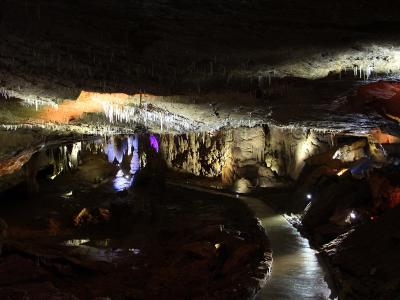
Places of the same kind
Resort — all places
Nearby settlements