



Kintsvisi Monastery
Link copied
Photograph: Jaba1977 (CC BY-SA 4.0), Unknown author (Public domain), Abramia Giorgi (CC BY-SA 4.0), GuramGraphy (CC BY-SA 4.0)
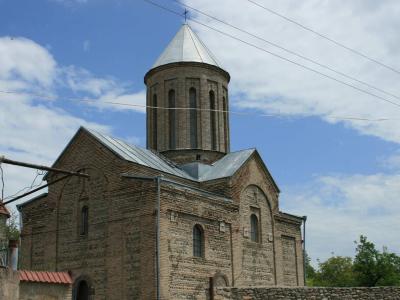
A medieval monastery in Kareli municipality, on a forested slope of the Dzama valley, 3 kilometres from the village of Qintsvisi. Its main church of St Nicholas, a brick domed building of the early thirteenth century, holds one of the largest and best-preserved medieval Georgian wall paintings: portraits of Giorgi III, Queen Tamar and Giorgi IV Lasha, the celebrated Kintsvisi Angel and backgrounds coloured with lapis lazuli. Beside it stand the small church of St George and the ruins of the church of the Virgin.
About
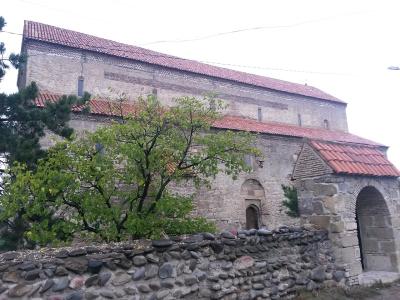
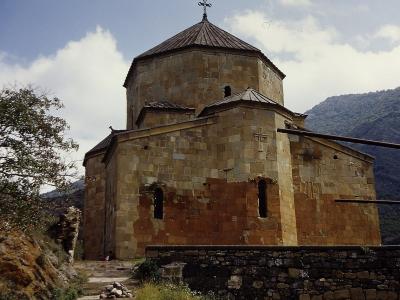
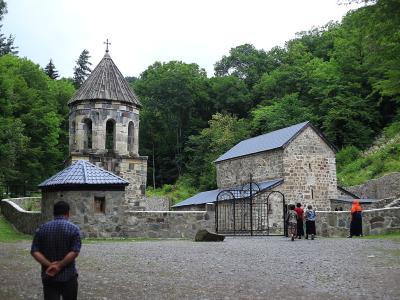
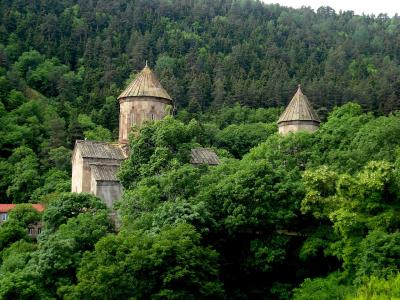
Kintsvisi Monastery stands on a rise in the valley of the Dzama river, on a forested slope of a high mountain near the village of Qintsvisi, in Kareli municipality in Shida Kartli. The complex has three churches: the main church of St Nicholas, the small church of St George beside its west façade and, to the north-west, on a slope by the bank of the Dzama, the ruins of the church of the Virgin. The grounds are surrounded by the ruins of a common wall, with the bell tower built into its northern side; there are also other buildings of the late Middle Ages.
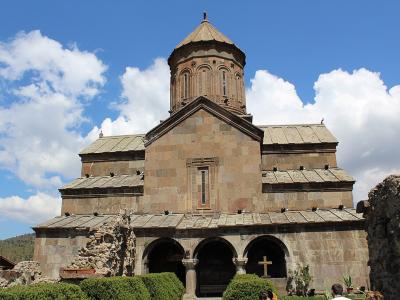
The church of St Nicholas, dated to the early thirteenth century, is a large cross-in-square domed building of red brick, a material rarely used at the time and an exceptional case for the beginning of the thirteenth century. In its overall look it is close to Timotesubani. The interior is formed by the four arms of a cross, while the plan of the building is rectangular; all the arms except the eastern one are rectangular, and the western arm is longer. The sanctuary apse has a bema and is flanked by a prothesis and a diaconicon, both ending in apses. Pendentives carry the transition from the square under the dome to the circle, and on them rises the drum with 12 windows, framed by arches laid in brick; the dome was originally covered with tiles of three colours. The church has three entrances, on the north, south and west. The façades were originally left plain: the only decoration is the arches of the drum windows. The narthex has two floors, with a porch below and a choir gallery above.
The church was plastered and painted from the start, and the original frescoes covered the walls entirely. Though damaged, the Kintsvisi murals are still among the largest and best-preserved Georgian medieval wall paintings. The dome shows the Virgin Hodegetria flanked by the archangels Michael and Gabriel, with the four evangelists in medallions on the pendentives. In the conch of the apse is a monumental Virgin with the Child, in the bema the Eucharist, and on the apse wall the church fathers walking toward the bema from both sides. The north wall holds New Testament scenes and the portraits of Giorgi III, Queen Tamar and Giorgi IV Lasha; above the kings, between two windows, sits the angel of the Resurrection scene, the so-called Kintsvisi Angel, pointing to the open sarcophagus, in blue robes on a blue ground. The backgrounds are bluish, painted with lavish use of lapis lazuli, and the haloes are gold. These frescoes date from before 1205 and rank among the most beautiful paintings of their time. The images of saints carry inscriptions in Georgian asomtavruli and in Greek, and remnants of a long historical inscription survive.
The small church of St George stands by the west wall of St Nicholas on a low two-stepped plinth; it is built of hewn stone blocks of different sizes, with a relief cross over the window of its east façade, and is in rather good condition. Of the church of the Virgin only the painted apse remains, with the enthroned Hodegetria and the Communion of the Apostles; the rest of the church has collapsed down the mountainside.
History
The building of the monastery is linked with the reign of Queen Tamar (1184–1212), often called the Golden Age of Georgian statehood and culture. The dates of the churches of the complex are not known exactly. The church of St Nicholas is placed in the early thirteenth century, a date made possible by the figures of the three kings of that time on its walls; by another account it belongs to the twelfth–thirteenth centuries. The paintings were commissioned by Anton Gnolistavisdze, a local magnate who served as a royal minister: on the lower register of the south wall he is shown holding a model of the church, next to a badly damaged cycle of the life of St Nicholas and images of Georgian saints. The church of the Virgin is dated in different ways, to the tenth–eleventh centuries or to the thirteenth; its sanctuary painting belongs to the second half of the thirteenth century. Some place the small church of St George at the same time as the main church, others in the sixteenth–eighteenth centuries.
In the fifteenth century the narthex of the main church was rebuilt by the local prince Zaza Panaskerteli: its interior was divided into three parts and painted, and the frescoes include a portrait of Zaza himself. The World Monuments Fund lists Kintsvisi among its field projects.
In early August 2019 an expensive marble floor was laid in the church on the initiative of the local clergy. The National Agency for Cultural Heritage Preservation of Georgia called the work “arbitrary” and “unlawful”: it had been carried out in disregard of the state institutions and of proper restoration methods, and the new mirror-like floor diminishes the painting of the early thirteenth century. The agency's supervision team was not allowed onto the monastery grounds. The superior of the monastery, Archpriest Ephrem, maintained that the old slabs were not cultural heritage. On 12 August 2019 the Patriarchate of Georgia stated that the floor was in complete dissonance with the church and the situation had to be corrected urgently, and that such work must be agreed with the cultural heritage agency.
Visit info
Kintsvisi lies about 12 kilometres by road from Kareli and 3 kilometres from the village of Qintsvisi, in the forested valley of the Dzama. It is a working monastery. Check entry arrangements and the schedule of services on site.
Safety
This is a working monastery: dress modestly, do not take photographs during services and do not touch the frescoes. The ruins of the church of the Virgin stand on a slope down which part of the church has collapsed; keep away from the edge.
Tip
Inside St Nicholas, look on the north wall for the portraits of Giorgi III, Tamar and Giorgi IV Lasha and, above them between two windows, for the Kintsvisi Angel; on the south wall for Anton Gnolistavisdze with his model of the church; and in the narthex for the portrait of Zaza Panaskerteli. Then go down to the north-west of the complex, toward the bank of the Dzama, to the ruined church of the Virgin, where the sanctuary painting survives. Timotesubani, close to Kintsvisi in its overall look, deserves a visit of its own.
Sources
Nearby places
All places in the region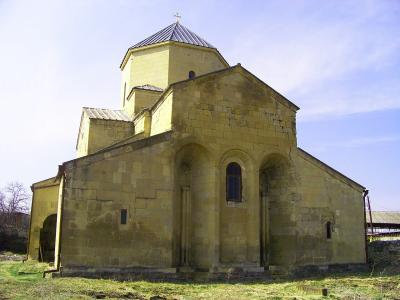
Places of the same kind
Monastery — all places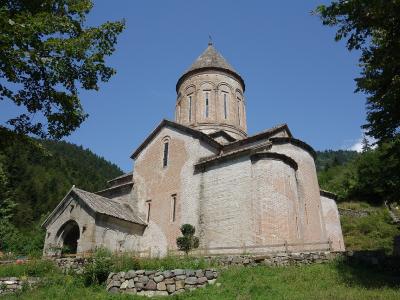
Nearby settlements