



Timotesubani Monastery
Link copied
Photograph: Yasuhiro Kojima (CC BY-SA 4.0), G.N. (CC BY-SA 3.0), Jonathan Cardy (CC BY-SA 3.0), Medieval artist (photo: S. Sarjveladze) (Public domain), Sergei Prokudin-Gorskii (Public domain)
A monastery of the Mother of God in the village of Timotesubani in Borjomi municipality, 18 kilometres from Borjomi, on the right bank of the Gujaretistskali river. Its main church, of the Dormition, was built at the turn of the twelfth and thirteenth centuries by Shalva Akhaltsikheli, lord of Tori, in pinkish “Georgian brick”; inside are wall paintings of 1205–1215, among the most complex of their time, whose conservation won a Europa Nostra medal in 2006.
About
Tori was one of the important lands of medieval Georgia and covered what is now Borjomi municipality. Here, 18 kilometres southeast of Borjomi, on the right bank of the Toristskali river (today the Gujaretistskali), stands the monastery of the Mother of God in the village of Timotesubani. The complex is made up of buildings raised between the eleventh and eighteenth centuries, of which the Church of the Dormition is the largest and artistically the finest. The monastery belongs to the eparchy of Borjomi and Bakuriani; it is a monastery of monks, and services have been held in it regularly since 1994.
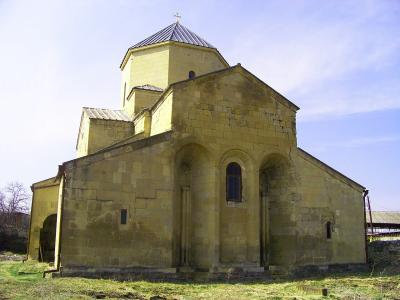
The main church is built of pinkish, so-called “Georgian brick”. It is a domed cross-in-square building with three apses projecting on the east; the drum of the dome rests on two free-standing pillars and on projections of the sanctuary wall, and the drum is decorated with azure glazed ceramic bowls. The church is 28 metres high including its cross, 19 metres wide and 11 metres long. The north windows were walled up and painted over while the church was still being built. Later a brick porch was added on the west and a porch of dressed stone on the south.
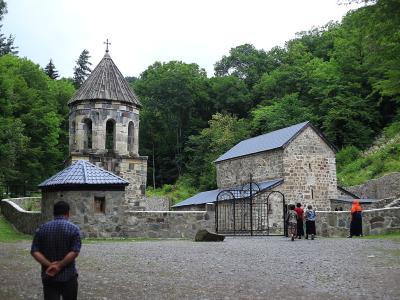
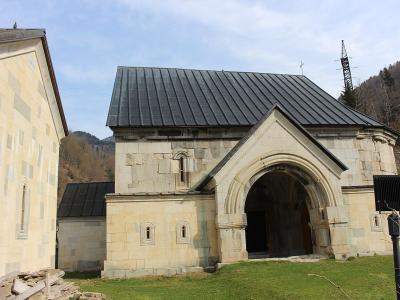
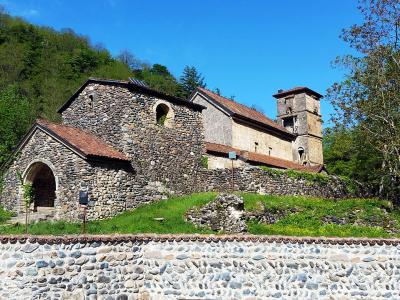
North of the church are the remains of monastic buildings of the tenth–eleventh century, and beside them an eleventh-century hall church of dressed stone. On the upper, northern terrace stands the small single-nave basilica of Saint Barbara, and northeast of the main church a vaulted burial crypt built of stone. In the monastery yard are the monks’ cells. The entrance to the grounds is an elongated arched building of red brick; a bell tower probably stood above it, and two-storey rooms on either side formed the core of the monastic complex. Ruins of living quarters and farm buildings survive to this day, and a new monastic complex is being built southwest of the church.
- Tradition / order
- Georgian Orthodox Church; a monastery of monks in the eparchy of Borjomi and Bakuriani
History
The church was built on the ruins of an older monastery by the lord of Tori, Shalva Toreli-Akhaltsikheli, an eminent Georgian military leader of the twelfth–thirteenth century whom the Church venerates as a holy martyr. A contemporary inscription commemorates him as the patron of the church, and he is credited with enlarging the Timotesubani monastery and with building and painting its great church. The church rose in the “Golden Age” of Georgian history, the reign of Queen Tamar (r. 1184–1213): by one account, building began in 1195 and was completed in 1215.
The whole interior is painted; the murals are dated to 1205–1215 and were in any case finished no later than the 1220s. They rank among the brilliant monuments of Tamar’s era: their iconographic programme is extraordinarily rich and typically Georgian, and the hands of several masters can be told apart, each with a sharp, unrepeatable character within a single style. The scheme includes an image of the Saviour and a Last Judgement composition of 20 square metres. Most of the frescoes survive.
The paintings were cleaned and studied in 1972–1976 under E. Privalova, whose monograph on the Timotesubani murals appeared in 1980. Over time, water infiltration and inappropriate earlier treatments left the frescoes in poor condition: the paint and plaster layers were flaking and powdering, salts were crystallising on the surface, and microbiological damage had spread a pink patina over much of the painting and plaster. In 2000–2006 the Georgian Arts and Culture Center (led by Mariam Dvalishvili), with help from Conservazione Beni Culturali and support from the World Monuments Fund and the Samuel H. Kress Foundation, cleaned and consolidated the frescoes. In 2006 the project won a medal of the European Union Prize for Cultural Heritage / Europa Nostra Awards.
Visit info
The monastery is in the village of Timotesubani in Borjomi municipality, 18 kilometres southeast of Borjomi. By car it is 19 kilometres from Borjomi (about 25 minutes), 4 kilometres from the resort of Tsaghveri, 19 kilometres from Bakuriani and 173 kilometres from Tbilisi (about 150 minutes). It is a working monastery of monks with regular services. Check locally for opening hours, the times of services and the conditions for seeing the frescoes.
Safety
This is a working monastery: dress modestly and keep quiet during services. The frescoes are sensitive to moisture and damage, so do not touch them, and check locally whether photography is allowed.
Tip
The setting is beautiful all year, but especially in autumn, when the mountain slopes turn gold, green and red. Inside the church, look for the image of the Saviour and the large Last Judgement composition, and outside for the azure bowls set into the drum of the dome. It is worth climbing to the basilica of Saint Barbara on the upper terrace.
Sources
Nearby places
All places in the region
Places of the same kind
Monastery — all places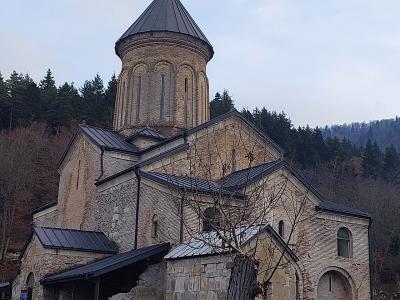
Nearby settlements