



Zarzma Monastery
Link copied
Photograph: Jaba1977 (CC BY-SA 4.0)
A medieval monastery in the village of Zarzma in Adigeni municipality, in the forested valley of the Kvabliani river, 8 kilometres from Adigeni and 30 kilometres from Akhaltsikhe. It was founded in the eighth–ninth centuries by Serapion of Zarzma, while the present domed church and bell tower were built at the start of the fourteenth century, in the time of Beka I Mandaturtukhutsesi. The church holds portraits of the Jaqeli family and of historical figures of the sixteenth century, and the bell tower is one of the largest in Georgia. Today it is a working monastery.
About
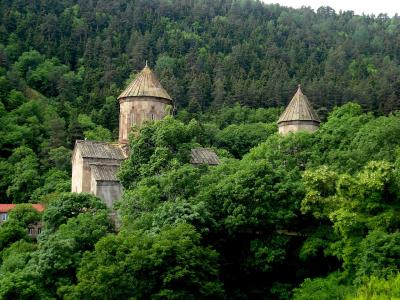
Zarzma Monastery stands in the village of Zarzma in Adigeni municipality, in the forested valley of the Kvabliani river and its tributary the Dzindze, 8 kilometres west of Adigeni and 30 kilometres west of Akhaltsikhe. The complex is dominated by a domed church and a bell tower; several single-nave chapels also survive, some of them in ruins. A little way off is a spring known since ancient times, while the other monastic buildings (the monks' cells, the refectory and others) have not survived. On 7 November 2006 the monastery was given the status of an immovable cultural monument of national significance.
The main church has a cross-in-square plan with two entrances, on the south and the west; the south portal is unusually stretched along the wall. The drum of the dome has 12 windows, half of them blind, as was usual at the time. The mouldings of the interior piers are made of rolls divided by horizontal bands, and the western gallery is false, purely decorative. The walls are faced with rectangular blocks, and the façades, as typical of the fourteenth century, are polychrome and richly decorated; carving frames the doors and windows, the dominant motif is the cross, and the east façade is the most richly adorned. The church shows clearly some of the new traits of the Georgian architecture of its time, with changes in the proportions of the building and in the system of façade decoration.
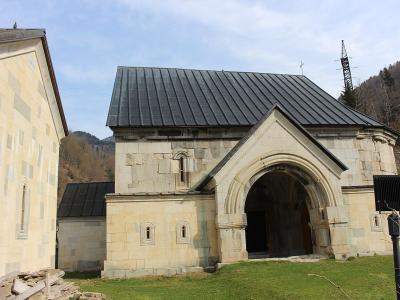
The interior is painted. Alongside the traditional religious scenes, the lower part of the south wall holds portraits of the Jaqeli lords of Samtskhe, Sargis, Beka Mandaturtukhutsesi, Sargis II and Kvarkvare, and the north wall shows historical figures of the sixteenth century: Bagrat III, king of Imereti, Serapion Khurtsidze, Giorgi Chorchaneli, Simon Gurieli and others. The bell tower, one of the largest in Georgia and one of the finest Georgian buildings of its type, was originally part of the enclosure wall, and its ground floor served as the entrance to the monastery; the upper floor is an octagon with eight arches and holds the bells. The other churches are of the hall type. Set into the entrance arch of one of the chapels is an inscription of the last decades of the tenth century, brought from an earlier building: the oldest surviving relic of the monastery.
- Tradition / order
- Georgian Orthodox Church; a monastery of monks in the eparchy of Akhaltsikhe and Tao-Klarjeti
History
Opinions differ on when the monastery was founded: the eighth or the ninth century. It was founded by Serapion of Zarzma, a churchman from Klarjeti, whose life is told in a tenth-century work by his pupil, Basil of Zarzma. According to legend, the pagan villagers would not let Serapion and his brother Ioane build a monastery here and ignored his warnings; then the ground moved, the rock bottom split, and muddy water washed away the village together with its mill. Serapion was greatly helped by the local lord Giorgi Chorchaneli, who gave the new monastery villages and estates. The church of Serapion's time, built by the architect Garbaneli and apparently a simple building, has not survived; by some accounts the old church was destroyed by an earthquake in the thirteenth century. The tenth-century inscription set into the chapel arch tells of the campaign of David III Kuropalates against Bardas Skleros: the military aid given by Georgian nobles to the Byzantine emperor Basil II against the rebellious general in 979.
The present church and bell tower were built in the first years of the fourteenth century, in the time of Beka I Mandaturtukhutsesi, lord of Samtskhe. In 1544 the new patrons of the monastery, the Khurtsidze family, renovated it. They replaced part of the old painting of the church with new work, and in 1577 they walled up the arches of the ground floor of the bell tower and turned it into a church of John the Evangelist. Over time Basil of Zarzma, Germane of Zarzma, Benedict of Zarzma and others worked at the monastery. After the Ottoman conquest of the area in the sixteenth century the monastery was abandoned; in the eighteenth–nineteenth centuries, surrounded by a Muslim population, the church gradually decayed. All of Zarzma's possessions, its icons, crosses and above all its chief relic, the Zarzma icon of the Transfiguration, one of the most important works of Georgian repoussé art, were taken to Guria and placed in a new church built specially for them in the village of Shemokmedi, which was also called Zarzma. Today all of Zarzma's surviving treasure is kept in Tbilisi, in the Shalva Amiranashvili Art Museum.
At the end of the nineteenth century, on the initiative of Grand Duke George Alexandrovich, a restoration of the complex began which, according to an inscription on the church wall, was completed in 1905; it was carried out by the architect-and-artist pair V. Svinyin and A. Slavtsev. The restoration harmed the colouring and partly the style of the painting, and some unique details were lost. In 1921 a tourist base was set up in the monastery, and from 1938 it housed a museum. In 1989 Catholicos-Patriarch Ilia II consecrated the main church, and in 1999 the monastery was founded anew. Today a community of Georgian monks lives here, and Zarzma is a place of pilgrimage and tourism.
The monastery's ossuary keeps the remains of those who served here, among them an incorrupt body. It was found in 1940, during the building of the Borjomi–Akhaltsikhe railway, near the village of Tsnisi, when the cliff-side walls of a ruined church were taken down: the body lay in a cave walled up with stone and mortar, and was then taken to the museum of local history in Akhaltsikhe. Research begun in 1970 dated the clothing by radiocarbon to 990±90 years; the body belongs to a man 172 centimetres tall who died aged 40–45 and probably walked with a limp. The researchers concluded that he was a cleric who lived in the tenth century.
Visit info
Zarzma lies 8 kilometres west of Adigeni and 30 kilometres west of Akhaltsikhe, in the valley of the Kvabliani river. It is a working monastery where monks live, and at the same time a place of pilgrimage and tourism. Check entry arrangements and the schedule of services on site.
Safety
This is a working monastery: dress modestly, do not take photographs during services and do not touch the frescoes. Drive carefully on the mountain roads in winter and after heavy rain.
Tip
In the church look at the lower part of the south wall, where Sargis, Beka, Sargis II and Kvarkvare Jaqeli are painted, and at the north wall with Bagrat III, king of Imereti, and Serapion Khurtsidze. Outside, the east façade is the most richly decorated; look for the tenth-century inscription in the entrance arch of one of the chapels. A smaller copy of Zarzma, Akhali Zarzma (New Zarzma), stands in the same municipality near Abastumani: Grand Duke George Alexandrovich had it built by the architect Otto Simons in 1899–1902, and its interior was painted by the Russian artist Mikhail Nesterov. To see the icon of the Transfiguration and the rest of Zarzma's treasure, visit the Shalva Amiranashvili Art Museum in Tbilisi.
Sources
Nearby places
All places in the region
Places of the same kind
Monastery — all places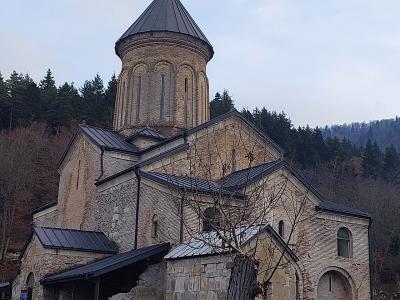
Nearby settlements