



Mghvimevi Monastery
Link copied
Photograph: Jaba1977 (CC BY-SA 4.0), Archil Sutiashvili (CC BY-SA 4.0), Phyrexian (CC BY-SA 4.0), Surprizi (CC BY-SA 4.0), Andrew Milligan (CC BY 2.0), Lasha (CC BY-SA 4.0)
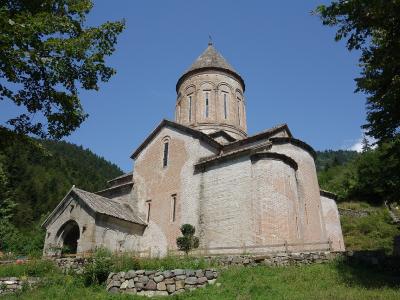
A nunnery cut into the cliff of the Kvirila valley on the eastern edge of Chiatura, founded in the second half of the thirteenth century by Rati Kakhaberidze, eristavi of Racha, his wife Rusudan and his brother Niania: a two-nave basilica of the Nativity of the Mother of God resting on a single massive pillar, a painted wooden iconostasis of the eighteenth century, the eleventh-century Vine Door and Supplication icon now in the National Museum, the rock church of St Catherine with its ram's head, and a great cave where the liturgy is sung on feast days.
About
Mghvimevi stands in the cliff of the right bank of the Kvirila on the eastern edge of Chiatura: from the town a long, narrow stair climbs to the monastery and passes into a tunnel cut by hand into the rock and braced with supporting arches, which ends at a great natural cave. The name comes from there, since mghvime is the Georgian word for a cave. According to Prince Vakhushti these caves served as refuges in wartime, and archaeologists have found arrowheads and traces of fire in them; the cave itself is also known for prehistoric finds. To this day, on the great feasts, the liturgy is celebrated in the cave itself.
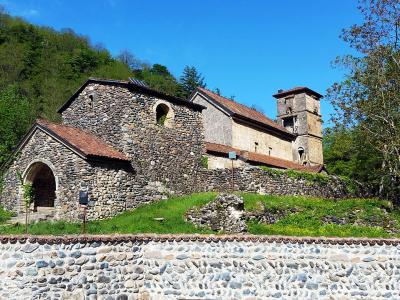
East of the cave portal is the main church, a two-nave basilica of the Nativity of the Mother of God. Its naves, the northern narrower than the southern, are divided by a two-arched arcade resting on a single massive pillar, and both end in apses faceted on the outside; the walls are faced with dressed stone slabs, while the ceiling is cut into the adjoining rock. The façade is richly ornamented with carved window frames, monumental crosses, interlocking lozenges and a decorated cornice. Inside stands a fully painted wooden iconostasis of the eighteenth century with the Saviour and the Twelve Apostles, its door covered with chased metal plates. The walls keep fragments of frescoes, including in the north nave the portraits of the founders, the eristavi Rati, Rusudan and Niania; the south wall was repainted in the sixteenth century.
On the other side of the portal is the small hall church of St Catherine, whose ceiling and west wall are the living rock, with a relief of a ram's head on the east wall and frescoes on the outer south wall. The bell tower and the cells are mostly of the nineteenth century, and in 2014 the buildings of the new nunnery were added. The treasures of the monastery, the carved wooden Vine Door of the eleventh century, taken down for safekeeping in 1920, and the chased Supplication icon of the same century from Racha, are kept in the National Museum. Since 7 November 2006 Mghvimevi has been a monument of national significance.
- Tradition / order
- Georgian Orthodox Church, a nunnery since 2014
- Dress code
- Headscarf and skirt for women, long trousers for men
History
The monastery was founded in the second half of the thirteenth century, in the years when building almost ceased in Mongol-ruled Georgia and patronage passed into the hands of the great nobles. Its founder was Rati Kakhaberidze, eristavi of Racha, who built the church together with his wife Rusudan and his brother Niania; the portraits of all three remain on the wall of the north nave. The Kakhaberidze were the eristavis of Racha and Takveri, and this monastery in the Kvirila valley marked the southern edge of their power. Art historians note that for all the richness of the individual carvings, the buildings lack the integrity and craftsmanship of the Golden Age monuments: this is already the architecture of a later age of decline.
In the sixteenth century the south wall was repainted, in the eighteenth the wooden iconostasis was made, and in the nineteenth the bell tower and the cells were built. The monastery was one of the richest treasuries of Imereti: it kept the chased Supplication icon of the eleventh century from Racha and a superb piece of woodcarving, the Vine Door, which in 1920, on the eve of Soviet rule, was taken down for safekeeping and carried to Tbilisi. Both are today in the collection of the Georgian National Museum.
In the Soviet period the monastery did not function, while the manganese mines of Chiatura ringed the cliffs. On 7 November 2006 the complex received the category of an immovable cultural monument of national significance, and in 2014 a nunnery was founded here, which repaired the cells and restored daily prayer in the church.
Visit info
Mghvimevi lies on the eastern edge of Chiatura on the right bank of the Kvirila; Chiatura is about 80 kilometres from Kutaisi, and marshrutkas run from the Kutaisi bus station and also from Tbilisi. From the town a long, narrow stair climbs along the cliff to the monastery and passes into a tunnel cut by hand into the rock and braced with supporting arches, which comes out at the great cave. The monastery is a working nunnery, open by day, free to enter, and the dress code applies. From the cable cars of Chiatura the monastery and its cliff can be seen from afar.
Safety
The stair cut into the cliff is narrow, its steps uneven and slippery in rain: keep to the rail and wear sturdy shoes; in frost the stair is especially dangerous. The tunnel is low and dark, so a torch helps. Stones fall from the cave and the slope, so stay back from the edges. You are in a working monastery: the dress code is kept and the cells are not approached.
Tip
The climb by the stair from the town side is the most impressive: as you leave the tunnel the cave and the façade of the church open up at once; for photographs the morning light is better, when the sun strikes the cliff from the east. Look for the founders' portraits in the north nave and the sixteenth-century layer on the south wall, and for the ram's head on the east wall of St Catherine's. The Vine Door and the Supplication icon are in the National Museum in Tbilisi, worth seeing before or after the trip. In one day Mghvimevi combines with the Katskhi pillar (12 kilometres) and the cable cars of Chiatura.
Sources
Nearby places
All places in the region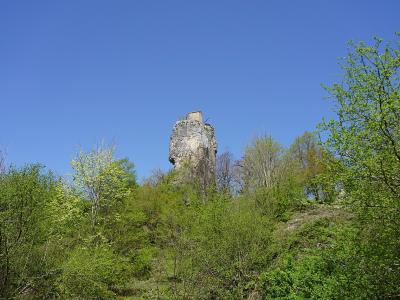
Places of the same kind
Monastery — all places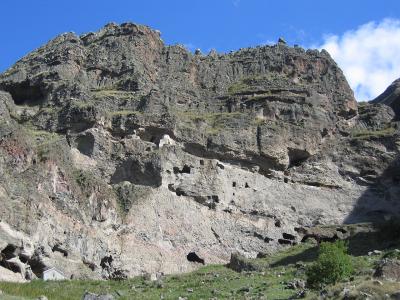
Nearby settlements