



Khotevi Fortress and Archangel Church
Khotevi Ambrolauri Municipality Racha-Lechkhumi and Kvemo Svaneti
Link copied
Photograph: Aleksey Muhranoff (CC BY-SA 3.0), G. N. (CC BY-SA 3.0), Natia Maisashvili (CC BY-SA 4.0)
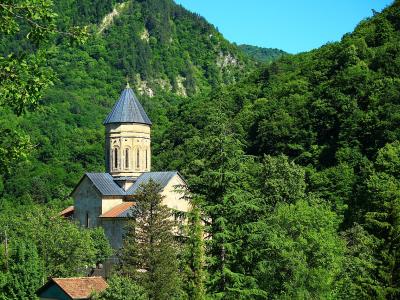
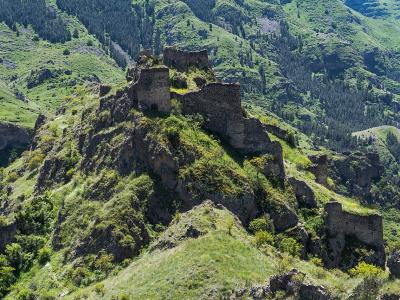
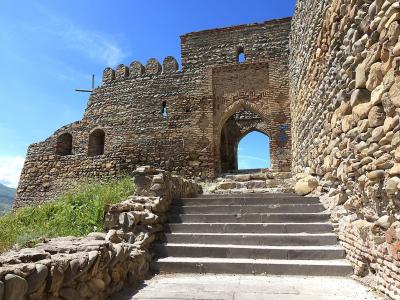
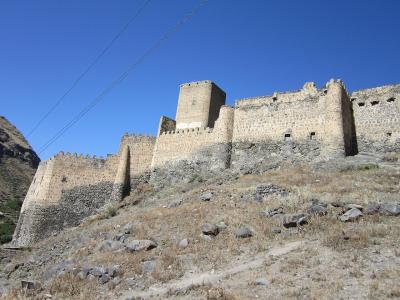
Two monuments of Khotevi facing each other on the northern slope of the Racha range at 1,000 metres: the two-storey fortress of the Tsulukidze of the sixteenth and seventeenth centuries with its loopholes, and the medieval church of the Archangel on whose frescoes Marie Brosset read the names of Merab Tsulukidze and his family. The village was listed among the towns of Imereti by Russian envoys in the seventeenth century, and its name is said to come from a king's question, "Do you fit in the fortress?".
About
Khotevi stands 10 kilometres from Ambrolauri on the road to Nikortsminda, on the northern slope of the Racha range by the river Khoteuri, at 1,000 metres above sea level. Historically the village was the centre of the princely domain of the Tsulukidze, and its two monuments belong to that family. The fortress is of the sixteenth to seventeenth century and is held to have been built by Prince Merab Tsulukidze: a two-storey building with an enclosure wall, whose surviving part keeps its loopholes; the fortress is partly ruined, but its mass and the thickness of its walls still read clearly. A tale ties the name to the fortress: the king of Imereti who resettled the Tsulukidze here, entering the newly built fortress, is said to have asked "Do you fit in this fortress?", and the name stuck first to the fortress and then to the village.
Opposite the fortress is the church of the Archangel, a medieval building of cut stone, at first without a dome, whose inner walls were entirely painted. In the nineteenth century Marie Brosset read the donors' portraits on the frescoes: Merab Tsulukidze, his wife Marekh, Datuna Tsulukidze and a daughter of the Loladze. During the Soviet anti-religious campaign the church was pulled down and only one inscribed stone survived from the old painting; it was later rebuilt and is today in use, belonging to the eparchy of Nikortsminda.
The village itself is historic: it is mentioned in the eleventh-century Nikortsminda charter, it was a prosperous trading post on the road linking Imereti and Lower Racha, and in 1650–1652 the Russian envoys Aleksei Ievlev and Nikifor Tolochanov recorded it among the towns of Imereti. In the nineteenth century Khotevi was for a while the centre of the Racha district with a garrison of 200 men and a steam bath; in 2014 it had 130 inhabitants.
- Construction period
- Fortress of the 16th–17th century, built by Merab Tsulukidze; church medieval, rebuilt in the 20th century
- Material
- Fortress of rubble stone; church of cut stone
History
Khotevi first appears in the Nikortsminda charter of the eleventh century, the deed of donation issued by the eristavis of Racha to the church of Nikortsminda. The village on the road linking Imereti and Racha prospered by trade, and in the seventeenth century the Russian envoys counted it a town. It was in those years that Prince Merab Tsulukidze built the fortress and had the church of the Archangel painted, with his family on the frescoes, as Marie Brosset recorded in the nineteenth century. Prince Vakhushti mentions Khotevi in his description.
In the nineteenth century, within the Russian Empire, Khotevi was for a time the centre of the Racha district, with a garrison of 200 men, a steam bath, vineyards and wheat. During the Soviet anti-religious campaign the church of the Archangel was pulled down and the fortress was left without an owner. The church was later rebuilt and is today in use; by the census of 2014 the village had 130 inhabitants.
Visit info
Khotevi is 10 kilometres from Ambrolauri on the asphalt road to Nikortsminda and Shaori; the Kutaisi–Ambrolauri marshrutka passes through the village. The fortress and the church stand in the middle of the village by the road, facing each other, and cars stop beside them. Both are open and free, with no ticket or guide; the church is in use and the dress code applies. An hour is enough for the visit, and it makes a natural stop on the way to Nikortsminda.
Safety
The walls of the fortress are partly collapsed and climbing to the upper storey is dangerous, since stones fall; watch the children. This is a working church: keep to the dress code and to silence. The Ambrolauri–Nikortsminda road is icy in winter.
Tip
In the church look for the inscribed stone that survived from the old painting, and on the wall of the fortress for the loopholes, which face the valley and show from where the enemy was expected. For photographs the morning light is better, when the fortress and the church fit in one frame. Khotevi combines in a day with Nikortsminda, Shaori and Barakoni.
Sources
Nearby places
All places in the region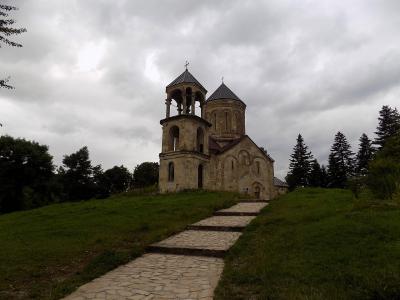
Places of the same kind
Fortress — all places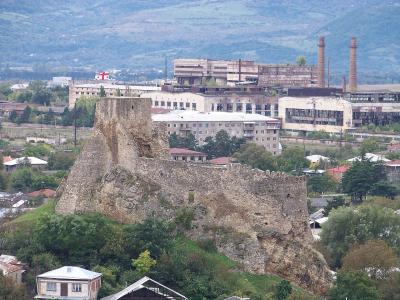
Nearby settlements