



Jumati Monastery
Link copied
Photograph: M. (CC BY-SA 4.0), Dmitri Yermakov (Public domain), Unknown author (Public domain)
The monastery of the Archangels Michael and Gabriel on the Guria range above the Supsa valley at 492 metres, from which all of western Georgia comes into view: the bishopric of Jumati of the fifteenth to nineteenth centuries and the seat of the Guria diocese in 1844–1886, home of the eleventh-century icons of the archangels whose enamel medallions are today in the Metropolitan Museum in New York, the Hermitage and the Louvre.
About
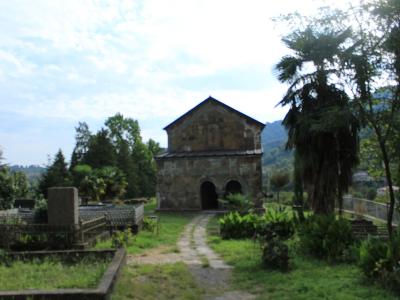
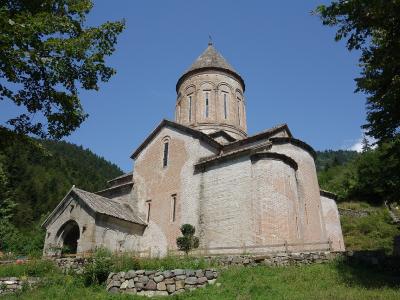
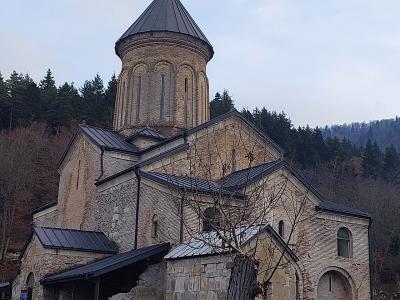
The Jumati monastery stands in the village of Dzirijumati in Ozurgeti Municipality on the Guria range above the valley of the Supsa, 14 kilometres from Ozurgeti and 492 metres above sea level, and from its yard practically all of western Georgia is in view: the Colchian lowland, the Greater Caucasus, Lake Paliastomi and the coast of Adjara. The monastery consists of the church of the Archangels Michael and Gabriel, two bell towers and a wall, and is an immovable cultural monument of national significance. The church is of hall type with a semicircular apse projecting on the east, entered from the south and west, with a blocked door in the northern wall too; the apse has three wide lintelled windows, the long walls are divided by three pairs of pilasters carrying the arches that support the vault, the sanctuary is raised one step, and the floor is paved with stone. It is built of dressed sandstone, in places of shirimi, several building layers can be read on the walls, the earliest on the southern and western walls, and the date of building is unknown: Dimitri Bakradze held it earlier than the church of Shemokmedi, it is dated roughly to the early feudal age, in construction it resembles the church of the Saviour at Shemokmedi, and Vakhushti mistakenly described it as domed. In 1847 the church was faced with grey porphyry and a chapel of the Mother of God added on the south, whose walls covered part of the frescoes.
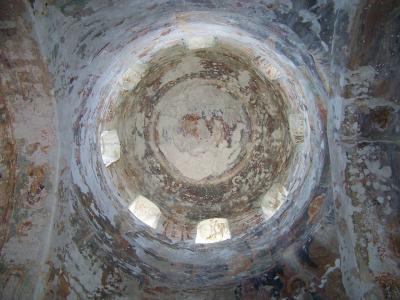
The frescoes are of the sixteenth to eighteenth centuries (the oldest fragments no later than the fourteenth) and badly damaged: a large archangel fills an arch of the northern wall, the rest shows scenes from the lives of the Saviour and the Virgin, on the northern wall the wife of the prince of Guria and on the southern the prince himself, the donors, and holy warriors in light blue, orange and wine red close to the Palaiologan style; the upper part was whitewashed in the nineteenth century. In 1904 a two-storey pavilion bell tower of limestone rubble was added on the west, and built into the wall is the second, older bell tower with a stone stair of twelve steps and a tall six-windowed dome, close to the bell towers of the sixteenth and seventeenth centuries and akin to those of Khobi and Tsaishi; in Ermakov's photograph of 1878 it still stands at full height, a cannon of the Soviet military unit brought it down, and it has lately been restored.
- Tradition / order
- Georgian Orthodox Church, a monastery of monks of the Shemokmedi diocese
History
By legend the church of Jumati is tied to the birth of Lake Paliastomi: a flood sank the "tribe of Pavlia" in the lake, only a deacon named Darchia survived, carrying the icon of the archangel up Mount Jumati, and there a church was built for the icon. Before the see was founded there was a monastery here; in the fifteenth to nineteenth centuries Jumati was the second bishopric of Guria after Shemokmedi, with the land between the Supsa and the Rioni, great wealth and precious icons: the monastery held estates at Chibati, Chochkhati, Shukhuti, Aketi, Lanchkhuti, Askana and Gurianta and 235 peasant households, the bishop of Jumati was owed a tithe of the fish caught in Paliastomi and kept a watchtower on the Maltakva. The monastery is mentioned by Vakhushti Bagrationi, by Johann Güldenstädt in 1768–1774 and on the 1737 map of Imereti attached to Jacques François Gamba's work; in the eighteenth century Giorgi IV Gurieli and Queen Khvaramze Dadiani renewed it and gave it a abbatial cross. The bishops lived at Jumati only in summer, going down in winter to Bogili on the Supsa. The bishopric of Jumati was abolished in 1827, and in 1844 the Guria diocese was founded with its seat at Jumati until 1886; in 1846 the Guria theological school opened here (moved to Ozurgeti in 1848) and in 1868 a one-class school.
The treasures of Jumati were the eleventh-century gold-covered icons of the Archangels Michael and Gabriel, with enamel medallions bearing Georgian and Greek inscriptions (the icon of Michael was given by Giorgi Gurieli, his son Loma and Loma's wife Adasujan), and the gold icon of St George of the eleventh or twelfth century given by Vardan Vardanisdze, eristavi of eristavis; Dimitri Bakradze described them in 1873 and Dimitri Ermakov photographed them in 1877–1878. In 1882 the Tbilisi photographer Stepane Sabin-Gus, with the exarch's permission, took both icons "for restoration" and never returned them: six medallions with Georgian inscriptions he gave back to Shemokmedi (later melted down at Ozurgeti), four he sold to Botkin and Bobrinsky, and those with Greek inscriptions to Prince Zvenigorodsky, from whom nine medallions passed to the millionaire Morgan, who presented them to the Metropolitan Museum in New York; three plaques are in the Hermitage and the medallion of St Demetrius in the Louvre. In 1879 the monastery was robbed and Bishop Gabriel wounded, in 1895 the Wardrops visited, on 5 August 1905 six robbers carried off icons worth 40 thousand roubles and the people's court of the Guria Republic sentenced them to two years' confinement in the monastery, in 1921 the icon of St George was lost in a robbery and sold piecemeal in the Tbilisi market, and by 1924 almost nothing of the antiquities remained. In Soviet times a single monk, Ioane Gogua, lived in the monastery (he died in 1955), then came a military unit and in the 1980s a pioneer camp; monastic life was restored on 21 November 1990 with the blessing of Metropolitan Konstantine Melikidze, Ilia II made a pilgrimage in 1995, a church of the Presentation was built in 1998, and in 2007 the monument was listed as of national significance.
Visit info
Jumati is 14 kilometres north of Ozurgeti, in the village of Dzirijumati, about half an hour by car. The monastery is a working house of monks: dress modestly, and check transport and opening hours locally.
Safety
This is a working monastery: do not disturb services, and keep away from the monks' cells. The mountain road can be slippery in rain.
Tip
The view from the edge of the yard is best on a clear morning, with Paliastomi, the sea and the Caucasus in one frame; inside, look for the archangel on the northern wall and the donor on the southern. The medallions can be seen in the Metropolitan Museum's online collection, worth a look before you come. With Shemokmedi and Likhauri it makes one day.
Sources
Nearby places
All places in the region
Places of the same kind
Monastery — all places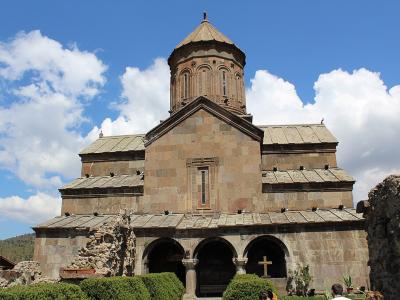
Nearby settlements