



Mount Khvamli
Link copied
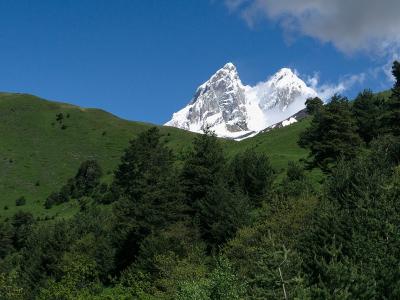
Photograph: Roberto Strauss (CC BY-SA 2.0), Ann Koridze (Public domain), Kober (CC BY-SA 3.0)
The limestone massif of Lechkhumi, 2,002 metres, visible from Kutaisi itself by its 300-metre cliff turned to the south: a double cuesta of sinkholes, with the Tekenteri cave entered through the hollow of a beech tree, the hiding place of the royal treasure named in the chronicle of 1259, the legendary rock to which Prometheus was chained and today the best day hike from Kutaisi, since from 2020 the asphalt climbs to 1,700 metres and two kilometres remain to the summit.
About
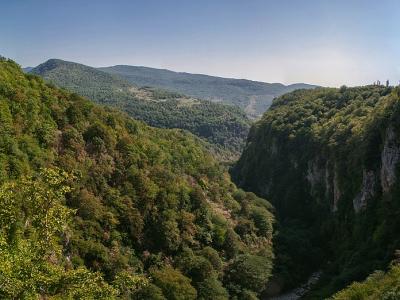
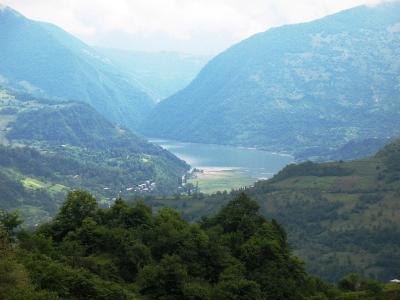
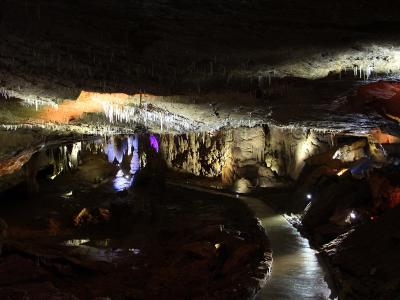
Khvamli, anciently Khomli, stands in the western part of Lechkhumi on the border of Tsageri and Tskaltubo municipalities and divides the valleys of the Rioni and the Tskhenistskali. It is a double cuesta of Cretaceous limestone, 2,002 metres high, which presents to the south a cliff of 300 metres: it is this white wall that shows on the horizon from Kutaisi, Gelati and Motsameta. The northern slopes of both cuestas are riddled with sinkholes and shafts. The most famous of the caves is Tekenteri at 1,400 metres: its only entrance is the hollow of a great beech, below which an 18-metre shaft drops to a lake of cold, clean water, and from the depths comes the sound of a waterfall; the other is the ice cave Boga. The massif is clothed in mixed forest, and above lies a plateau of alpine meadow from whose edge Imereti, Samegrelo and, on a clear day, the Black Sea come into view.
Khvamli is one of the most mysterious places in the history of Georgia. The fourteenth-century Chronicle of a Hundred Years tells that in 1259, under Mongol rule, the cousins David VI Narin and David VII Ulu divided the kingdom and took only certain articles from the treasure of Khomli: Narin received "the famous chain of diamonds, the superb jewel cut in the form of an anvil and a great pearl, of which the like was never seen", while most of the treasure stayed hidden in the caves. Marie Brosset reports that in the 1840s Prince Dadiani dug here without result, and in the 2000s the Georgian press wrote of secret searches by the Nazis and the Soviet security services. On the massif are the ruins of a church of St George of the twelfth or thirteenth century, whose inscription found in 1910 names Ioane, eristavi of the Svans; the present church was built on the old site at the beginning of the twentieth century, and on the summer feast of Khvamloba a service is held at dawn.
An ancient legend names Khvamli as the rock to which Prometheus, or his Georgian counterpart Amirani, was chained: in the 1850s the Italian traveller Pisagalli searched here for the traces of the Argonauts and Prometheus on the strength of the Greek sources, and was astonished that the locals knew the legend and celebrated the killing of the vulture that pecked at the liver of Prometheus. Jules Verne in Kéraban the Inflexible named the rock of Khomli above Kutaisi as the place of the chained Prometheus. By another tale the alternating flow of the nearby Verdzistava spring is caused by the movements of an immortal dragon living in the caves. Since 23 July 2020 Khvamli has been a monument of national significance and the territory of a planned managed reserve.
- Best season
- Autumn
- Difficulty
- Moderate
- Route type
- Out & back
- Surface
- Mixed
- Access notes
- Turn-off at Okureshi on the Kutaisi–Tsageri road; since 2020 an asphalt road climbs to the parking area at 1,700 metres, from which the summit is 2 kilometres on foot
- Safety notes
- The plateau has no railing and ends in a 300-metre cliff; in fog the marking is lost; the vertical caves are entered only with gear and a guide
- Parking
- Yes
History
By the explanation of Prince Vakhushti the mountain is named for its height, since khomli in old Georgian means a constellation. The anonymous chronicler, the Georgian Chronicles and Ivane Javakhishvili all name Khvamli as the hiding place of the treasure of the Georgian kings: during the Mongol invasions the royal treasure was kept in these inaccessible caves of Lechkhumi, and when the two Davids divided the country in 1259 they took only a part of the treasure of Khomli. For centuries this corner of Lechkhumi was the storehouse of church treasures carried up from the lowlands.
The rock shelters of Khvamli also sheltered the population in wartime, and on the summit stood a church of St George in the twelfth or thirteenth century. In the 1840s Dadiani searched for the treasure in vain, in the 1850s Pisagalli searched for the rock of Prometheus, and the excavations of 1910 found the building inscription of Ioane, eristavi of the Svans. Through the notes of nineteenth-century European travellers Khvamli even found its way into a novel of Jules Verne.
In the 2000s the archaeological survey of Khvamli drew the attention of the Georgian media, and in 2011 environmentalists feared the impact of the Namakhvani cascade of power plants and the Tvishi dam. On 23 July 2020 a government decree gave Khvamli the category of national significance, and the same year an asphalt road was brought up from Okureshi, which turned the former 30-kilometre trek into a two-kilometre climb.
Visit info
The Khvamli parking area is an hour and a half to two hours by car from Kutaisi: after 55 kilometres on the Kutaisi–Tskaltubo–Tsageri road you turn right at the sign near Okureshi and climb for another 30–40 minutes on the asphalt laid in 2020 to the clearing at 1,700 metres; the road is steep but passable in a sedan. From there the summit is 2 kilometres and 300 metres of climbing away, by a forest path to the church and then across a stony plateau, marked in yellow; the round trip takes 2–3 hours. From the central bus station of Kutaisi the Tsageri marshrutka leaves at 11:00, 14:00 and 16:00, and you get off at Okureshi, from where the parking area is 14 kilometres on foot or by taxi; a taxi from Kutaisi costs up to 70 lari one way. From the Tvishi side, in the Rioni valley, a 14-kilometre trail climbs up. Entry is free and no ticket or permit is needed; there is a spring on the road before the turn-off and no water on the summit. The best time is April to November.
Safety
The southern edge of the plateau is a 300-metre cliff without a railing: in fog, which comes down fast here, do not leave the marked route and keep away from the edge. Karst shafts hide in the grass, and Tekenteri is 18 metres deep, so descend only with caving gear and a guide. The tall grass includes giant hogweed, so wear long trousers. In winter the snow is deep and the climb takes a whole day; on the roads of Lechkhumi landslides are frequent in spring.
Tip
In summer go up only at dawn, since the plateau is exposed and the midday sun is merciless; sunrise from the summit against the Caucasus is the finest view in Lechkhumi. Autumn, the end of September and October, is the most beautiful for the colours of the deciduous forest. The Tekenteri hollow is 15–20 minutes from the church, but the path is unclear, so hire a local guide and do not go down the shaft. On the road are the Rachkha and Ophitara waterfalls, and near Tvishi the Lakhepa waterfall and lagoon; Tvishi wine takes its name from this valley.
Sources
Nearby places
All places in the region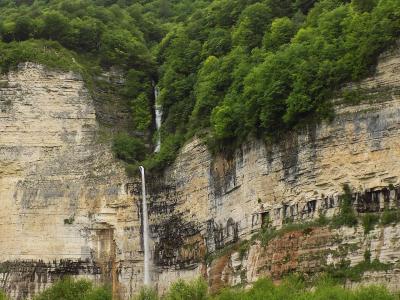
Places of the same kind
Trail — all places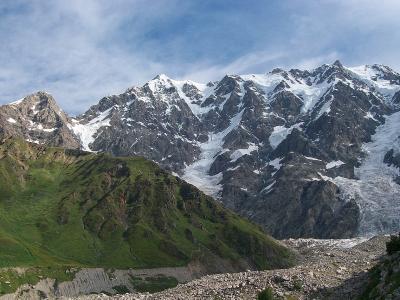
Nearby settlements