


Lake Ritsa
Link copied
Photograph: Hons084 (CC BY-SA 4.0), LxAndrew (CC BY-SA 4.0), Jacques Dupakiers (CC BY 2.0), Члены семей Семёновых и Шакуриных: Юрий Поликарпович Шакурин (1938-2000). Загружено единственной наследницей. (CC BY-SA 4.0)
One of the deepest mountain lakes of the South Caucasus, in a gorge east of the Gagra range at 884 metres above sea level: the water of the Lashipse dammed by a rockslide, and one of the main tourist sights of Abkhazia, reached by a road from the coast since 1936.
About
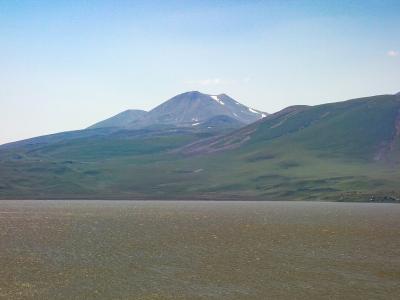
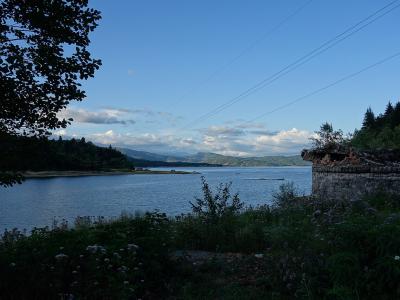
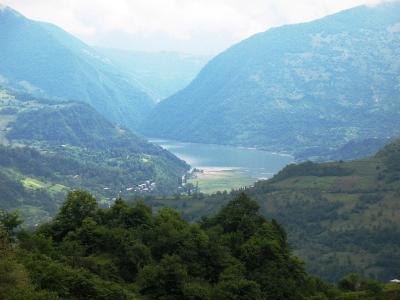
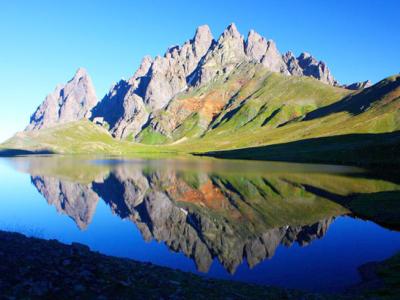
Ritsa, or Great Ritsa, is the largest lake in Abkhazia. It lies in Gudauta Municipality, in the basin of the Bzyb, east of the Gagra range, in the deep wooded gorge of the Lashipse and the Iupshara. The lake surface is 884 metres above sea level (other figures give 950 m); the area is 1.49 km², the length 2.5 km, the width from 270 to 870 metres and the volume 94 million m³. The greatest depth is given as 101 to 116 metres depending on the survey, the mean depth as 63 metres; by that measure Ritsa is one of the deepest lakes of the South Caucasus.
The basin was formed by a rockslide from Mount Pshegishkha that dammed the Lashipse, by some estimates about 250 years ago. Six rivers feed the lake, the Lashipse the largest of them; a single one drains it, the Iupshara, which joins the Gega and then the Bzyb. The water stands highest in May and lowest in February, with a mean annual range of 166 cm. The water is very low in dissolved minerals (66 mg/l) and changes colour: greenish-yellow in spring and summer, a cold blue in autumn and winter. The surface temperature is 3.8 °C in February and 17.8 °C in August; in exceptionally hard winters the lake freezes.
Mountains of 2,200 to 3,500 metres surround the lake, their slopes covered with mixed mountain forest, groves of Colchic box and Nordmann firs, single trees of which reach 70 metres. Trout live in the water. Mean annual precipitation is 2,000–2,200 mm and the mean temperature 7.8 °C. Higher up to the north lies the climatic resort of Avadhara, and nearby the Lesser Ritsa (0.2 km²).
- Access notes
- By the road built in 1936 from the coast up the Bzyb, Gega and Iupshara gorges; the road continues to the Avadhara resort
History
The lake is geologically young: it formed when a rockslide dammed the valley of the Lashipse. In Abkhazian legend Ritsa is a girl whom her brothers Agepsta, Atsetuka and Pshegishkha could not save from the robbers Gega and Iupshara; the brothers turned into mountains, and the robbers' names stayed with the rivers.
The road from the coast to the lake was built in 1936, and in the Soviet period Ritsa became one of the most popular tourist sites of the country, with up to a thousand visitors a day. On the shore stands the dacha of Joseph Stalin, with the dacha of Nikita Khrushchev adjoining it; both keep their historic furniture and interiors. In 1946 the Ritsa reserve of 16,289 hectares was created to protect the lake and its surroundings; today it forms part of the Ritsa Relict National Park. On the road to the lake, on the so-called Chabgar cornice, is a viewing point that tourist legend has named "Farewell, Motherland".
Visit info
From the coast, up the Bzyb gorge, a road of about 40 kilometres climbs to the lake through the gorges of the Gega and the Iupshara. On the shore Stalin's dacha is shown on guided visits, the eastern shore has a car park and tent sites in a beech grove, and in the bay there is a pebble beach where the water is 1–3 degrees warmer than in the rest of the lake.
Abkhazia is an occupied territory. Under Georgian law entry to the region is lawful only through the Enguri crossing; entry from Russia is a breach of Georgian law. Check the current conditions of movement before travelling.
Safety
The road is narrow and runs along rock cornices: drive carefully. Even in summer the water is cold (up to 18 °C); swim in the fenced bathing area of the bay. Mountain weather changes fast. Consular assistance in the occupied territory is limited.
Tip
The colour of the lake changes with the season: greenish-yellow in spring and summer, a cold blue in autumn and winter. Above the lake the road continues to the climatic resort of Avadhara, and the Lesser Ritsa lies nearby.
Sources
Nearby places
All places in the region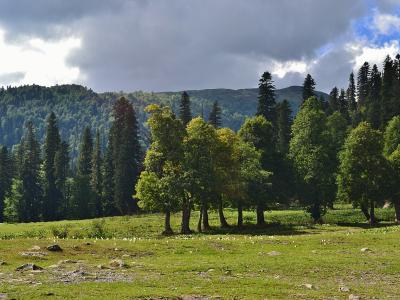
Places of the same kind
Lake — all places