



Prince of Oldenburg's Palace
Link copied
Photograph: Natalia Senatorova (CC BY-SA 4.0), maxell81 (CC BY 3.0), Наталья Филатова (CC BY 3.0), Dmitrij Yakovlev (CC BY-SA 2.5)
An Art Nouveau palace on the slope of Mount Signalka in Old Gagra, built in 1898–1902 by Prince Alexander of Oldenburg, founder of the Gagra resort: red tiles, oddly shaped windows and a falconer's tower; a sanatorium from 1917, and after war and fire under a long restoration.
About
The palace of Prince Alexander of Oldenburg, also called his castle, stands in Old Gagra on the slope of Mount Signalka, near the Zhoekvara river and the Abaata fortress. It is an Art Nouveau building of flowing forms and vivid details: a roof of red tiles, colourful balconies, windows of intricate shape, a semicircular central pediment and, rising over the main façade, the "falconer's tower", built on the orders of the prince, a devotee of falconry. The prince's study had a round panoramic window; a hotel wing for guests of royal blood and the highest nobility of the empire was added to the palace. The building stood in a garden of pools, sculptures and fountains behind a tall arched gate; two lighthouses in the grounds lit the way for ships and yachts, and a wooden turntable was devised in the narrow courtyard for the prince's Mercedes.
The palace was built in 1898–1902 to a design by the architect Grigory Lyutsedarsky; by tradition, after the foundations had cracked twice, the local contractor Yahya Kerbalai Abbas completed it. In 1906 a wing with a tower was added, over whose purpose, lookout or falconry, scholars still argue. In January 1903, in the newly opened Gagripsh restaurant, the prince announced the founding of the Gagra climatic station, and so the history of the resort began.
- Century
- 1898–1902, architect Grigory Lyutsedarsky; wing with the tower 1906
History
Prince Alexander of Oldenburg, a relative of the Russian imperial house, visited Gagra at the end of the nineteenth century and resolved to make a climatic resort here: he laid out the seaside park on the shore, had the clock-towered hotel, now Gagripsh, brought from Norway in pieces and the restaurant from Vienna, and opened the resort in 1903; at his request the Gagra climatic station was placed under the Sochi district of the Black Sea governorate. In February 1917 the prince left Russia, his property was nationalised and the palace turned into a sanatorium for nervous patients; Isaac Babel and Dmitry Furmanov describe it in their sketches as a place fallen into neglect and only beginning to revive. In 1919 a decree of Lenin declared Oldenburg's resort a "workers' resort". In the Soviet period the palace housed first the Stalin sanatorium and then the elite Chaika guest house.
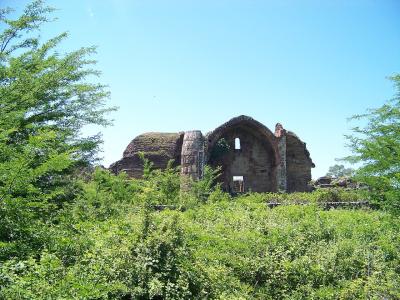
In the war of 1992–1993 the building was badly damaged, and in the early 2000s it suffered a fire. In 2010 the de facto authorities leased the palace to a private company for 49 years; the replacement of the roof began without the agreement of the heritage protection department, and as of 2022 the restoration was still in progress. In 2013 Huno, Duke of Oldenburg, a relative of the prince, was received with his wife in the restored wing. Because of the occupation Georgia can neither study nor protect the monument.
Visit info
The palace stands in Old Gagra on the slope of Mount Signalka, about half a kilometre from the Gagripsh restaurant and the seaside park. As of 2022 the restoration was still in progress; check locally whether the building can be visited.
Abkhazia is an occupied territory. Under Georgian law entry to the region is lawful only through the Enguri crossing; entry from Russia is a breach of Georgian law. Check the current conditions of movement before travelling.
Safety
The building was badly damaged in the war and by fire and is under restoration: do not enter the site. The paths on the slope are slippery after rain. Consular assistance in the occupied territory is limited.
Tip
The Gagripsh restaurant, the seaside park, the colonnade and the Abaata fortress all lie within about a kilometre of the palace and can be combined with it in one walk.
Sources
Nearby places
All places in the region
Places of the same kind
Palace — all places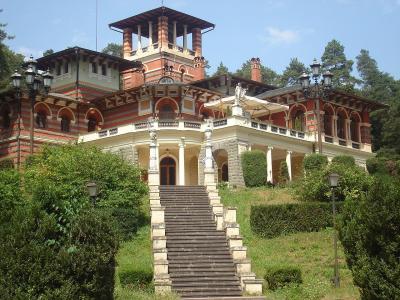
Nearby settlements