



Abaata Fortress
Link copied
Photograph: Valera N. Trubin (CC BY-SA 4.0), Sukhovand (CC BY-SA 4.0), Poglik (CC0), ᴀɴᴅʏ ᴏɴᴇ (CC BY-SA 2.0)
The oldest building of Gagra: a fortress of the fifth and sixth centuries on the seashore at the mouth of the Zhoekvara gorge, closing the road from the west; within its walls stands the sixth-century church of St Hypatius, in 1830 a Russian garrison was installed here, and at the beginning of the twentieth century the Prince of Oldenburg built a hotel inside it.
About
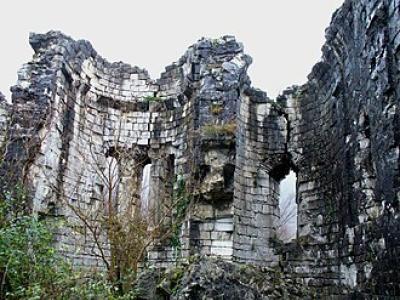
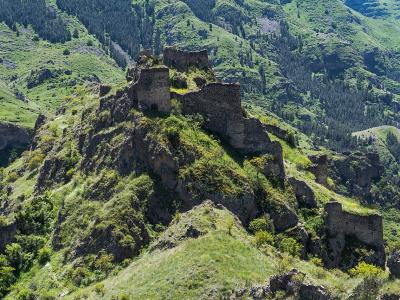
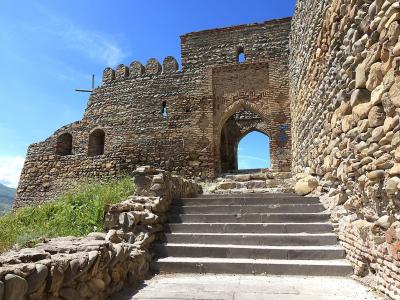
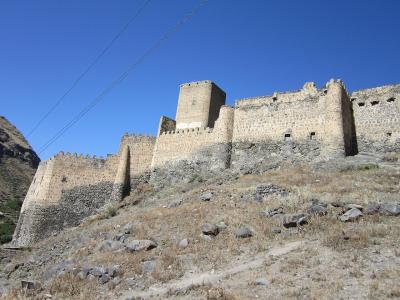
The Abaata fortress stands in the old part of Gagra, on the seashore at the foot of the mountain by the mouth of the Zhoekvara gorge, and is the oldest building of the town. The site was strategically apt: the fortress closed the main road from the west and protected the Abkhazian settlements from raids. Its construction is placed in the fifth and sixth centuries, as the masonry of large square blocks characteristic of that age, visible in the surviving stretches of wall, attests; the old gate with its stone arch also survives.
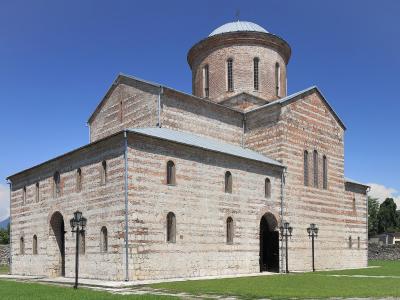
The wall facing the sea was washed away by the surf and has all but vanished, while the remaining walls and towers are fairly well preserved; part of the enclosure is occupied by a hotel built at the beginning of the twentieth century. Within the walls stands the sixth-century church of St Hypatius, one of the oldest places of worship in Abkhazia. Canonically the church lies within the jurisdiction of the Georgian Orthodox Church and is in use today.
- Construction period
- 5th–6th century; rebuilt for a Russian garrison in 1830 and remodelled by the Prince of Oldenburg at the beginning of the 20th century
History
The fortress was built in the fifth and sixth centuries to guard the approach from the Zhoekvara gorge; in the eleventh century part of the walls was dismantled. In 1830 a Russian military detachment landed here, rebuilt the fortress and set up the Gagra fortification, where the 5th Black Sea battalion was stationed; the fort communicated with the outside world only by sea. The Decembrist writer Alexander Bestuzhev-Marlinsky, who served here, described the place as "the dreadful climate of Abkhazia": a hollow shut in between huge mountains where no wind reaches, where the heat of the scorched rocks is unbearable, the stream dries into a stinking pool, the enemy fires into the fort's windows from every side, and fever rages so that every year deaths reach one and a half times the strength of the garrison. The fortress was repeatedly ruined and rebuilt afterwards.
At the beginning of the twentieth century, when Gagra was being built up as a climatic resort, Prince Alexander of Oldenburg ordered part of the fortress wall demolished and built a hotel on its grounds. The church of St Hypatius is listed as a cultural heritage monument of Georgia; because of the occupation Georgia can neither study nor maintain the monument.
Visit info
The fortress stands in Old Gagra at the mouth of the Zhoekvara gorge; the palace of the Prince of Oldenburg, the Gagripsh restaurant and the seaside park are among the other sights of the town. The church of St Hypatius is a working church; check access to the precinct and the church locally.
Abkhazia is an occupied territory. Under Georgian law entry to the region is lawful only through the Enguri crossing; entry from Russia is a breach of Georgian law. Check the current conditions of movement before travelling.
Safety
The remains of the seaward wall are undermined by the surf, so do not climb them. Dress rules are observed in the working church. Consular assistance in the occupied territory is limited.
Tip
The large-block masonry of the walls and the arched gate of the fortress show best in the morning side light. A short walk into the Zhoekvara gorge from the fortress and a look at the Oldenburg palace, Gagripsh and the seaside park fit into half a day.
Sources
Nearby places
All places in the region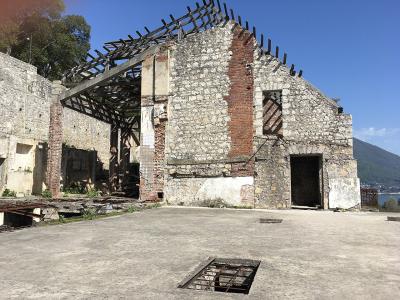
Places of the same kind
Fortress — all places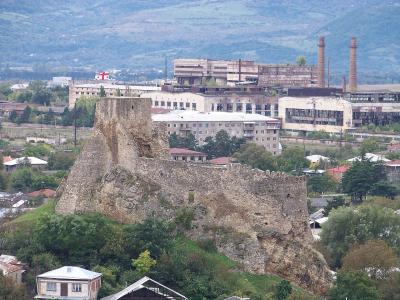
Nearby settlements