



Lykhny Church
Link copied
Photograph: Hons084 (CC BY-SA 4.0), Alexxx1979 (CC BY-SA 4.0), Михайлов К. А. (Public domain), Rod vlad (CC BY-SA 4.0)
A tenth-century domed church in the village of Lykhny, the old residence of the princes of Abkhazia, with fourteenth-century frescoes, more than a dozen Georgian and Greek inscriptions and a record of Halley's Comet of 1066 cut into its wall.
About
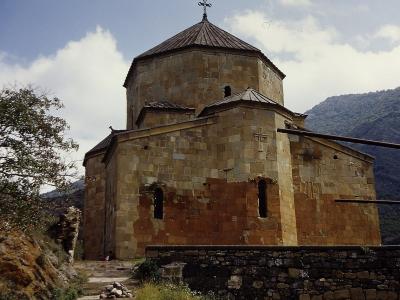
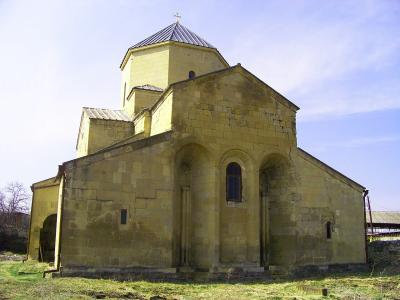
The church of the Dormition of the Mother of God at Lykhny stands in the middle of the village of Lykhny, in Gudauta Municipality, a few kilometres from Gudauta. It is a tenth-century cross-in-square domed building of neat courses of well-dressed ashlar. The small dome, with a low drum and a sloping roof, rests on four free-standing piers; on the west is a gallery. The façades are plain, broken only by the window openings, and three projecting apses stand out on the east.
Inside are traces of painting of the tenth and eleventh centuries, while the surviving cycle belongs to the fourteenth and bears the influence of the Byzantine art of its time: delicate colouring and somewhat elongated, dynamic and expressive figures. In the upper tier of the sanctuary apse are the enthroned Mother of God with the Child and two angels, the Eucharist and the myrrh-bearing women at the tomb; in the middle tier the Hospitality and the Sacrifice of Abraham, in the lower Basil the Great and Gregory the Theologian; on the west wall part of the Dormition. The paintings carry more than a dozen Georgian and Greek inscriptions naming Bagrat IV, Giorgi II and churchmen. In the church is the tomb of Safarbey (Giorgi) Shervashidze, prince of Abkhazia; in the village lie the ruins of the palace of the princes of Abkhazia.
- Denomination
- Georgian Orthodox (canonically); held de facto by an unrecognised church body
History
The church was built in the tenth century; the main source for its history is its architecture and painting themselves. Lykhny, then also called Souk-Su, was the residence of the princes of Abkhazia. The antiquities of the church were first described in 1848 by the French Kartvelologist Marie-Félicité Brosset, who copied several Georgian and Greek inscriptions from its walls. The most famous is an asomtavruli inscription on the appearance of Halley's Comet in 1066, in the reign of Bagrat IV (1027–1072): the event is dated three ways, from the Creation, by the indiction and by the koronikon, with month and days; by Brosset's reckoning the comet appeared between 9 and 16 April 1066, between Palm Sunday and Easter. The same comet is recorded in the Kievan chronicle, a Chinese chronicle and the Bayeux tapestry.
On 7 November 2006 a decree of the President of Georgia listed the Lykhny church as an immovable cultural monument of national significance. In 2010 the de facto authorities began conservation works and put a temporary roof over the monument; in the assessment of Georgian specialists the works proceeded without professional restorers and endangered the authenticity of the monument and its painting. Because of the occupation Georgia can neither study nor maintain the monument.
Visit info
Lykhny is a few kilometres north of Gudauta; the working church stands in the middle of the village.
Abkhazia is an occupied territory. Under Georgian law entry to the region is lawful only through the Enguri crossing; entry from Russia is a breach of Georgian law. Check the current conditions of movement before travelling.
Safety
Do not climb on the palace ruins. Dress rules are observed in the working church; do not touch the frescoes. Consular assistance in the occupied territory is limited.
Tip
The comet inscription is inside; ask local people which wall it is on, and bring a torch and a high ISO for photographs. In the village see also the ruins of the princes' palace. Lykhny fits easily into one day with New Athos and the road to Ritsa.
Sources
Nearby places
All places in the region
Places of the same kind
Church — all places
Nearby settlements