



Tsromi Church
Link copied
Photograph: Jaba1977 (CC BY-SA 4.0), Kober (CC BY-SA 4.0)
An early medieval domed church in the centre of the village of Tsromi in Khashuri municipality, on the right bank of the Mtkvari, built in 626–635 at the order of Stepanoz II, presiding prince of Kartli. It is the first Georgian church whose dome rests on four free-standing piers, and the two deep triangular niches of its east façade, which appear here for the first time, later became a hallmark of Georgian church architecture. The conch of its sanctuary was decorated with a mosaic of Christ in Glory, whose surviving fragments are kept in the Art Museum of Georgia.
About
Tsromi Church stands in the centre of the village of Tsromi in Khashuri municipality, on the right bank of the Mtkvari, 3 kilometres from Gomi railway station. It is dedicated to the Saviour. The church is a cross-in-square building, 25.6 × 19.85 metres, built of well-dressed sandstone blocks, partly also of dark grey and yellowish porphyrite, laid with straight horizontal joints. It stands on a plinth of two or three steps and has three entrances, on the west, north and south. Its artistic importance is compared with that of the Jvari monastery at Mtskheta, and it stands at the root of the later development of Georgian church architecture in the Middle Ages.
Tsromi is the first Georgian church in which the dome rests on four free-standing piers, a solution that freed the walls and opened new prospects for Georgian architecture. The piers sharply mark out the square under the dome, over which rises an octagonal drum; the passage from the square to the octagon is made by four large semi-conical squinches. The dome stands at the centre of the building, with the cross arms on all four sides under powerful barrel vaults set at right angles to each other. Inside, a long east–west axis runs from the apse to the gallery in the west, which makes the western arm as long as the eastern and balances the whole interior. Under the gallery is a long narthex, barrel-vaulted in the middle and cross-vaulted at the sides, with three doors into the church; a stair of four flights, each carried on an arch, leads up to the gallery, which was meant for the nobility, women and singers. In the south-west is a two-storey room: the lower floor, open to the east, was for women and the upper one for the nobles. On either side of the apse lie the square diaconicon and prothesis, the north-eastern with a cross vault and the south-eastern with a star-shaped one. Light comes in through a large window in each arm, four windows in the drum and several round windows.
The façades are severe and monumental. The east façade is in three parts: the raised middle plane, ending in a gable, corresponds to the sanctuary, with low corner rooms under lean-to roofs on either side. Where the apse meets the side rooms two deep triangular niches are cut into the wall: they relieve the wall of excess mass and give the façade its design, and this device, first seen at Tsromi, was developed in later Georgian church architecture. The niches are linked by a triple arcade, paired columns with capitals and bases stand deep inside them, and painted rays survive in their rounded heads. The west, south and north façades share a similar central axis: a rectangular door with an arched tympanum, a wide arched window above it at the level of the gallery, and a round window in the gable. On the tympanum of the wide west door is a tall stepped cross, and on that of the south door a cross; under the south gable is a relief of a flowering cross, with rosettes and leaf reliefs on the cornice stones above it. To the left of the middle window of the south façade is an asomtavruli inscription naming Stepanoz II, son of Adarnase, presiding prince of Kartli. The church is roofed with tiles and stone slabs.
The conch of the sanctuary was decorated with a mosaic of the first half of the seventh century. Most of it is lost, its surviving fragments were taken to the Art Museum of Georgia in the 1930s, and only the outlines of the preparatory drawing remain in the sanctuary. It showed Christ in Glory, a composition linked with the theme of the Ascension: at the centre Christ stood full-length on a pedestal, and of him only the outline of the face, part of the halo and the raised right hand survive; the figures approaching him were probably the apostles Peter and Paul, with a vase of flowers and other vessels between them. The background was laid with gold tesserae of different sizes and shapes, black and red-painted limestone, and bluish and pale green local stone. In the arch of the sanctuary window are three medallions, a cross in the middle one and busts of martyrs in the others, with an ornamental band of acanthus leaves beneath them. The other walls and vaults of the church were never painted.
- Denomination
- Georgian Orthodox Church; dedicated to the Saviour
- Century
- 626–635 (by another dating 626–634), commissioned by Stepanoz II, presiding prince of Kartli; restoration since 1949
History
An important church stood at Tsromi long before the present one: there, as the chronicler relates, Razhden, who had accepted Christianity in the time of Vakhtang Gorgasali, was martyred in August 457. On the ruins of that old church, as the academician G. Chubinashvili noted, Stepanoz II, presiding prince of Kartli, built the present domed church; by the south façade it dates from 626–634 (by another dating, 626–635). The village is named after a bird: by the explanatory dictionary of the Georgian language, tsromi is "the same as ch'ot'i", a kind of owl.
The church was damaged and altered several times, between the eleventh and twelfth centuries and in the sixteenth–seventeenth centuries. Tsromi, one of the important settlements of western Kartli, was ruined by the Lek raids of the eighteenth century: on 24 September 1731 a Lek raid destroyed the church's enclosure wall, and the village was resettled only from the sixties and seventies of the eighteenth century, when the Tsitsishvili princes brought in settlers from Javakheti. The earthquake of 8 May 1940 badly damaged a large part of the church: the dome fell, together with the walls of the square under it and much of the barrel vaults of the west and south arms, and the west wall leaned over; even so, the original plan and the overall composition of the church remained unchanged.
Restoration began in 1949 under L. Khimshiashvili. In 1949 special supporting structures were put up to hold the west wall, in 1959 the leaning west wall was straightened, and in 1974–1975 the squinches were built up to the base of the drum and a trial wooden dome was placed on the church. In 2006 a decree of the President of Georgia gave the church the status of an immovable cultural monument of national significance.
Visit info
Tsromi lies in Khashuri municipality, on the right side of the Mtkvari, at 800 metres above sea level, and the church is 3 kilometres from Gomi railway station. By road it is about 14 kilometres from Khashuri, 44 kilometres from Gori and 122 kilometres from Tbilisi. Check locally whether the church is open and when services are held.
Safety
The church was badly damaged by the earthquake of 1940 and restored with a trial wooden dome: keep to any barriers you find and do not climb on the walls. If a service is under way, keep quiet and ask before taking photographs.
Tip
Start with the east façade: see the two deep triangular niches, the triple arcade that links them and the paired columns set deep inside, and look for the traces of painted rays in the heads of the niches. On the south façade find the flowering cross under the gable and the inscription of Stepanoz II beside the middle window. Inside, look at the squinches that carry the drum and at the apse, where the outlines of the lost mosaic and the medallions in the window arch survive; the mosaic fragments themselves are kept in the Art Museum of Georgia. The village also has a church of Saint Marine.
Sources
Nearby places
All places in the region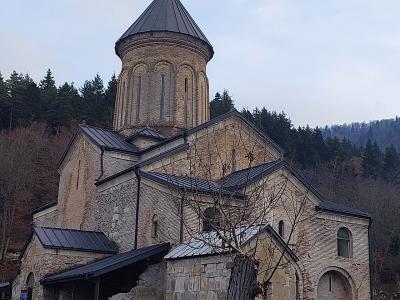
Places of the same kind
Church — all places
Nearby settlements