



Otkhara Cave Monastery
Link copied
Photograph: Alexxx1979 (CC BY-SA 4.0), Lex Kravetski (CC BY 2.0)
Caves cut in several tiers into a sheer cliff at the foot of the Bzyb range near the village of Otkhara, above the karst source of the Mchishta: by tradition a home of monks and later a refuge of brigands, first explored scientifically in 1958 and dated by its finds to the thirteenth and fourteenth centuries.
About
The Otkhara cave monastery complex lies near the village of Otkhara in Gudauta Municipality, some twenty kilometres north-west of Gudauta, at the foot of the Bzyb range. The caves are cut into a sheer cliff from whose base the karst river Mchishta (the Black River) wells up, which is why they are also called the Mchishta caves. The complex is considered an early medieval church, but its exact function and date have not been established.
The cave openings lie several metres above the ground, arranged in several tiers. They are rectangular, plainly cut by human hands, and faced with stone laid in lime mortar. Each is a narrow grotto two to three metres wide and up to fifteen metres high; wooden details of the rock-cut openings have survived. Objects of everyday use found in the caves are dated to the thirteenth and fourteenth centuries. In the village also stand the ruins of the medieval Otkhara castle, which likewise needs urgent conservation.
- Tradition / order
- Orthodox (presumably); the function and date are not firmly established
History
By local tradition a community of monks lived in the caves, and later brigands used them as a refuge; one scholarly hypothesis likewise supposes a religious use in the Middle Ages. In the second half of the nineteenth century Mazhar Shervashidze, a nobleman of Otkhara, led a group of villagers in an attempt to explore the caves: he managed to climb to the first tier and reportedly recovered two silver objects, whose later fate is unknown.
The first scientific exploration took place only in 1958, when a group of specialists from Tbilisi climbed into the caves with the help of mountaineers; the household objects found there were dated to the thirteenth and fourteenth centuries. Because of the occupation Georgia can neither study nor maintain the monument.
Visit info
Otkhara is 18 kilometres north-west of Gudauta; from the village the way to the cliff runs up the valley of the Mchishta (the Black River), where a trout farm known since Soviet times operates. The caves cannot be climbed without equipment, so they are seen from below; check the approach and the state of the path locally.
Abkhazia is an occupied territory. Under Georgian law entry to the region is lawful only through the Enguri crossing; entry from Russia is a breach of Georgian law. Check the current conditions of movement before travelling.
Safety
Attempting to climb the cliff is dangerous: the openings are several metres above the ground. Paths can be slippery after rain, and the river is cold and fast. Consular assistance in the occupied territory is limited.
Tip
The openings are several metres above the ground, so bring binoculars or a telephoto lens. The karst source of the Mchishta at the foot of the cliff is worth seeing too. Otkhara combines with Lykhny and Gudauta in one day.
Sources
Nearby places
All places in the region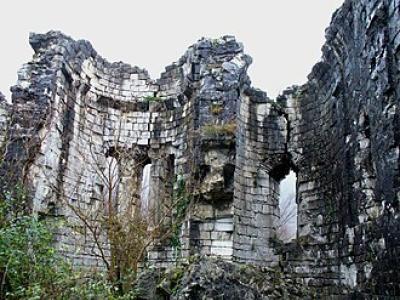
Places of the same kind
Monastery — all places
Nearby settlements