



Mravaldzali Church of St George
Mravaldzali Oni Municipality Racha-Lechkhumi and Kvemo Svaneti
Link copied
Photograph: Yasuhiro Kojima (CC BY 4.0), Island (CC BY 4.0), Unknown author (CC BY-SA 3.0), Jaba1977 (CC BY-SA 4.0)
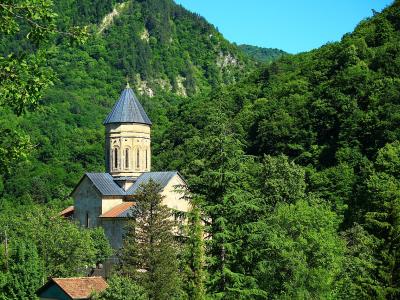
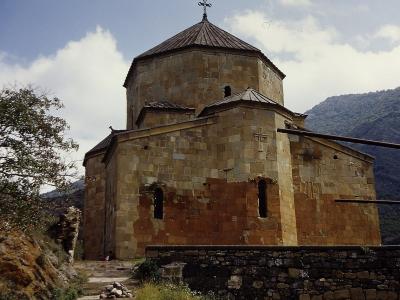
The eleventh-century church of St George in Mravaldzali, the highest village of Racha at 1,840 metres: a hall church of the time of Bagrat III with singular reliefs and inscriptions, held across western Georgia as a place of oaths, once the keeper of the helmet of Jalal ad-Din and the sword of Shah Abbas, given a dome in 1894, brought down by the earthquake of 1991 and restored to its original form in 2009.
About
Mravaldzali is a mountain village of Oni municipality at 1,840 metres above sea level, the highest village in Racha, from which the main ridge of the Caucasus and the Rioni valley lie open to view. The church stands on the slope of Kvintsikhe hill, where the monks moved from an older monastery by the Cholevi cliff, the ruins the people call Naeklesievi. The church of St George was built in the eleventh century and is probably tied to the founding of the eristavate of Racha by Bagrat III in 1010, the same wave that produced Nikortsminda, Patara Oni and Zemo Krikhi. It was at first a single-nave hall church of middling size typical of Racha, 10.75 by 6.75 metres, famed for its refined forms, its carving, its lapidary inscriptions, its fully painted walls, its carved stone iconostasis and the treasures given to it.
In the Middle Ages hardly any other shrine in western Georgia could match the standing of St George of Mravaldzali: a thirteenth-century monastery of the Crucifixion in the village of Sori was built in its name, oaths were sworn here and the spoils of war were offered. The church kept the helmet of the Khwarazmshah Jalal ad-Din and the sword of Shah Abbas I, a pair of silver-mounted drinking horns which Ekvtime Takaishvili described in 1920, and inscriptions read by Marie Brosset. A legend explains the name: an Ottoman army that broke into Racha was blinded by fog, and the host named the church Mravaldzali, the one of many powers, and dared raid Racha no more. The villagers still greet one another with the words "May St George of Mravaldzali protect you".
In 1894, under Dean Mikheil Skhirtladze, the church was renewed and enlarged into a cruciform building of 18.75 by 13.10 metres with a ten-sided dome and a western bell tower, in which only the eastern part of the old church remained; the heads of a bull and a cow were then carved above the west door, and they can still be seen. The Racha earthquake of 29 April 1991 brought down the nineteenth-century building and damaged the old part as well; the restoration begun in 2007 was completed in the autumn of 2009, and the church regained its eleventh-century hall form. Since 2018 Mravaldzali has been a monument of national significance, and its architectural fragments of the tenth and eleventh centuries are kept in the Oni museum.
- Denomination
- Georgian Orthodox Church, eparchy of Nikortsminda
- Century
- Hall church of the 11th century; rebuilt as a domed church in 1894; returned to its original form in 2007–2009
- Dress code
- Headscarf and skirt for women, long trousers for men
History
Three kilometres from the village, at the end of the Cholevi cliff above the little Chikis lake, lie moss-covered ruins the people call Naeklesievi: a monastery stood here from the earliest times. For some reason the monks left and settled on the slope of Kvintsikhe hill, where in the eleventh century, after the founding of the eristavate of Racha, the church of St George was built. In the thirteenth century the monastery of the Crucifixion at Sori was founded in its name. Over the centuries spoils of war and offerings gathered in the church: the helmet of Jalal ad-Din, the sword of Shah Abbas, silver-mounted drinking horns, crosses, icons and manuscript books. A letter printed in the newspaper Iveria in 1894 also preserves the legend of the Ottoman army and the fog.
In the nineteenth century the Russian exarch abolished the monastery and turned it into a parish church. In 1894 Dean Mikheil Skhirtladze renewed and enlarged the church, setting a dome on it and adding a bell tower on the west. In 1920 Ekvtime Takaishvili visited the church and described its treasure. In the Soviet period most of the objects passed to museums.
The Racha earthquake of 29 April 1991, the strongest in the history of Georgia, brought down the nineteenth-century building and damaged the old part as well. In 2007 the monument protection service of the Ministry of Culture began the restoration and finished it in the autumn of 2009; the dome was not returned, and the church was rebuilt in its eleventh-century form. In 2018 a decree of the government of Georgia gave the Mravaldzali church the category of an immovable cultural monument of national significance.
Visit info
Mravaldzali is about 33 kilometres and an hour from Oni by mountain road; check the state of the road with locals in advance, and in winter snow often closes it. No regular public transport reaches the village, but a taxi or a local driver can be found in Oni. The church is in use, open by day and free to enter, and cars stop by the yard. An hour is enough for the visit; allow more time for the view from Mount Khikhati and the walk to the Lake of Love.
Safety
The village lies at 1,840 metres: the weather changes fast, warm clothes and a rain jacket are needed even in summer, and in winter and early spring the road is snowy and slippery. Drive slowly on the mountain serpentine in fog. This is a working church: keep to the dress code and to silence.
Tip
The reliefs of the façade, the bull and cow heads over the west door, the eleventh-century carving and inscriptions, read best in the morning sun; for photographs take the view from the south-west, where the Caucasus rises behind the church. The Oni museum keeps fragments of this church from the tenth and eleventh centuries, worth seeing before you come. Picnics and tents are allowed by the Lake of Love. Greet the locals with "May St George of Mravaldzali protect you".
Sources
Nearby places
All places in the region
Places of the same kind
Church — all places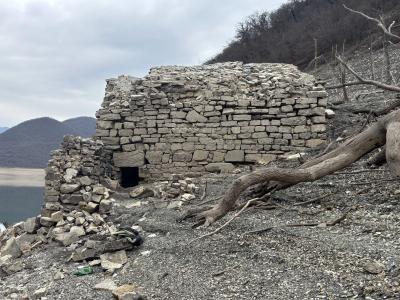
Nearby settlements