



Minda Fortress
Tsesi Ambrolauri Municipality Racha-Lechkhumi and Kvemo Svaneti
Link copied
Photograph: Yasuhiro Kojima (CC BY-SA 2.0), Jelger Groeneveld (CC BY 2.0)
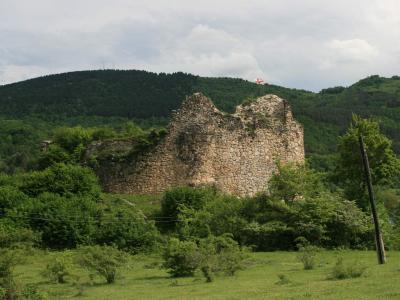
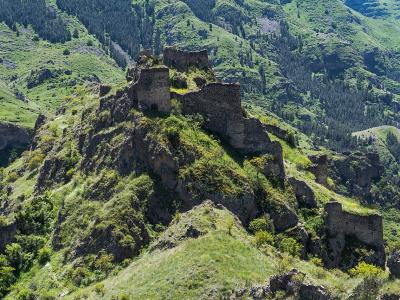
The chief fortress of the eristavis of Racha above the village of Tsesi, on a high rocky spur at the confluence of the Lukhuni and the Rioni: in the words of Vakhushti "a strong fortress, beyond the reach of the enemy", which controlled the trade road to Oni, was handed in the 1530s by King Bagrat III of Imereti to the Chkhetidze together with the banner of Racha, was taken by Solomon I in 1769 and has left a curtain wall, three towers and a room with a window; its image appeared on the Soviet label of Barakoni wine.
About
The Minda fortress stands above the village of Tsesi on a high rocky spur of the left bank of the Lukhuni, where the Lukhuni joins the Rioni and where the Barakoni church rises below. From here both valleys of Racha lie open, the Rioni towards Oni and the Lukhuni towards the mountains, so the fortress controlled the road to Oni, an important trading centre of western Georgia. Prince Vakhushti describes it as "a strong fortress on a high cliff, beyond the reach of the enemy", and to this day it is one of the hardest fortresses in Georgia to reach: only a narrow path lost in the forest climbs to it.
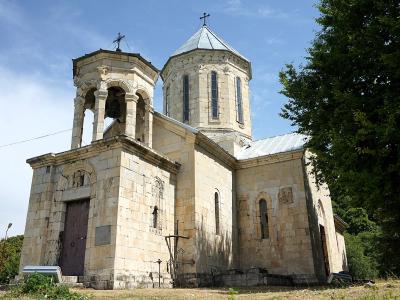
The fortress is badly damaged: what survives is the curtain wall, three towers, the western one cylindrical and the northern and south-eastern ones square, and a room with a window; there should be a second room, but it is inaccessible. The entrance is from the south. To the east is a small, damaged church of the early Middle Ages. The building was rebuilt several times and the building layers overlap one another. By tradition an eight-ton wine jar stood in the fortress, of which no trace remains.
In the Soviet years the silhouette of the Minda fortress was printed on the label of Barakoni wine and became a kind of emblem of Racha. From below, from the yard of Barakoni or the bridge over the Rioni, the towers of the fortress are made out on top of the cliff from afar.
- Construction period
- Probably from the 10th century; in written sources from the 17th century; rebuilt several times
History
By one account the Minda fortress already existed in the tenth century: it was the chief fortress of the eristavis of Racha, the Kakhaberidze, whose family monastery was Nikortsminda and whose domain was ruled from Tsesi; below, on the site of Barakoni, the first eristavi Rati son of Liparit built a court church. In the thirteenth and fourteenth centuries, after the fall of the Kakhaberidze, the fortress belonged to the royal government. In the 1530s King Bagrat III of Imereti (1510–1565) handed the castle to the house of Chkhetidze and entrusted it with the command of the banner of Racha, and so a new dynasty of the eristavis of Racha began.
The fortress appears in written sources from the seventeenth century, and in the eighteenth Prince Vakhushti described it as an impregnable stronghold. In 1769 King Solomon I of Imereti punished the rebellious eristavi of Racha, abolished the eristavate and took the Minda fortress; after that it lost its military meaning and gradually fell into ruin. The study of V. Bochorishvili of 1994, Historical Monuments and Antiquities of Racha-Lechkhumi, is its principal description.
Visit info
The climb starts from the village of Tsesi, 6 kilometres from Ambrolauri towards Oni, at the yard of the Barakoni church, where the car is left. The path climbs steeply through the forest to the rocky spur, with the last stretch a scramble over rock; there is no marking, so ask the locals for the way. The fortress is open, entry is free, and there is neither ticket nor guide. Plan the climb for dry weather, from late spring to autumn.
Safety
The path is steep, slippery when wet and ends with a scramble over rock: sturdy shoes, free hands and dry weather are needed, and do not go up in rain or fog. The walls of the fortress crumble and the edges have no railing, so do not climb the towers and lead children by the hand.
Tip
From the towers Barakoni, the meeting of the two rivers and the Rioni valley towards Oni fit in one frame; the best light is in the afternoon, when the sun lights the valley from the west. From below, the silhouette of the fortress is photographed from the bridge over the Rioni. Barakoni, the Minda fortress and the Khotevi fortress fit into one day, and Khvanchkara and Racha ham are sold at the Ambrolauri market.
Sources
Nearby places
All places in the region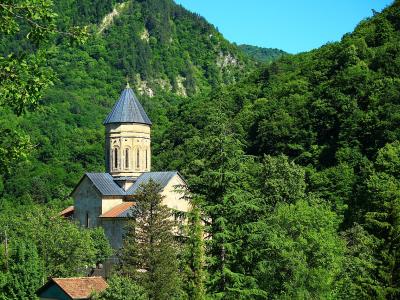
Places of the same kind
Fortress — all places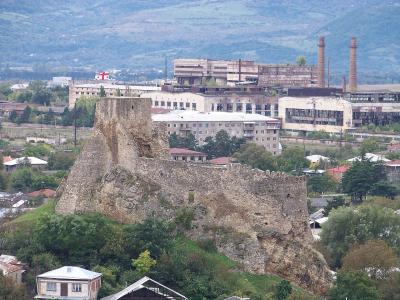
Nearby settlements