



Joseph Stalin Museum
Link copied
Photograph: Goichev (CC BY-SA 4.0), Sasha India (CC BY 2.0), Adam Jones (CC BY-SA 2.0), Marmontel (CC BY 2.0)
A state museum in the centre of Gori, the town where the Soviet leader Joseph Stalin (Jughashvili) was born in 1878. The complex takes in the small memorial house where he was born, opened as a museum in 1937 during his lifetime, a two-storey exhibition building with a tower, and Stalin's armoured personal railway carriage. The display largely keeps its Soviet-era character, and since 2010 a separate room of the museum has been devoted to the period of repressions.
About
All three parts of the museum are in the centre of the town. The memorial house was built in the nineteenth century in the former "Rus Ubani" quarter of old Gori, at 10 Kviratskhoveli Street, of mud brick and Georgian brick. Stalin's parents rented one room and the basement here; in the basement his father, Besarion Jughashvili, made shoes. The Jughashvilis' room holds objects of the period, and the second room, which belonged to the landlord, shows the belongings of his mother, Ekaterine Jughashvili. The house was originally part of a quarter of similar dwellings, which was cleared in Soviet times to make way for new housing, a square and the museum. A protective pavilion stands over it (architect Mikheil Neprintsev).
The two-storey exhibition building with a tower was built to a design by the architect Archil Kurdiani in the Stalinist style of architecture. It is faced with eklari stone, its columns are decorated with ornament, and the vestibule is lined with red marble. The permanent exhibition fills six halls: the first covers the years before and during the revolution, the second the Soviet period that followed, and the third the Second World War, with photographs of the Tehran, Yalta and Potsdam conferences and one unretouched photograph of Stalin. In the fourth hall, between marble columns, stands one of the copies of the bronze mask taken after Stalin's death (sculptor M. Manizer), with Ucha Japaridze's canvas "Stalin in His Coffin"; the fifth hall holds gifts presented to Stalin, and the sixth his study, where he worked in 1918–1922, and his personal belongings. A separate room, open since 2010, is devoted to the period of repressions.
Among the personal belongings are a black Siemens telephone, the Pelikan pen Stalin used at the Potsdam conference, pipes, and his marshal's greatcoat and cap. The gifts include a bas-relief on Lebanese cedar, a grain of rice engraved with a greeting sent from India, and a desk lamp presented in 1945 by the Chelyabinsk tank plant, which Stalin gave to Marshal Zhukov and Zhukov passed to the museum in 1969. To the right of the exhibition building, on rails, stands Stalin's personal carriage: built in Saint Petersburg before the revolution, it is armoured and weighs 83 tons. Its red-wood interior holds, one after another, a kitchen with a Russian stove, a compartment for the duty officer, two compartments for his companions, Stalin's own compartment and a saloon used for meetings.
The museum complex covers 3,529.7 square metres in all, its stores hold more than 40,000 exhibits, documents, canvases and auxiliary materials, and it has a research library. A large part of the exhibits was handed to the museum by the Museum of the Revolution in Moscow. Many consider that the exhibition and the official labels present Stalin in too favourable a light and say nothing of the dark side of his rule.
- Focus
- The life and career of Joseph Stalin: the memorial house where he was born, personal belongings, gifts presented to him, paintings, photographic and film documents, his personal railway carriage; a separate room is devoted to the period of repressions
- Opening hours
- Daily 10:00–18:00; from 1 November to 1 April 10:00–17:00; closed on 1 January and on Easter Day
- Visitor rules
- Keep your ticket until the end of the visit; touching the exhibits is not allowed; photography for personal use is allowed in the permanent exhibition without flash or tripod, and photo and video are not allowed in temporary exhibitions
- Official website (if any)
- https://www.stalinmuseumi.ge/
History
The house where Stalin was born was restored and opened as a museum on 10 November 1937, while he was still alive. Work on the main building began in 1951, ostensibly for a museum of the history of socialism, though it was clearly meant to become a memorial to Stalin. Stalin died in 1953, and the museum complex opened in 1957. In 1985, for the 40th anniversary of victory in the Second World War, Stalin's personal carriage, which he had used from 1941, was brought to Gori from the railway station at Rostov-on-Don and handed to the museum.
In 1989, amid the collapse of the Soviet Union and the movement for Georgian independence, the museum was closed; it later reopened. During the war of August 2008, when Russian troops occupied Gori, the museum staff moved the exhibits to Tbilisi; when the Russian forces left on 22 August many buildings in the town had been damaged, but the museum had not. On 24 September 2008 the Minister of Culture, Nikoloz Vacheishvili, announced that the museum would be turned into a Museum of Russian Aggression. A sign was put up at the entrance: "This museum is a falsification of history. It is a typical example of Soviet propaganda and it attempts to legitimise the bloodiest regime in history"; it had been removed by 2017.
On 25 June 2010 the Stalin monument was taken down from the central square, and the same year the room on the repressions opened in the museum. On 20 December 2012 the Gori municipal assembly voted to end the plans to change the museum's content. Among other proposals was the idea of the historian Lasha Bakradze for an "exhibition about the exhibition" that would bring out the inaccuracies and falsehoods of the original display.
Visit info
The museum is in the centre of Gori, at 32 Stalin Avenue, about 85 kilometres by road from Tbilisi; Gori Fortress is about 500 metres away in a straight line. The museum is open daily from 10:00 to 18:00, and from 1 November to 1 April from 10:00 to 17:00; it is closed on 1 January and on Easter Day. A guided visit of the whole complex (exhibition halls, memorial house and carriage) costs 15 GEL, the carriage alone 5 GEL, students pay 10 GEL and schoolchildren 1 GEL, and children under 6 enter free; for a reduced or free ticket show the relevant document. Prices and hours may change, so check on site.
Safety
Touching the exhibits is not allowed. In the permanent exhibition, photography for personal use is allowed only without flash or tripod, and photo and video are not allowed in temporary exhibitions. Group leaders are responsible for the behaviour of their group; keep an eye on children throughout the visit.
Tip
Start with the memorial house, then take the six halls in order and finish in the carriage. Do not miss the room on the repressions. Among the museum's paintings is a canvas by A. Alvaridze showing the young Soso Jughashvili with his comrades on Gori Fortress, and the fortress itself is close to the museum.
Sources
- Description — Joseph Stalin State Museum
- Memorial house — Joseph Stalin State Museum
- Carriage — Joseph Stalin State Museum
- Opening hours — Joseph Stalin State Museum
- Entrance fees — Joseph Stalin State Museum
- Joseph Stalin State Museum — Georgian Wikipedia
- Joseph Stalin Museum — English Wikipedia
- Stalin State Museum — Russian Wikipedia
- Stalin Museum — Hebrew Wikipedia
- Joseph Stalin Museum — Wikidata
Nearby places
All places in the region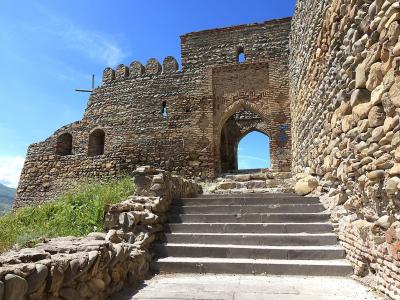
Places of the same kind
Museum — all places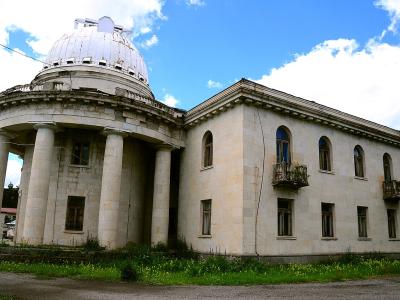
Nearby settlements