



Urbnisi Cathedral
Link copied
Photograph: კოლხი (CC BY-SA 4.0), Jaba1977 (CC BY-SA 4.0), Aleksey Muhranoff (CC BY-SA 3.0), Kober (CC0)
A large three-nave basilica in the village of Urbnisi in Kareli municipality, on the left bank of the Mtkvari, on the site of one of the chief cities of ancient Kartli. Known as the Sioni of Urbnisi and dedicated to Saint Stephen the Protomartyr, it is dated by its style and by the asomtavruli inscription on its north façade, one of the oldest in the Georgian script, to the fifth–sixth century, and was rebuilt in the ninth–tenth century and in 1668. In 1103 Urbnisi, together with Ruisi, hosted the church council of David IV; today it is one of the two principal cathedrals of the eparchy of Urbnisi and Ruisi.
About
Urbnisi Cathedral stands on the high left bank of the Mtkvari in the village of Urbnisi in Kareli municipality, in the eastern part of the old city site of Urbnisi, where archaeologists have found material from the Chalcolithic and the early Bronze Age down to the eighth century AD. It is dedicated to Saint Stephen the Protomartyr; following the medieval Georgian custom of naming churches after places in the Holy Land, it is also called Sioni, after Mount Zion in Jerusalem. The church is a three-nave basilica, 32.1 × 22.4 metres, and belongs to the group of large basilicas of early medieval Georgia, together with the Trinity church of Katsareti and Khirsa.
The building phases can be read clearly in the walls. The oldest, lowest layer is of well-hewn sandstone blocks laid in regular horizontal courses; the irregular masonry above it, of stones of many shapes, is the ninth–tenth-century rebuilding; and the upper part of the walls, of thin bricks and supported by two brick arch-buttresses on either side, dates from 1668. Fragments of an architrave stone and a horseshoe-shaped lunette at the east entrance remain from the first building. The church has three entrances, on the south, west and north.
Inside, the naves are separated by four pairs of cruciform piers with simply profiled imposts; the piers and the semicircular brick arches they carry divide the central nave into five almost equal bays, and the nave is covered by a brick barrel vault. The sanctuary is raised one step above the floor, and the side naves end on the east in chambers used as the prothesis and diaconicon. The church had two annexes: the south one is as old as the church and ends on the east in a small chapel, an eukterion, while the north one was added later. A brick cross is laid into the east façade and another into the west; in the western part of the north façade, under a window, is a stone with a cross, and below it the image of a horse. The church has a toothed brick cornice and a tiled roof.
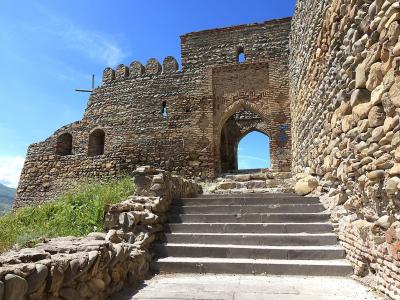
The undated inscription on the north façade names the founders of the church, a certain Konstanti and Father Mikel. Four more asomtavruli inscriptions, one above the south door and the others on the east façade, were left by the tenth-century rebuilders and name, among others, Bishop Tevdore and the deacon Abiathar; the east façade also bears inscriptions left by pilgrims. About 15 metres west of the church stands a three-storey bell tower of stone and brick, 9.1 × 10.2 metres; by the asomtavruli inscription on its west façade, it was built in 1706 at the order of King Vakhtang VI and his wife Rusudan. Its ground floor, with an arched entrance, is the gateway to the church grounds, the upper floor held living rooms, and the east façade has an open balcony. Near the church are other remains of old Urbnisi: a circuit wall with ramparts, a bathhouse of the third century, a medieval winery and an aqueduct.
- Century
- Turn of the fifth and sixth centuries (by the north façade inscription); rebuilt in the ninth–tenth century and in 1668; bell tower of 1706
History
Urbnisi has a long history of settlement: people began to live in the area in the third millennium BC, and by the fourth century BC the Georgian written tradition already speaks of it as a city. It was sacked by foreign invaders around the third century BC and revived in the first centuries AD; in the ancient period Urbnisi was the second most important city of the kingdom of Iberia after Mtskheta, with a pagan temple, a Jewish house of prayer, a bathhouse, a strong wall and a ceramic water main. Georgian written sources link Urbnisi with Saint Nino: arriving in Kartli, she stayed here for a month and then went on to Mtskheta with the people of Urbnisi who were travelling there to worship.
After Christianity spread in the fourth century, a Christian church was built on the site of the pagan temple, and Urbnisi became a major centre of Georgian Orthodox culture and the see of a bishop with the title Urbneli, known since at least the eighth century. The basilica, which keeps a Georgian inscription of the fifth century, belongs to this age. At the turn of the sixth and seventh centuries the city was enclosed by a wide wall of mud brick with a tower every 50 metres. In the 730s the Arab commander Marwan the Deaf destroyed Urbnisi; from then on it was an ordinary village of Kartli, but the cathedral of Saint Stephen remained the centre of a diocese.
In 1103 Urbnisi, together with nearby Ruisi, was one of the two meeting places of the church council convened by King David IV to deal with problems in the church hierarchy. Urbnisi was a seat of old Georgian learning: the scribes and poets Vlasi Urbneli (sixteenth century), Evdemon Ratishvili (1623–1710) and Nikoloz Kherkheulidze (eighteenth century) worked here, and the most important manuscript to survive from it is the Urbnisi Gospel of the tenth century. In 1668 the upper part of the church was rebuilt in brick, and in 1706 Vakhtang VI and Rusudan built the bell tower. The cathedral is an immovable cultural monument of national significance, and today Urbnisi and Ruisi are the two principal cathedrals of the eparchy of Urbnisi and Ruisi.
Visit info
Urbnisi is on the left bank of the Mtkvari: by road it is about 96 kilometres from Tbilisi, 18 kilometres from Gori and 12 kilometres from Kareli. Ruisi Cathedral is 7 kilometres away by road, so the two are easy to see on the same day. The cathedral is a working church; check opening times and the schedule of services locally.
Safety
This is a working cathedral: keep quiet during services, ask before taking photographs inside and do not touch the inscribed stones.
Tip
Read the walls from the bottom up: the regular sandstone courses of the first building, the irregular ninth–tenth-century masonry and the brick of 1668 are plain to see. Look for the founders' inscription on the north façade and, under a window in the western part of the same façade, the stones with the cross and the horse; on the east façade, the inscriptions of the tenth-century rebuilders and of pilgrims and the brick cross. Enter the grounds through the bell tower and look at the 1706 inscription on its west façade.
Sources
Nearby places
All places in the region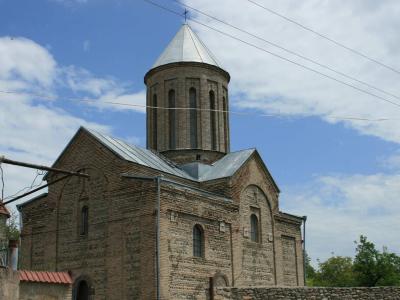
Places of the same kind
Cathedral — all places
Nearby settlements