



Abastumani Astrophysical Observatory
Link copied
Photograph: Sarah Murray (CC BY-SA 2.0), Unrecognizablepineapple (CC0), Surprizi (CC BY-SA 4.0)
The Evgeni Kharadze Georgian National Astrophysical Observatory, on Mount Kanobili in Abastumani, 1,600–1,700 metres above sea level and 30 kilometres north-west of Akhaltsikhe. Founded in 1932, it was the first mountain astrophysical observatory of the former Soviet Union, and it is heir to the small observatory where Sergei Glazenap observed double stars in 1892–1893. On day and night astrotours visitors see the 40 cm refractor brought here in 1934, a working telescope that is now also a museum piece, and on clear nights look at the sky through it.
About
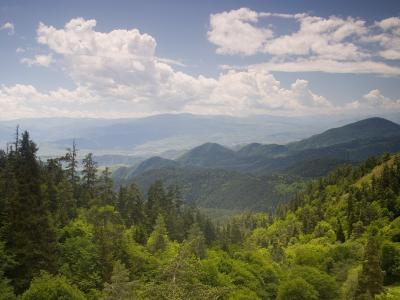
The observatory stands on Mount Kanobili in the township of Abastumani in Adigeni municipality, 1,600–1,700 metres above sea level and 30 kilometres north-west of Akhaltsikhe. Mount Kanobili is known for atmospheric conditions unique for astronomical observation: in 1979 studies by an international expedition treated it as a benchmark of an ecologically clean place. The site is far from air pollution and artificial light, the hilly landscape around it is covered with coniferous forest, and the weather is stable, without harsh and sudden changes. The observatory carries out research in astronomy, astrophysics, cosmology, atmosphere-ionosphere and near-space physics. Since 24 November 2019 it has been a legal entity of public law, the Evgeni Kharadze Georgian National Astrophysical Observatory.
Over its existence 15 stellar and solar telescopes have been installed here. The 33 cm reflector of 1932 is now in the observatory museum; the 40 cm Zeiss refractor, brought here in 1934, was until almost 2000 the main telescope for the polarimetric study of the Moon and the planets, with a polarimeter designed and built at the observatory. Today it is in working order and serves both as a museum exhibit and as an instrument for tourists to observe with, and its building has the status of a cultural heritage monument. In 1955 a Maksutov meniscus telescope with a 70 cm meniscus and a 98 cm mirror was installed, and the largest was the 125 cm reflector of 1977. In 2023–2024 the old telescope and dome in its building were replaced by a new 1.5-metre telescope made by the Austrian firm ASA and a dome made by the Italian firm Gambato.
A laboratory for the study of the Earth's upper atmosphere also works on the grounds, and the observatory's restored library has been placed in its building. In 2023–2024 a science tourism centre with spaces for events and presentations opened in the former dining hall, and in 2022 the so-called Glazenap tower was moved onto the observatory grounds.
- Focus
- A demonstration hall on the history of the observatory and of Georgian astronomy, the offices of Evgeni Kharadze and Mikheil Vashakidze, the 40 cm refractor brought here in 1934, housed in a building with the status of a cultural heritage monument, and night-sky viewing through the telescope
- Opening hours
- In 2026, daily. Daytime astrotour: May–August 11:00–19:00; March, April, September, October 11:00–18:00; January, February, November, December 11:00–17:00. Night astrotour: May–August 21:00–01:00; March, April, September, October 20:00–24:00; January, February, November, December 19:00–23:00. No tours on public holidays
- Visitor rules
- Groups of up to 30 visitors; tours in Georgian or English; the observatory may refuse service to visitors who are drunk or aggressive
- Official website (if any)
- https://abao.ge/
History
The history of astronomy at Abastumani begins at the end of the nineteenth century. Grand Duke George Alexandrovich, son of Emperor Alexander III of Russia, who lived at the Abastumani resort because of a lung disease, invited the St Petersburg professor Sergei Glazenap here on 21 May 1892; Glazenap was looking for a suitable place in the south of Russia to observe double stars. He brought a 9.5-inch refractor from the university observatory; the best spot was found near the grand duke's palace, and George paid for the observatory out of his own funds. It was built on the southern slope of the Meskheti range, 1,300 metres above sea level, and building the tower, assembling the dome and mounting the telescope took less than two months. Glazenap observed here until May 1893, making 1,156 observations of 610 double stars. In 1893 the American astronomer Sherburne Burnham wrote that no observatory in Europe was so favourably placed. In the summer of 1899 Grand Duke George died suddenly and the observatory stopped working; in 1918 Abastumani was taken by Turkish troops.
In 1931 expeditions of the Leningrad Astronomical Institute and the Tbilisi Geophysical Observatory studied the atmosphere of the mountain districts of Georgia and judged Abastumani the most satisfactory place for a large observatory. By a decree of 8 February 1932 an astrophysical observatory was founded at Abastumani, with the 24-year-old Evgeni Kharadze as its director, who went on to lead it for sixty years. In November 1932 the first Soviet telescope, a 33 cm reflector, was mounted in Glazenap's tower; in June 1934 the 40 cm refractor was brought to the observatory, and on 11 August of the same year building began on Mount Kanobili. In 1937 the reflector was moved up to Kanobili and the first issue of the observatory's Bulletin came out, and on 4 July 1938 the observatory's offices also moved to Kanobili.
In 1942 Giorgi Tevzadze discovered two previously unknown comets here, the first astronomical discovery made by a Georgian, for which the Astronomical Society of the Pacific awarded him the Joseph Donohoe medal. Mikheil Vashakidze established the physical nature of the Crab Nebula, showing that in the optical range too it shines by the synchrotron mechanism; in 1970 a crater on the far side of the Moon was named after him. In 1961 R. Kiladze was the first to measure the thickness of Saturn's rings, and in 1974 he was the first to notice an atmosphere around Mercury. The observatory made the spectral classification of more than 200,000 faint stars, and minor planet 1247 was named after Evgeni Kharadze. From 1957 a station for observing artificial Earth satellites worked here, and two years later a cable car opened from Mount Kanobili down to Abastumani. From 1941 the observatory belonged to the Georgian Academy of Sciences, from 2007 it was integrated with Ilia State University, and since 2019 it has been a legal entity of public law.
Visit info
The observatory is in Abastumani, on Mount Kanobili, 30 kilometres north-west of Akhaltsikhe. Two astrotours are held for visitors, both in the building of the 40 cm refractor. The daytime astrotour (45–60 minutes) covers the demonstration hall on the history of the observatory and of Georgian astronomy, the offices of Evgeni Kharadze and Mikheil Vashakidze, the 40 cm refractor and its tower, and a lecture on the structure and evolution of the universe. The night astrotour (50–80 minutes) includes the refractor and, if the sky is clear, observing celestial objects through the telescope with the help of the astro-guide; in cloudy weather visitors see the demonstration hall instead.
Prices for 2026: daytime tour 10 GEL for Georgian citizens, 5 GEL for schoolchildren and 20 GEL for foreign visitors; night tour 20, 10 and 40 GEL respectively. Children under 7 and socially vulnerable people go free. The minimum charge per tour is 50 GEL for Georgian citizens and 100 GEL for foreign visitors by day, and 100 and 200 GEL by night. Payment on site is by Bank of Georgia Express Pay terminal or by card. For questions about the tours, contact the observatory's education service: (+995) 595 01 11 86, [email protected]. Prices and tour hours may change, so check before you visit.
Safety
The observatory is on a mountain at 1,600–1,700 metres, so dress warmly for the night tour. Use the telescope only with the astro-guide's help and follow the guide's instructions. The observatory reserves the right to refuse service to visitors who are clearly drunk or aggressive. Drive carefully on the mountain roads in winter and after heavy rain.
Tip
To see the sky, choose the night tour and wait for clear weather: on a cloudy night you will see the demonstration hall instead of observing through the telescope. The observatory's website also publishes the periods when planets are visible in the telescope. Visitors may ask to change the order of the parts of a tour or to skip one of them, but the fee is not refunded in that case. Near Abastumani stands the church of Akhali Zarzma, a smaller copy of Zarzma Monastery, commissioned by the same Grand Duke George Alexandrovich.
Sources
- About us — Evgeni Kharadze Georgian National Astrophysical Observatory
- History of development — abao.ge
- Daytime astrotour — abao.ge
- Night astrotour — abao.ge
- Rehabilitation — abao.ge
- Abastumani Astrophysical Observatory — Georgian Wikipedia
- Georgian National Astrophysical Observatory — English Wikipedia
- Abastumani Astrophysical Observatory — Russian Wikipedia
- Georgian National Astrophysical Observatory — Wikidata
Nearby places
All places in the region
Places of the same kind
Museum — all places
Nearby settlements