



Skhalta Cathedral
Link copied
Photograph: Goderdzi Bolkvadze (CC BY-SA 4.0), Jaba1977 (CC BY-SA 4.0)
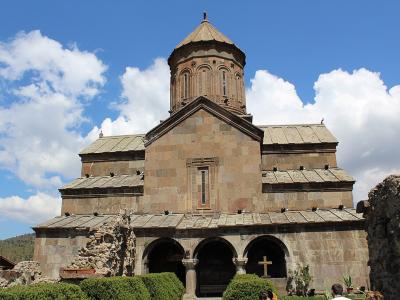
A large medieval hall church in the village of Qinchauri in Khulo municipality, in the valley of the Skhalta river, 100 kilometres from Batumi: the centre of the eparchy of Skhalta, with fragments of Palaiologan wall painting of the fourteenth–fifteenth century and a rare image of John the Baptist as a youth; the only medieval church in Adjara that survived both the Ottoman and Soviet periods and became active again in 1990. Its date is disputed: the twelfth century or the middle of the thirteenth.
About
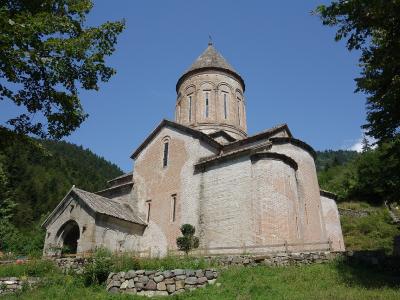
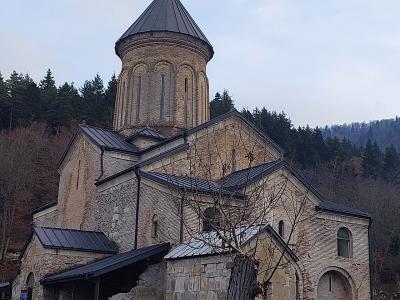
Skhalta Cathedral stands on a hill in the village of Qinchauri in Khulo municipality, in the valley of the Skhalta river, beside the road that in the Middle Ages linked Adjara with Artani (modern Ardahan). It is a large hall church, 25 paces long and 12 paces wide and high. It has a protruding seven-faceted apse, two main doors on the south and west and an extra entrance on the north, and is built of grey-white stone. Porches once stood against the south and west sides: of one only the arched entrance survives, the other fell long ago, and traces on the walls show that there was also an annex on the north. The spacious hall is roofed with arches resting on prominent pilasters and a cylindrical vault, and the side walls are decorated with arches. The interior is lit by nine arched and two round windows.
The interior walls are faced with white dressed stone and were once extensively painted: of the frescoes of the fourteenth–fifteenth century, the painting of the sanctuary, the vault and the west wall survives today, and in 1997 a Georgian expedition uncovered fragments of New Testament scenes of the Palaiologan age. On one of the façades John the Baptist is shown as a youth, said to be the only such fresco in Georgia. On the east façade are three cross-shaped carvings, and from the same façade comes an inscription in Asomtavruli script: "God Jesus, have mercy on Nikoloz".
Around the church stand service buildings of the late Middle Ages: by the road is a rectangular wine cellar with an old wine press and kvevri, and over the Skhalta river stands a medieval bridge. The complex also includes a small church and an enclosure wall. The date of the church is disputed: it is placed in the twelfth century or in the middle of the thirteenth, and some researchers waver between the tenth–eleventh and the twelfth–thirteenth centuries.
- Tradition / order
- Georgian Orthodox Church; a monastery of monks of the Nativity of Mary and the seat of the bishop of Skhalta
History
Many scholars have tried to date the church (Dimitri Bakradze, T. Kluge, N. Severov and R. Mepisashvili): some placed it in the tenth–twelfth centuries, some in the eleventh, and others in the middle of the thirteenth. The case for the twelfth century rests on its architectural features and on the situation of its builders, the Abuserisdze eristavis: earlier, when they held wide domains and the cathedral of Tbeti, they had no need of such a church in Adjara, and by the middle of the thirteenth century, weakened by the Khwarazmian raids, they no longer had the means to build it. Others give the middle of the thirteenth century, when the Skhalta valley belonged to the Abuserisdze. Legend attributes the church to Queen Tamar; another tale has Tamar staying at the Khikhani fortress during an enemy invasion and coming to Skhalta to pray by a secret path. Skhalta is rarely mentioned in written records: by a document of the time of Alexander I (1412–1442), it belonged to the patriarchal see of Mtskheta.
In the sixteenth century, after the Ottoman conquest, the church was abandoned. In 1874 it was rediscovered and sketched by Giorgi Kazbegi, a Georgian officer in Russian service, and after Adjara passed to Russia in 1878, when the church lay in the estate of Sherif Bey, it was visited and described by Dimitri Bakradze and Countess Praskovya Uvarova. The church came down to us badly damaged: much of the facing stone had been stripped from its walls, it stood without a roof until restoration began, and it shows the traces of many repairs.
In the last years of the Soviet Union the revival of the Church returned Skhalta to Christian worship. In June 1989 Catholicos-Patriarch Ilia II visited Skhalta and held a requiem for those killed in the landslides and floods of that year, and in 1990 the church was consecrated as a monastery of monks of the Nativity of Mary. In 1997 a Georgian expedition uncovered fragments of the painting. Today Skhalta is the seat of the bishop of Skhalta and a working monastery.
Visit info
Skhalta is about 100 kilometres from Batumi, in the village of Qinchauri in Khulo municipality, on the right bank of the Skhalta river; the church is beside the road. It is a working monastery. Check entry arrangements and the schedule of services on site.
Safety
This is a working monastery: dress modestly, do not take photographs during services and do not touch the frescoes. Drive carefully on the mountain roads of Khulo in winter and after heavy rain.
Tip
Inside, look for the frescoes of the sanctuary, the vault and the west wall, and on the façade for the youthful John the Baptist and the three carved crosses of the east side. By the road is the medieval wine cellar with its press and kvevri, and over the river the medieval bridge.
Sources
Nearby places
All places in the region
Places of the same kind
Monastery — all places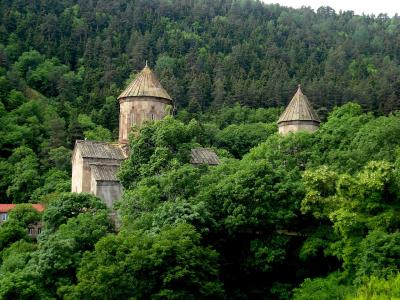
Nearby settlements