



Motsameta Monastery
Link copied
Photograph: Alexkom000 (CC BY 4.0), Marcin Konsek (CC BY-SA 4.0), madras91 (CC BY 2.0), Kober (Public domain), Elmie (CC0)
The "place of the martyrs" on a rocky promontory in a bend of the Tskaltsitela, 6 kilometres from Kutaisi: the relics of David and Constantine Mkheidze, princes of Argveti, tortured to death by Murvan the Deaf in 735–737, whose blood turned the river into "red water"; Bagrat IV's eleventh-century monastery, renewed in 1844–1863 by the Berekashvili builders, with the reliquary, two wooden lions and the passage beneath it for pilgrims.
About
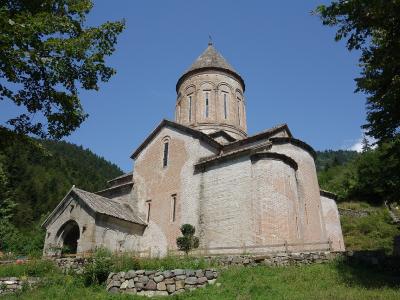
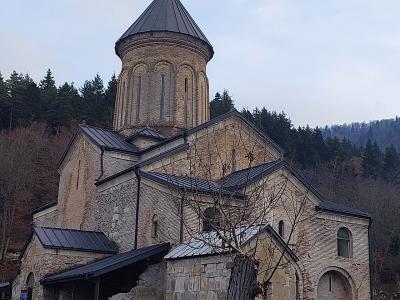
The monastic complex of Motsameta stands in Tkibuli Municipality, 6 kilometres north-east of Kutaisi, on a rocky promontory rising in a bend of the Tskaltsitela, a tributary of the Rioni, among wooded cliffs; the traveller Alexei Muravyov wrote that "no better place could be chosen for monastic seclusion". Bagrat's church was a small hall building; in 1844–1845, on the initiative of David Tsereteli, Metropolitan of Imereti, and the abbot Porfiri Tsereteli, it was enlarged, in the 1860s a dome was added, and in 1863 the holy bishop Gabriel Kikodze consecrated it, the work directed by Levan, Mose and Pilipe Berekashvili. The renewed church took the form of an inscribed cross: the dome rests on two square piers and the projections of the sanctuary, an image of the Deesis of the fourteenth to sixteenth century survives in the sanctuary conch, and the church's peculiarity is its unusual orientation, with the altar to the north. The reliquary with the remains of Saints David and Constantine stands at the eastern wall on a platform raised by five steps, before it two wooden statues of a recumbent lion made in the 1840s, and beneath it a passage for pilgrims, which passed three times is said to grant a wish; the present reliquary and its canopy were remade in 1954. The outer decoration uses the medieval elements typical of the Berekashvilis: an arcade carried on triple-shafted half-columns encircles the drum, a carved cross stands above the southern door, and the western façade is adorned in a rusticated field by a large profiled arch enclosing two smaller arches and a high-relief rosette.
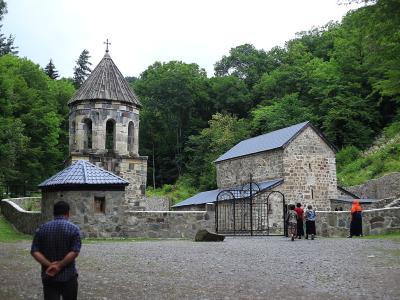
The two-storey bell tower, 1.5 metres south of the church, was built in 1845–1847, with an inscription over the northern door naming the abbot Porfiri; in 1960 the abbot's house was built to its west on the remains of an old tower. The gateway into the yard is the ground floor of a tower of the sixteenth to seventeenth century, square in plan with a saucer dome on pendentives, and to it is joined the long covered corridor to the monastery that replaced the drawbridge still in use in the nineteenth century; on either side of the gateway survive remains of the wall in large-block masonry like that of the fifth- to sixth-century fortresses of Kutaisi, Nokalakevi and Tsebelda, and some hold Motsameta to be the fortress of Ukimerioni. Outside the monastery are the remains of a guesthouse and a three-storey tower of the sixteenth century, in whose wall is set a Bolnisi cross in a medallion, possibly a detail of the original Annunciation church of the fifth to sixth century.
- Tradition / order
- Georgian Orthodox Church; the monastery of Saints David and Constantine
- Dress code
- Headscarf and skirt for women, long trousers for men; both are lent at the entrance
History
In the early Middle Ages a church of the Annunciation stood here in the fortified town of Tskaltsitela, destroyed in 735–737 by the Arab army of Murvan the Deaf. The princes of Argveti, the brothers David and Constantine Mkheidze, rose against the Arabs, were captured, refused pardon in exchange for conversion to Islam and died under torture; their bodies were thrown into the river, the water turned red, and the river was named Tskaltsitela, "red water". By tradition the remains found on the bank were carried east at the command of a divine voice until sunrise, and at dawn were buried by the ruins of the burnt church, in the crypt of the Annunciation church. In the eleventh century King Bagrat IV built a monastery here and set the tomb of the holy martyrs in its church (some scholars take the King Bagrat of the "Martyrdom" to be Bagrat V), and the place was named Motsameta; the Georgian Church canonised the brothers, and by legend a secret tunnel used in wartime joined the monastery to Gelati.
In 1844–1863 the church was renewed by the Berekashvilis and in 1845–1847 the bell tower built; later the church was repaired in the 1890s by Archimandrite Besarion Akhvlediani, in 1909–1912 by Archimandrite Nestor Kubaneishvili and in 1954–1955 by Metropolitan Gabriel Chachanidze. In 1923 the Bolsheviks closed the monastery and moved the relics of the saints to the Kutaisi museum, which caused such outrage that they were soon returned; in 1954, by the efforts of Metropolitan Gabriel Chachanidze, they came back to the monastery for good and the reliquary was remade. Every year on 15 October the monastery holds the popular festival of Motsametoba; on 7 November 2006 the monastery was granted the category of an immovable cultural monument of national significance, and from 2018 tourist infrastructure was laid out.
Visit info
Motsameta is 6 kilometres north-east of the centre of Kutaisi by a turning off the Gelati road, about 15 minutes by car, and also reached by marshrutka from Kutaisi. Cars stay at the car park and the last 500 metres are walked. The monastery is in use and open by day, entry is free and the dress code applies. Motsametoba, the feast of the brothers David and Constantine, falls on 15 October.
Safety
This is a working monastery: dress rules are observed, and photography during services is avoided. The edges of the promontory are sheer and not everywhere railed, so hold children by the hand; the paths are slippery after rain.
Tip
Pass three times through the passage beneath the reliquary, which is said to grant a wish; note the altar set to the north and the rosette of the western façade. The best view of the monastery on its promontory is from across the Tskaltsitela on the far side of the road, in morning light. It goes with Gelati in one visit.
Sources
Nearby places
All places in the region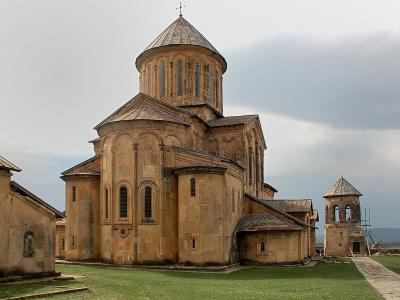
Places of the same kind
Monastery — all places
Nearby settlements