



Lamaria Church of Ushguli
Link copied
Photograph: Jaba1977 (CC BY-SA 4.0), Maesi64 (CC0), FingerWiki (CC BY-SA 4.0), Alen Ištoković (CC BY 3.0)
A hall church of the Dormition of the Mother of God of the ninth and tenth centuries above Zhibiani, at 2,100 metres at the foot of Shkhara: the Christian heir of the Svan cult of Lamaria, with two layers of medieval frescoes, a Svan tower and the legend of the killing of Puta Dadeshkeliani; today the seat of a bishop.
About
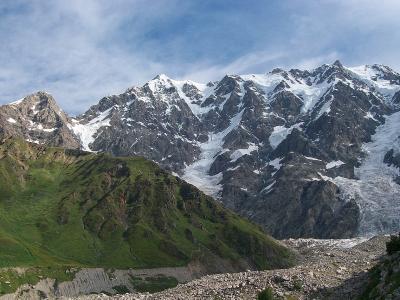
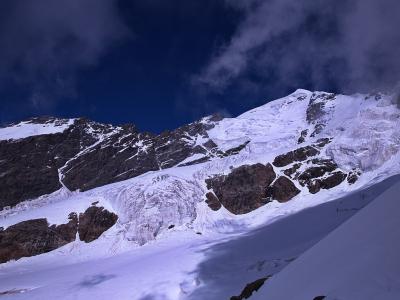
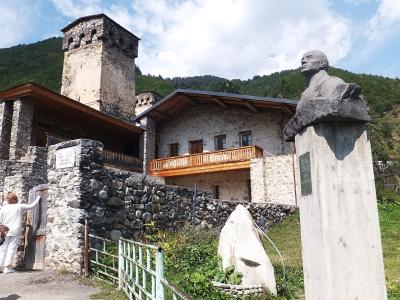
The Ushguli church of the Dormition of the Mother of God, popularly called Lamaria, stands on a hill at the northern edge of the village of Zhibiani, one of the villages of the Ushguli community, at 2,100 metres above sea level, against the backdrop of the 5,201-metre Shkhara, one of the highest peaks of the Greater Caucasus and the highest point of Georgia. The complex consists of the church within a low wall of slate and a dwelling and farm building set against the wall on the west, with a Svan tower; today it is the seat of the bishop of Mestia and Upper Svaneti. The church is built of neatly dressed blocks of shirimi limestone, a hall building of settled proportions with a strongly projecting triangular apse and a contemporary two-sided ambulatory running along the south and west; the ambulatory is entered by a low arched door on the south, the nave from the west. The oblong nave ends in a semicircular apse raised three steps above the floor; the original stone altar table survives, as does the stone three-arched iconostasis dividing the apse, and a single supporting arch divides the vault in two.
The church is lit by two windows, in the apse and the west wall. The interior walls and the iconostasis are covered with two layers of faded frescoes, the lower of the tenth century, the upper painted in the thirteenth; of the thirteenth-century painting of the ambulatory only fragments remain. The façades carry scant ornament: on the west façade a cross in relief and a four-line Georgian inscription in mixed khutsuri and mkhedruli script, palaeographically of the eleventh century, naming a female donor, Gurandukht; on the walls are scratched graffiti from the tenth century to the eighteenth. In 1910, during his expedition to Svaneti, Ekvtime Taqaishvili catalogued the dozens of church objects kept at Lamaria, manuscripts, icons, crosses and vessels.
- Denomination
- Georgian Orthodox; seat of the bishop of Mestia and Upper Svaneti
- Century
- 9th–10th century; murals of the 10th and 13th centuries
History
Lamaria does not appear in historical records and is dated by its architecture to the ninth or tenth century. The church is dedicated to the Dormition of the Mother of God: "Lamaria" is the name the Svans gave to Mary, whose veneration was superimposed on the ancient pre-Christian cult of Lamaria, a goddess of motherhood and fertility. Ushguli was historically a community without a lord and by tradition killed seven nobles who tried to rule it; the last of them, Puta Dadeshkeliani (second half of the seventeenth century), was killed at Lamaria, the whole village, the legend says, pulling together a cord tied to the trigger of a musket so as to share the responsibility equally; Dadeshkeliani's garments were long kept in the church.
In 1910 Ekvtime Taqaishvili's expedition to Lechkhumi and Svaneti catalogued the treasury of Lamaria. The great avalanche of 1987 turned part of the population of Ushguli into eco-migrants; in 1996 Upper Svaneti, with Chazhashi, was inscribed on the UNESCO World Heritage List. The church is an immovable cultural monument of national significance, is in use and serves as the seat of the bishop of Mestia and Upper Svaneti.
Visit info
Lamaria stands on a hill above Zhibiani, one of the villages of Ushguli, 45 kilometres from Mestia by a mountain road that is often closed for avalanches in the snowy half of the year. The church is in use.
Safety
At 2,100 metres the weather changes fast and it is cold even in summer; in winter the avalanche danger is high. Do not touch the frescoes. This is a bishop's residence, so dress modestly.
Tip
Go early in the morning or at sunset, when Shkhara shows best above the church. Look on the west façade for the Gurandukht inscription and the cross in relief. Elsewhere in Ushguli are the towers of Chazhashi and the ruins of the castle linked with Queen Tamar, seen in half a day.
Sources
Nearby places
All places in the region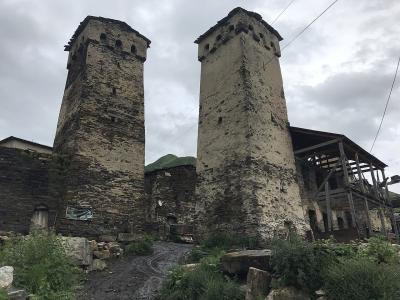
Places of the same kind
Church — all places
Nearby settlements